Wednesday, September 27, 2006

Online matrimony: a few surprises

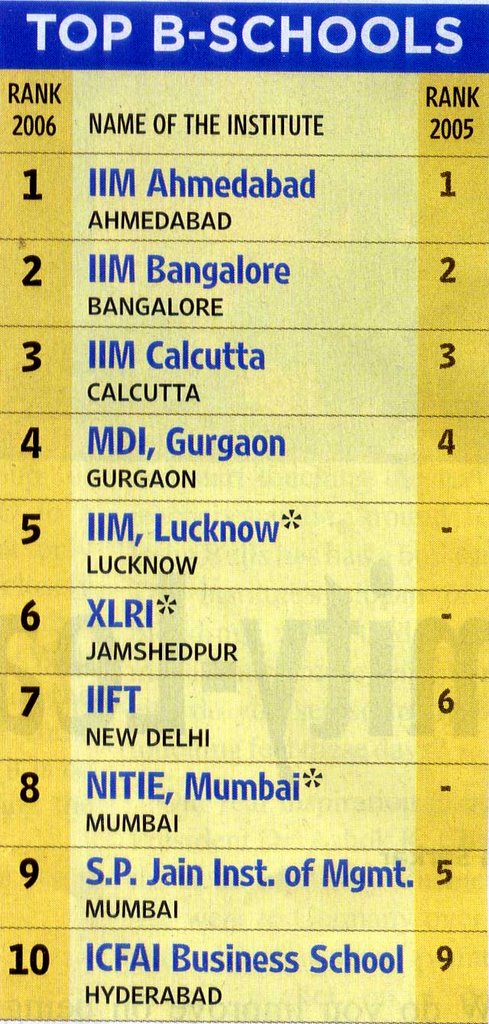
That's a screenshot from popular online matchmaker shaadi.com

So far so good. HT reports that "online matrimony in India is becoming one of the fastest growing businesses, with a growth trajectory of as high as 90 per cent annually in some cases".

According to an Internet and Mobile Association of India (IAMAI) report on Matrimonial Search... in the fiscal year 2005-06 these services garnered Rs 58 crore, in the current year the amount is expected to cross Rs 98 crore. There has also been a surge in member subscriptions from 4 million in 2004-05 to 5.5 million in 2005-06. Membership is estimated to grow to 7 million users by the end of this year.

Several of these sites have received funding and now advertise on TV. Along with wider choice and more control to the actual bride/ groom than the traditional route or parent-centric newspaper advertising, some sites claim to be offering additional services such as profile screening. Not sure how they do this - and is it for the premium memberships only?

That said, my sole experience with online matrimony was registering a profile for a cousin whose parents were like, "Chalo yeh bhi try karte hain". But online matrimony is something you have to take charge of yourself. Responses started poured in but my cousin was painfully shy and did not wish to trawl through the humongous number of emails. I mean, she'd rather someone else did the dirty job for her.. which really does not work.

Online matrimony is a project just like offline matrimony. It requires considerable time, energy and capacity to reject/ accept rejection.

Another friend who got divorced some time ago put up her profile on a few of these websites. Her complaint is that guys are way too 'chipku' for her liking. "You exchange a couple of emails and a few phone calls and next thing you know the guy wants to fix a date to get married", she says.

After one marriage that ended painfully, she would rather get to know someone a little better than jump into another potential disaster zone. But the guys in their 30s who would respond to her profile are in a hurry to 'settle down' and don't seem that picky!

Of course the opposite attitude seems to prevail on 'dating' sites. Most guys on those sites are looking to have a good time ie get sex and do not hesitate to say so in their very first email. As if.. that turns on women. Especially when it's done with complete lack of style.

An interesting experiment was carried out by HT's Brunch supplement a few Sundays ago. One of their staffers registered two profiles on a dating website. One was an 'adventurous, fun loving, 'wants to live life to the fullest' type' and the other a more staid description.

Profile 1 was flooded with response (the sex variety) while profile 2 got barely a trickle. And a male journalist who registered his profile got.. absolutely no response.

Reminded me of my experience with starting India's first dating column back in 1994. 'Saturday Date' was a column I started in the 'Metropolis on Saturday' which featured profiles of young professionals who wanted to meet interesting people, but not necessarily get hitched right away.

The column only featured 4 profiles at a time - many were friends who were persuaded to try out something new. Response mechanism for the guys was simple: they printed their telephone numbers. For the girls, respondents had to write in, c/o the newspaper's address. I would actually screen them - chuck out the 90% rubbish that came in and hand over just a few decent/ interesting ones (rarely did you get both together!) to the girl in question.

And yeah, in the line of duty I too went on a couple of dates. Got bored out of my skull... but I guess someone may have found someone. And now, with technology enabling a far higher degree of pre-meeting communication, surely the 'success rate' is much higher!

The biggest problem
Back then, and even now, the success or failure of a dating/ matrimonial site hinges on one simple fact: how many girls are registering?

I think the 'open-to-dating' women have enough choices in real life, when they are in the college-age bracket. The trouble starts when you finish your education and into your second job by which time you may have a limited social life and little opportunity to meet new people. That's when they turn to matrimonial websites.

So dating sites suffer from an awful girl: guy - I think 1: 10 would be a fair estimate. Matrimonial sites, according to IAMAI stats have a gender ratio of 69% male, 31% female, which is far better.

But surprisingly, 37% of registered users on dating sites are between age 18-25... so I am guessing they are actually using it for dating purposes. But perhaps the 'matrimonial' purpose of the website cues that 'I am not that type of girl/ guy'. As in I may eventually wish to marry you.

What I did not understand however was this startling statistic:

Marital status
63% Unmarried
31% Married without kids
25% Married with kids
4% Divorced

Um... iska kya matlab? Why are only 63% of the people on a matrimonial website UNMARRIED? Yeh married with kids/ without kids ka chakkar kya hai?

And even if there were married types looking for someone to fool around with - or marry again - wouldn't they be more likely to masquerade as being 'unmarried' in the first place? So where and why this data is captured remains unclear.

The only plausible explanation is that these are uncles/ aunties/ didis/ jijajis of prospective grooms and brides. People like me, searching for other people. But still.. it creeps me out.

Will someone from the matrimonial industry please explain?

Tuesday, September 26, 2006

RJ Regurgitation: 89.1 FM Dubai

The world really is a global village. This, I realised, when I received this email from a reader of my blog in Dubai. She writes:

Yesterday, I was listening to one of the radio stations here (89.1 FM) and the RJ was reading out (very badly) a movie review for Dor. As he was reading it out I realized that he was reading out your review, word for word.

"Since when did widows in Rajasthan wear dark blue clothes? I always thought they wore white! In fact, the clothes Meera wears after Shanker's death resemble a burqa more than anything else... and this to me seemed odd throughout the film.

I also felt that for the first time Nagesh Kukunoor has made a film which got caught up in exotic foreigner-friendly locations. That the backdrops got more importance than the struggle of the characters themselves.

And honestly, I wish he would at best make a cameo appearance and not actually play a part in every film. At the very least, he needs to lose that Hyderabad-meets-Hudson accent!"

This whole bit was said word for word. He did not acknowledge the fact that it has been taken from your blog or anything.

I felt this was a bit unfair, so I sent the radio station an sms saying that the review was copied from the blog Youthcurry and that I would let the author know about it.

The RJ calls me back in 10 mins saying " you wanted to talk to the author right? I'm the author. Go ahead. What do you wanna say?"

I told him that the review was taken from Youthcurry by this person who is the editor of JAM and he asked "Do you have any idea where Jam gets their reviews from? Do you know who writes it? We are part of the JAM *something* (I forget what) panel .

For a second I faltered thinking that maybe you had one of your reporters write it and the RJ might be of them. Then I remembered how he was reading the review. He could hardly pronounce the words correctly, and was obviously reading the review out loud for the first time.

So I called his bluff, and he then started talking about how radio is a free medium and that he can pick up anything from anywhere and say whatever. And that he writes for magazines as well and he never copies, but if a few words happens to come in here and there, that is not a big deal.

He tried to put it in my head several several times that it's not copying. I guess it may not be. But I still feel you should've been acknowledged or at least he could've said something like " According to this review from JAM mag..."

And the fact remains that he tried to pass off as the author. Which is a LIE.

Also, when I asked him for his name ( cos I really didn't know who he was, all the RJ's of this station sound the same and I had just turned on the radio at the time, I was driving home) he refused to say. Which I found to be an extremely immature and cowardly thing to do. His name is Harsha, if at all you're interested.

If what's happening is alright by you, ok then. If not, please do let the station know.


XXXX (name withheld)

Well, it's not OK and I am letting the station know by printing this letter on my blog. It would be funny if it were not so... unethical. To use the word 'I' and rattle off someone else's thoughts and views shows such a paucity of brainjuice that I have nothing more to say.

Google scripting and google journalism is NOT ok. Not for a college project, not in print, not on radio.

Will 89.1 FM care to lay down this law for its RJs?

Monday, September 25, 2006

When did I join the Indiatimes 'Community'?

The 'About us' section on Indiatimes states:

Indiatimes is the most popular Internet and mobile value-added services destination for the global Indian.

Covering everything from art to airlines, Indiatimes is taking the digital age into people's lives, influencing the way they live and respond to changing times, work and transact. In a short span, we have created multiple relationships with millions of users.


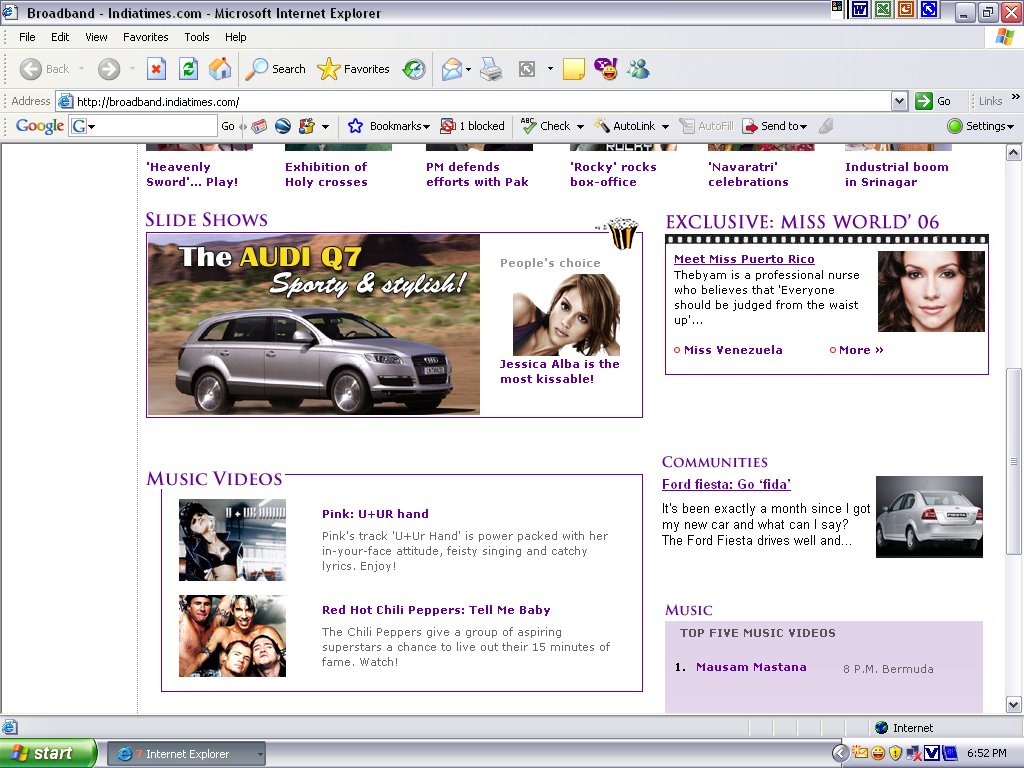
That's great - but I am not one of those millions of users... and hence see no reason why my last post on Ford Fiesta is linked from Indiatimes Broadband's homepage, under the "Community" section.

Click on the screenshot to enlarge pic

Now you might say I am being sticky here... Indiatimes may argue I should be happy they are sending additional traffic my way - an attitude shared by most large media houses.

DNA also does something similar although they only provide links to blog headlines. Here too, I think they should clearly label the section as 'What bloggers feel or have to say' about current issues. In the way Mumbai Mirror specifies w.r.t.'Blogger's park': a 'daily column on what the worldwide web is talking about'.

The bottomline is - link to stuff I write. That's fine by me. Coz I link to stuff published by your journalists every now and then - credit it to them and comment on it.

Accord me the same privilege. But don't co-opt me into your community without my knowledge or consent.

That's borderline unethical - same as Fiesta's advertising strategy. In a world of global Indians, it won't be seen as a value add. Trust me!

And I know you will soon yank the link off.. but this is not a one-off complaint but a policy issue. Please take it seriously!

Ford Fiesta - 'go fida' but not on the mileage!

It's exactly a month since I got my new car and what can I say? The Ford Fiesta drives well, looks great and feels good. My cousin who owns an Ikon - and is far more knowledgable than me in this area - went gaga over it. Especially how silent the engine was.

So net: net I would recommend the car to anyone looking to buy/ upgrade in the Rs 6-6.5 lakh range. Maybe you could consider diesel - I did not because the price difference between diesel and petrol is around Rs 1.2 lakhs (including the extra interest cost you'll be paying). And even though I use it a fair bit, by my calculations, it would take 3 years before the diesel car 'makes more sense'. By which time I might want to trade this in - who knows.

Anyhow, the reason I am writing this is the ads I am seeing on sites like this one extolling the Ford Fiesta entering the Limca Book of records for its amazing mileage. The 'Max mileage marathon' was a first of its kind in India, and recorded the longest distance ever travelled on a single tank of diesel and petrol.

Here's a news report of the event:

The marathon was held at the 4.226 km high-speed track at the National Centre for Automotive Testing (NCAT) at the Vehicle Research & Development Establishment (VRDE) in Ahmednagar. The entire event was monitored and supervised by the Federation of Motor Sports Association of India (FMSCI) and representatives of the Limca Book of Records.

The Ford Fiesta 1.4 litre Duratec Petrol was flagged off by Singh, joint director VRDE at 12:37 p.m. July 29. After travelling continuously for 1,183 km, the car finally ran out of petrol at 10:11 a.m. the next morning, nearly 22 hours later! The car extracted 22.43 km from every litre of petrol.

The Ford Fiesta 1.4 litre Duratorq TDCi Diesel, flagged off at 12:40 p.m. on July 29, travelled nearly 29 hours, before finally running out of fuel at 5:23 p.m. on July 30, after covering 1,570.8 km. The car returned an astounding average of 31.48 km per litre.


But what purpose did this serve, really? Here's the carefully worded statement given out by the event organisers:

A brainchild of Autocar India, the Max Mileage Marathon was organised with the objective of proving that ideal road conditions, skilful driving and modern engine technology can result in huge fuel savings, thereby contributing positively to national savings. The marathon also brought into limelight the vast difference between ideal road conditions and real road conditions that could result in potentially high fuel efficiency.

Hormazd Sorabjee, editor of Autocar India, while receiving the certificate from Limca Book of Records, commented, "Through Max Mileage Marathon, we wished to demonstrate that good driving conditions, combined with sound driving skills, and high-performance modern engines have the potential to considerably increase fuel efficiency and result in savings for the car owners as well as lower the burden of fuel bills for the country."


Wonderful. But we all know road conditions are far from ideal in real life. And so, a clause should have been laid down by Autocar prohibiting this kind of banner advertising:

How far can you go at 31 km per litre ?

Fiesta enters Limca Book of records

Mileage for 1.4 TDCi Duratorq 31.468 km/litre

Mileage for 1.4 Fiesta Duratec 22.43 km/litre

To take a test drive sms xxxx


The irony of it all is that a misleading ad is appearing on a portal popular with advertising and media types - www.exchange4media. There isn't even a star saying 'conditions apply', perhaps because unlike print there is no corner you can hide those necessary but minor details.

In the current dratty road conditions my Ford Fiesta petrol 1.4 gives around 9 km per litre. That might go up to 10 someday at best. In fact, the fuel guage is electronically calibrated to project how many kms the car will run every time you fill petrol. And that guage has been calibrated at 9 km per litre, as far as I can tell.

I'm not complaining, because I was aware the Fiesta is not a car offering fuel economy. In fact my purana Esteem does much better on that front. I just don't see the point of a company making tall claims. Record apni jagah par hai but none of us is planning to take a spin on the high speed track in Ahmednagar.

In fact, even the practice of highlighting the 'highway mileage' of cars (as tested by auto magazines) is not of much use to prospective buyers - 95% of whom will use it mainly in the city under more taxing traffic and road conditions. But all manufacturers are doing it... and no one seems to be complaining.

So while Ford Fiesta diesel advertises 18.3 kmpl as the mileage (with a * specifying on the highway, as tested by Autocar India), a hoarding by Hyundai Accent CRdi claimed something like 27 kmpl! And the Pope just agreed to convert to Islam...

Ironically, Ford is also advertising the 'Fusion' as a no-nonsense car. Then why this nonsense with Fiesta... ?

And I think Autocar India has to take some responsibility. After all, their fair name is being misused, in a sense. I am not a hardcore car enthusiast or subscriber of auto magazines but as an ordinary person who bought a car recently, I feel that the consumer's interest should be placed ahead of carmakers.

A starting point would be to prevent the hijacking of a technical record for commercial purposes.

Sunday, September 24, 2006

Extra! Extra! Read all about it... for free

This morning a rep from Hindustan Times rang my doorbell. "Aapka ek saal ka subscription khatam ho raha hai... "

Yeah... so is there a new offer, I ask.

"Haan.. picchle saal aapne Rs 449 ka scheme liya tha. Aur humne sau rupaye refund kiya tha. Is saal 350 mein do saal ka subscription de rahe hain".

Wonderful. A newspaper for 50 paise a day. I will probably end up making more in these two years by selling the paper in raddi than HT makes from me. If you add in the cost of the reps visiting my house for renewal, and the delivery charge HT is paying the chap who brings in the paper they are pretty much giving away the paper FREE.

Anything, for readership. After DNA pipped them in the recent NRS survey they are obviously eager to hang on to their existing subscribers.

Of course, DNA is also in the same 'free' boat. On Sundays, the paper is impressively thick, with the regular stuff plus a kids supplement and a full-fledged Femina-type women's magazine. All this for two bucks but wait, in case you have subscribed then it's Rs 199 for the year. And in case you are an ICICI Bank card holder, like me, you might currently be getting it free in any case.

I guess all this is necessary when you are at war with the well entrenched Times of India. Which is making a little more money off the cover price of Rs 4 (with Mumbai Mirror worth Rs 2 'free' inside).

The Mirror has gone to town with its readership stats (8.8 lakhs), making it the 'second most widely read paper in the city'. Of course, it's also the second most widely unread paper in the city. While TOI's readership in Mumbai is pegged at 16.7 lakh readers, MM's is just about half that. Which means close to 50% don't open it at all! That's why there's a new offer where you can choose your free paper - if you don't fancy MM you can ask for the Maharashtra Times.

On the other hand, there is a trend where magazines are upping their prices. India Today - which I pick up once in a rare while and then wonder why?? - is now 20 bucks. A recent issue had a 'free' Nature's Basket granola bar. Mine happened to be nibbled upon... or dismembered by natural causes. Either way, I did not consume it and neither did I find much to consume in the magazine. Which I may add, had way tooo many layers of plastic even for my far-from-activist level of comfort.

The bottomline is - magazines are threatened by newspapers, newspapers by satellite TV, satellite TV by internet. And the internet by its ever changing self.

So everyone is encroaching into the other's territory. Newspapers are doing the lifestyle stuff magazines did; NDTV is looking more like MTV with its never ending KANK specials (a full half an hour was devoted to the making of 'Where's the Party'). And honestly, it was... perhaps the Abhishek effect... but rather watchable.

So we at JAM too have been affected. Everyone is going 'youth' - or at least youthful. I mean youth is hardly a 'niche' anymore, it is the market everyone is desperately angling for.

And that - coupled with the 'free mein lo' trend - is making life a little more difficult, or a little more challenging for people like me. Depends how you wanna look at it... More on this, in the days to come.

No one has the answers - except to sigh "ah, mobile!". If only we could all convert our content to caller tunes and charge 15 bucks to download it and 30 bucks a month to 'rent' the same.

If only...

Friday, September 22, 2006

Dor - 3 stars

Have you ever seen a film which your head says is 'good' but your heart does not embrace? Dor is a film which did that to me.

The story is simple but intriguing enough. Two young men go to the Gulf on work, leaving behind their young wives. The unforeseen happens... Shanker Singh topples (or is pushed off?) the balcony of the house they share. Aamir is convicted of murdering him and sentenced to death.

But under Saudi Arabia's Sharia laws, Aamir's wife Zeenat has a ray of hope. If Shanker Singh's widow 'forgives' the accused and signs a maafinama, his life can be spared. The film is about Zeenat's search for the wife, knowing only that she lives somewhere in Rajasthan. And on the basis of a single picture.

So yes, the story is 'different' but... It's somehow unconvincing. Zeenat is 100% sure that 'mera Aamir aisa nahin hai' - that Shanker's death was a 'haadsa' and not a murder. But we never know, really.

That's the big issue - there are smaller ones as well. For instance, since when did widows in Rajasthan wear dark blue clothes? I always thought they wore white! In fact, the clothes Meera wears after Shanker's death resemble a burqa more than anything else... and this seemed odd to me throughout the film.

I also felt that for the first time Nagesh Kukunoor has made a film which got caught up in exotic foreigner-friendly locations. That the backdrops got more importance than the struggle of the characters themselves.

And honestly, I wish he would at best make a cameo appearance and not actually play a part in every film. At the very least, he needs to lose that Hyderabad-meets-Hudson accent!

Gul Panag as Zeenat is an excellent choice but someone other than Ayesha Takia should have played Meera. She is not bad, but not all that great either. Shreyas Talpade plays a 'bahrupiya' and his role is to add some lighter moments to an otherwise ekdum serious film.... So serious that the lead actresses don't even wear any make up. Shreyas has performed well.

Actually, 'Dor' reminds me of the kind of films which were made in the 80s and dubbed 'feminist'. Zeenat comes to Meera to ask for her help, but ends up liberating her. Convincing her that her life is hers alone to live and that she must make her own decisions.

And yet, unlike Iqbal, you can't feel good at the end of it all... So watch it if you will, I just can't recommend it too strongly.

P.S. Also releasing today isKhosla ka Ghosla. The film gets 4 stars from JAM - read the review here.

Thursday, September 21, 2006

Lalu ban gaya gentleman?

He came, he spoke, he conquered. Read what I think of Laluji's maiden b school appearance here.

Tuesday, September 19, 2006

In defence of yuppieness

In March 2004, I wrote a piece titled ‘Life, liberty and the pursuit of yuppieness’. It was a deeply personal 1500 words and inexplicably, touched a chord in many, many readers.

Two key observations I had made:

1) The decision to do an MBA is more about external validation than internal conviction. The first validation occurs when you are accepted into the programme, the second when someone offers you a fantastic salary on passing out.

2) I'm not saying "Damn placement!" But let MBA students also be exposed to non-conventional choices…“ What makes us tick, what makes us passionate, fulfilled and happy? … If the answer is 'leading and managing corporations', are there any challenges beyond our usual frame of reference that we can explore?

Well, Sanjeev Chandran, an IIM A alumnus who currently works for ICICI Bank looks at the other side of the coin. A recent post of mine received this comment:

"MBA's are highly overrated. I wish magazines would cover people who actually make a difference rather than those who pass exams and then sell soap or shuffle money around for the rest of their lives."

Sanjeev wrote me an email which I share with you. He feels such comments are far too common nowadays:

There's a general impression which is conveyed which disparages the MBA community. These constitute two broad thoughts:

1. What a waste of intelligence that you sell "soaps"- as if it were this useless thing and doing nuclear research was the only sensible thing to do.

2. Walking down the trodden path is wasting your life - This has become especially prevalent in the last few years with cases of some IIM graduates choosing to start a business immediately on passing out and OOPSing (Optnig Out of Placement) rather than going to a corporate job. And the general impression given is that by joining the corporate world one

A. is doing something useless which adds no value to anyone

B. has sold out to Mammon and

C. is not repaying a debt to society (which one owes because one was in an IIM) because one earns a lot of money (and sometimes, by implication - hence one should be ashamed of oneself)


Sanjeev’s take on this.

"I never understand why selling soaps is considered such a stupid thing to do. Someone has to do it. And it isn't just about you paying the Rs 10 for the soap - it is about ensuring that you get that soap and that Rs 2 sachet of shampoo in the remotest of villages in India - a distribution nightmare- which those same "selling soap" people in HLL, Colgate, P&G struggle with every day and solve- so that you and I get that soap when we want it as also does "Radha Bai" living in one of the 600,000 villages in India.

Also the point that MBAs work only for money and make no difference to society seems a narrow view point. I work for ICICI Bank. I am not directly involved with retail loans- but the reality is that we have changed the face of consumer lending in India. Sure, we make money on it. But millions who otherwise could not have dreamt of owning a house till they retired today have one when they are 35. Has that not added value to society?

I am involved today, among other things, in rural insurance and we have insured a large number of people - insured their lives, their loans and their health. People have used this insurance to get themselves treated for serious diseases at small hospitals and nursing homes. It has enabled some people to repay loans when an accident occured. Some farmers were not destroyed financially when it did not rain and their crops were destroyed. We have actually made a difference to all those lives.

Yes, while doing this business, I looked at profitability- because if I didn't, this service would not last for a long time. Yes over the last couple of years, I got a salary raise, a bonus and a promotion -for doing a good job in this area. But that doesn't take away from the fact that thousands have benefited because of the work we have done. I have gained personally- so have a large number of the rural populace. What better example of win- win could there be?

I believe as an MBA, now working for almost seven years I have made a huge difference to people's lives. Most of whom I have never even met. And I am fairly certain that most of my batch mates have done the same - directly or indirectly.

Yes, at some times (in fact, I would say quite often) there is unnecessary corporate hype which disguises the actual work being done. Some crazy organizational structures and procedures can often make one pull one's hair in frustration. And yes, people here do make money!! Unfortunately, most people tend to see only the huge salary figures and the comfortable lifestyles- not the actual impact their work makes.

I am proud to be an MBA- and that too from the finest college in India. If I do nothing else but what I have done till today - and if there is a judgement day- then just my work till now will give me enough reasons to hold my head high in front of the Judge."

What I think
Sanjeev has raised some important points Yes, someone has to sell soap, as well as home loans. And this job can be imbued with meaning if you see it – at some broader level - as reaching hygiene to the masses, or making the common man’s dream come true.

But, I suspect, this is organization specific. ICICI Bank is a company which topnotch MBAs join for quality of job and exposure – not because they offer the best pay packet or post you to London/ Singapore. Moreover, it was originally a development finance institution, which metamorphosed into a bank. And I think this gives it a unique DNA.

The question is – would Sanjeev feel similarly had he worked for Citibank, ABN Amro or Lehman Brothers? Honestly – I think the answer would be no. In fact, had Sanjeev been associated not with rural insurance but credit cards, I doubt he would be feeling as good about his job. The simple reality is credit cards are a convenience but they are ruining a lot of people’s lives.

And that’s the story with many a company MBAs choose to work for. What’s more, you are generally doing a job which has been done before. Systems are set, the wheel is turning…increasing the market share of soap X or paint Y by 2% in northern region might be my achievement of the year. And I don’t think that is achievement enough.

Even in home loans, I think really bright minds must find a market solution to the biggest problem urban India faces today: Slums. People who can afford prepaid mobile phones - and haftas to slumlords – can pay installments for their homes. And I am sure it will happen one of these days…

And it may be an MBA like Sanjeev who finds an economically feasible way to make this a reality. In an organization that encourages innovation and can see ‘wealth in waste’, so to speak.

On the other hand, I'm not saying MBAs have to serve only the bottom of the pyramid. Look at the contribution Phaneesh Murthy made by joining an Infosys at a time when marketing software was about as unglamorous as Ajay Devgan before he married Kajol.

This article in Businessworld some years ago, sums up the story:

When he left IIM-A, FMCG was big. The Nirma versus Hindustan Lever battle was drawing to a close; most people from the top of the class headed for a Lever or a Britannia. Phaneesh made the first unconventional decision of his life. He chose Sonata Software, a start-up in a tiny industry.

To put things in perspective, TCS, a $1-billion company today, had a turnover of $15 million in 1987. "I did not find soaps intellectually stimulating. I wanted to do product management. In soaps or industrial products, most of the product definition is rarely changed. In software, you can use the customer feedback to improve the product," says Phaneesh.

In Sonata, he also started on his first Mission Impossible. Design and sell a software for the Indian market. All the heroics were in vain though. The Indian IT industry was undergoing a disruptive change.


Apparently an ad in India Today caught his eye:

It was a two-page recruitment advertisement for a company called Infosys. There was a small line at the end of the ad: "We also need a marketing manager for the US. Should be willing to relocate and travel extensively." The position did not require major qualifications. "I said this is a company that needs some serious marketing help. For every other post advertised they had at least a paragraph of qualifications!"

The article credits Phaneesh with creating the 'two cultures' of Infosys. The process-driven, conservative software developers... and the more customer-facing culture that he developed, which resulted in Infosys being able to command a far higher price for its work

In 1996, that point was proved. For the first time Infosys went head-to-head with a formidable consulting firm - Cambridge Technology Partners (CTP). The contract was for about $9 million. CTP bid $8 million. Phaneesh and his team's math: total cost, including profits, of $4 million. The majority was for quoting this price.

The sales team figured it would be a mistake: the client would think they had no idea of the project's complexity. So the team doubled the bid to $8 million. Infosys got the project. It was a crossing of the Rubicon. Infosys could beat the heavy guns at their own game.


OK - we all know the Phaneesh Murthy @ Infosys story had a sour ending but it seems to be a great example of an MBA 'making a difference'. And not necessarily in the social sector. There are, of course, many others.

The bottomline is I have nothing against MBAs earning a lot of money (if their work results in profit for their companies, they certainly a share of the spoils). But I would disagree with the notion that ‘most of my batchmates’ have made a huge difference to people’s lives. At least not yet.

But I know many are thinking about it.. and that’s a start.

Lastly, one can argue that the notion of 'making a difference' is pretty arrogant to begin with. I mean, who are MBAs, to stake such a claim anyways?

But then arrogance is ... natural to MBAs. So kindly don't mind it!

Saturday, September 16, 2006

Pyaar ke side effects - 4 stars

This morning I had no idea who Saket Choudhary was. Now, I bow this rocking young writer-director. Pyaar ke side effects is yet another film Bollywood should be proud of. A truly modern and witty take on man-woman relationships in yuppie India.

Perhaps faintly inspired by a couple of Hollywood films but on the whole so very fresh and original! So who is this Saket Choudhary? Well, the only info I could dig up on him is that he co-wrote Santosh Sivan's Asoka (a film I could barely sit through).

That was in 2001 - God knows what he was doing for the last 5 years. Perhaps biding his time, waiting for his talent to be recognised... And hats off to PNC for putting faith in him.

Right from the little Delhi vs Bombay jokes to the odd collection of friends and sidekicks (great casting!), the film manages to ring true and yet entertain. Commitment phobia is not a new theme - several recent Bollwyood films tried to explore that theme - but they fell flat. Remember 'Home Delivery'... and worse, 'Neal and Nikki'?

The plot
Sid (Rahul Bose) is a DJ playing at Trisha (Mallika Sherawat's) wedding.Witness a scene which goes something like this :

A white sheet is dangling and from it jumps down a fully decked up Trisha

Sid: You're running away from your own wedding?
Trisha: Haan..I don't love him, how can I marry him ? Accha chutta hai, rickshe ke liye?
Sid : Don't be silly.. pyaar shaadi ke baad ho jayega (hands her the change)
Trisha (thinking): Taht's true.. Mere mummy-daddy ke saath bhi to yehi hua tha. Pehle shaadi, phir honeymoon, phir bacche, phir pyaar...

She decides to go back and they exchange goodbyes. A few minutes later she is seen running past Sid and friend Nanu, even as she assures 'taiji' on her cellphone: "Main paanch minute mein aa rahi hoon.|"

And that's the tone throughout - comedy without slapstick, questions and issues minus self importance or gravity. Although Trisha is a central character, the whole film has been written from the guy's point of view... And that makes it different and interesting.

Pyaar ke side effects include 'marriage' - that's what Trisha wants after she's moved to Bombay, met and fallen in love with Sid... 3 years after her original flight out of the mandap. But Sid is not so sure... yet he agrees. And what follows is Engagement ke Side effects which include the pain of selecting an engagement ring and meeting 'papa'.

Following permafrost conditions from daddy's side and an unfortunate (but funny)accident on the golf course, the couple breaks up. Trisha starts hanging out with the same guy she ran out on - a 'Vivek Chadda' looking Jas Arora - while Sid has coffee conundrums with 'Baby doll vol 3' (an item girl played by Sophiya Haque).

There are some side plots - the hilarious roomie Nanu (Ranvir Sheorey) who hates changing his underwear and thinks the fact that superheros never marry is a good argument against the institution of marriage as a whole. Then there's Sid's sister
(Taraana Raja) and brother in law Kapil, Nanu's kooky girlfriend (Sapna Bhavnani) and a wooden chest.

A scene in a club where Sid, Nanu and Kapil are hanging out after the break up is particularly funny.

Girl to Sid: come, dance with me
A few minutes later : "OK bye.. I gotta go home."
Sid : " You have work tomorrow?"
Girl: " NO.. I have school...My boards are starting on Monday.. "
Ouch!

All the actors were excellent in their parts, of course there are kisses - including one underwater - but Mallika is very believable in her single-Mumbai-chick role. The fact that she is taller than him, earns more than him but still loves and wants to marry him is a new and refreshing representation of a woman in Bollywood.

So, what's the verdict?
Almost all reviews I've read say the ending's a farce and give the film around 2 stars. But I thought it was all pretty cool and so, without nit picking and fault finding - because I enjoyed the movie and am pretty sure you will too - I give PKSE 4 stars. Do watch it!

And Saket Choudhary - he is definitely a guy to watch out for!

Wednesday, September 13, 2006

Outlook b school rankings 2006

I picked up Outlook's 'India's best b schools' issue as a matter of routine. And opened it with the usual 'let's see where they screwed up' kind of attitude. Just past experience - coz year after year these surveys never fail to disappoint.

Well, I must say that this year's Outlook effort is better thought out and likely to be a little more helpful to students. I still disagree with the survey on a few points - but overall there is improvement.

a) Year after year survey rankings suffer when some well known institutes refuse to participate. Most notably, the IIMs had decided to stay out of all rankings a couple of years ago.

Solution: IIM A volunteered information. CFore - which conducted the survey for Outlook - used the Right to Information act to get data from the other IIMs.

b) What about Bajaj and FMS? One or the other usually refuses to participate because they score very low in parameters like infrastructure.

Solution: University departments have been listed separately. The bad news is, no scores are provided. Sadly, this means that UBS Chandigarh - which ranked # 11 last year gets slotted as the no 3 'univ department'(below JB and FMS). Not fair, I'd say.
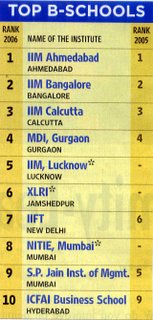


Also, nowhere do we get a sense of where the univ depts stand with respect to the entire universe of b schools. In fact, to avoid controversy, an 'overall' ranking has been provided only for the top 10.
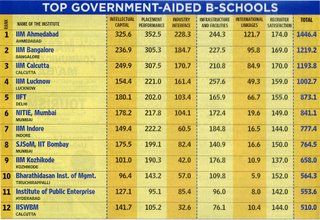


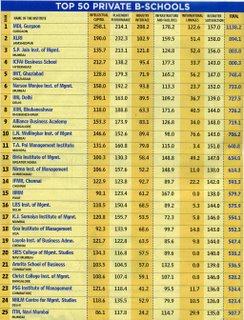
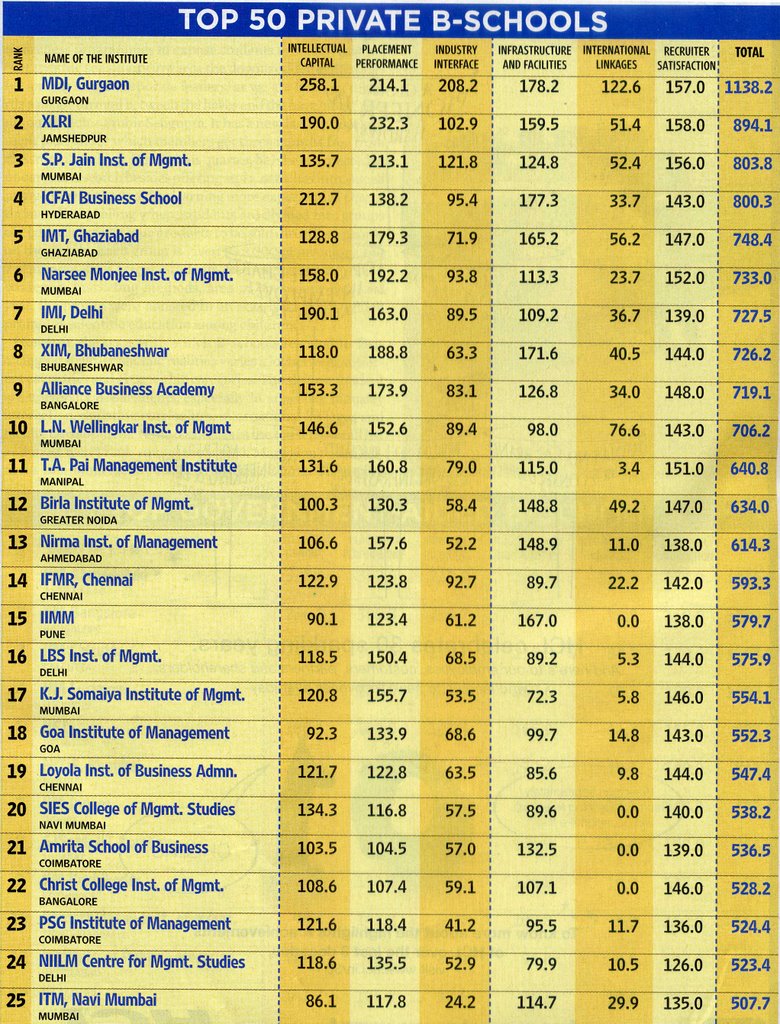
There are separate rankings for the 'top government aided b schools' and 'top 50 private b schools'. (click to see enlarged pic - scanned from mag as results will be available online only from Oct 16)

I like the idea of comparing apples with apples and oranges with oranges. The trouble, however, is that a student is equally willing to bite into either the apple or orange - all he/ she wants to know is: how sweet is it?

And herein lies the crux of the issue. This survey is based almost entirely ie 88% on facts. And 12% on a subjective parameter called 'recruiter satisfaction'. Fair enough (although satisfaction can also broadly be gauged by the fact that a company is coming back year after year to recruit from a campus).

But what about intangibles like 'brand value' and 'alumni network'? They are not factored in - as far as i can see. A way has to be found to quantify and include this X factor - and I think it must be given a weightage of around 20%.

Otherwise the advantage certain b school brands have over the other will never truly be captured... Compartmentalising is convenient but dances around the problem instead of tackling it head on.

The overall rankings
Which Outlook did not publish.. but which can be compiled on the basis of the scores provided. When you mix up the government and private b school rankings the top 25 looks like this (note: univ departments have not been given scores and hence not included in this list).

Figures alongside are composite scores.

1 IIM A (1446.4)
2. IIM B (1219.2)
3. IIM C (1193.8)
4. MDI (1138.2)
5. IIM L (1002.7)
6. XLRI ( 894.1)
7. IIFT ( 873.1)
8. NITIE ( 841.1)
9. SPJain ( 803.8)
10. ICFAI Hyd ( 800.3)
11. IIM Indore( 777.4)
12. SJSOM ( 764.5)
13. IMT G'bad ( 748.4)
14. NMIMS ( 733.0)
15. IMI Delhi ( 727.5)
16. XIM B ( 726.2)
17. Alliance ( 719.1)
18. Welingkar ( 706.2)
19. IIM K ( 658.0)
20. TAPMI ( 640.8)
21. Bimtech ( 634.0)
22. Nirma ( 614.3)
23. IFMR ( 593.3)
24. IIMM ( 579.7)
25. LBS ( 575.9)

A few observations:

1) MDI consistently manages to be ranked # 4. But as far as students are concerned, it's IIM A, B, C and L - then XL, SP, and MDI. In fact on IIT campuses students generally apply only to the '4 IIMs' (not even I and K) and rarely if ever to MDI.

2) IIM Indore or SJSOM would be preferred by most over ICFAI Hyderabad. In fact, despite scoring well on a large number of parameters, ICFAI to my mind does not belong in the top 10 for the following reasons:

- Placement performance is merely 138.2. In comparision, IIM Indore is 222.2, SJSOM 199.1, XIM B 188.8, IMI Delhi 163. The ICFAI Hyderabad class size is 700 which in itself is not a bad thing but certainly puts a lot of pressure on placements, especially quality of job.

You have only to compare the list of companies and designations of jobs offered at their flagship Hyderabad campus with the same at IIM Indore to realise the difference. For example UTI Bank offers 'Deputy manager' positions at XIMB but 'Executive' positions at ICFAI Hyd.

- ICFAI scores when it comes to 'intellectual capital'. While I think their case study initiative is commendable, the books and journals they publish - what I have seen of them - are less than impressive. One can, of course argue that almost all research generated from Indian b schools (IIMs included) is unimpressive. Then, why give an institute brownie points for churning out such material in larger quantities than other b schools and help it achieve a higher ranking?

- ICFAI has an independent entrance exam, which last year attracted 30,000 students. The buzz is that 'almost everyone' gets an interview call. Which may be an exaggeration but certainly the selectivity ratio is not very high

Secondly, not only must you travel to Hyderabad, you pay 3000 as 'interview processing fee'. So imagine, a cool Rs 3-5 crores is in the ICFAI kitty even before you join the course. This is not a practice one associates with institution of repute. Especially given the high course fee charged in any case ! (Rs 5.5 lakhs excluding boarding/ lodging)

3) IIM Kozhikode has been ranked no 19. It won't affect student interest in the campus ('IIM is after all IIM yaar') but it helps answer the question: I or K? Clearly Indore has established it is # 5 in the IIM hierarchy.

So yes, IIM K ranked # 19 appears absurd but, seen objectively, it should be a wake up call to the institute. Sure, it has the IIM brand name but that should not make it complacent.

Kozhikode appears to have a problem with intellectual capital. In fact, there's been an exodus of sorts last year. Notice the lack of full time faculty (barely 25%). Strangely enough the 'academic background' of the guest and adjunct faculty remains undisclosed on the website although I can tell several are professors at other IIMs.

K and I also suffer on industry interface. As Premchand Palety rightly observes in the opening essay 'The New Badshahs':

A major reason for their bad performance is location disadvantage. For effective industry linkages, any B-school should be near a corporate hub. Explains Pritam Singh, ex-director of IIM-Lucknow, "To achieve excellence, a B-school must have a business lab, like medical colleges have hospitals, that provides real-life exposure to live cases and projects." In light of the experiences of IIMs in Lucknow, Indore and Kozhikode, he questions the government’s wisdom in starting a campus in Shillong.

4) There are some absences in the Outlook survey, notably: all IIT b schools except for SJSOM, Symbiosis and related instis, and MICA.

If RTI could be used to extract info from IIMs, I think the same should have been done for IIT SOMs. If I were an engineers an IIT SOM would rank far higher on my list than several institutes outside the top 10.

Symbiosis, it appears, declined to volunteer information - although it has given an ad in the issue. They're smart enough to know they cannot repeat the no 4 ranking achieved in the Business Today survey.. so better to not be featured at all than explain an inglorious tumble.

Also, there is a separate feature on ISB, there is no mention of Great Lakes. I guess in times to come 1 year programs will be included in rankings as a separate list.

So what would I do as a b school director?
1) Add international linkages - exchange programs for both students and especially for faculty. That's one area MDI has absolutely cracked - it has a clear 70 point lead over rivals like XL and SP and all IIMs except A, which is almost equal.

I also think the ranking of the institutes you tie up with for exchange progams should be taken into account in some manner. Otherwise the parameter could lose its meaning.

2) Get an international accreditation. It's not easy, of course but MDI scores here again, with both Equis and AACSB accreditation.

3) The one thing you can buy with money is infrastructure - buy it. Most b schools are doing it in any case as the 2006 business school ratings of the All India Management Association (AIMA) published in Business Standard notes.

However, going forward we need to ask some questions: if a laptop for every student is fast becoming a norm, need we list computer: no of students ratio as a parameter?

And well, I could go on and on. But suffice it to say that if the recent Business Today b school ranking got an F, the Outlook survey gets a passing grade - but not distinction. Some of you may think I'm being too generous but I feel, taken in entirety, the rankings and the accompanying articles provide some perspective to the current b school scenario.

IIMs pe gussa kyun
I do wish, however, that Outlook would stop making statements like this:

Experts agree that while institutions like IIMs played a big role in raising the standards of management education and curricula, they gave little thought to the creative use of ecology on campus and connecting the students with nature. The new-age business schools have stepped in fill that void.

Evidently, the writer has not visited an IIM campus!

Then there's the anguished "Dalit students still get a raw deal":

...Students belonging to the SC/STs, who pass out of premier institutes like the IIMs, are still at the bottom of the heap when it comes to remunerations...The average salary for Dalits is at least Rs 2 lakh per annum less than the institute’s average and normally a Dalit is the recipient of the lowest salary offered at the IIMs. For instance, while the average salary for all students at IIM-A was Rs 9.7 lakh, the figure for the reserved category students was Rs 7.8 lakh.

So what is the point being made? That the highest paid jobs should also have quotas for reserved candidates? The article concludes that the differential is mainly attributable to lack of soft skills. But as a Dalit who graduated from IIM L points out:

Although IIMs offer special sessions for Dalits to tide over these problems, Doss admits that in an extremely competitive environment, there is a stigma attached to attending such remedial sessions, and most Dalits choose to give it a miss.

One question I would like journalists to ask is whether private b schools - on their own - are making any efforts to add diversity to their classrooms in the caste context.

If they can claim to emulate Harvard or Wharton in other areas -how about this one?

Sorry for the goof-up...
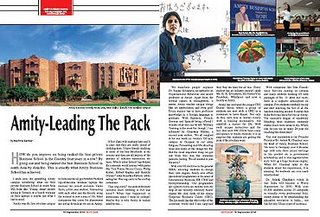
And finally, only Outlook would have the guts to acknowldge this error: a 2 page 'ad' by Amity cleverly disguised to look like two regular pages of the magazine. And its placement at the very beginning of the survey story makes it all the more misleading.

The following clarification has been published on their website:

On pages 28-29 of Outlook magazine dated 18th September 2006, there is an advertisement titled ‘Amity – Leading the pack.’

This is a paid advertisement released by the Amity Business School, Noida which was carried inadvertently. This, in no way, represents Outlook-C Fore survey.

The Amity Business School, Noida is not amongst the Outlook – C Fore rankings and, in fact, wasn’t included in the survey. The school has been refused approval by the AICTE which has been challenged in the courts. Right now, the matter is sub judice.

We regret any confusion that the advertisement may have caused to our readers.


The clarification will be carried in the next print issue as well. And for that sincerity, so rarely seen in a big media house, we must be grateful!

Tuesday, September 12, 2006

'Hutch Tuesdays'

Bet you have seen the hoardings and ads for the Hutch 'Tuesdays' offer. Tuesdays are the slowest day of the week for most malls and multiplexes, so any promo that revs up sales would be welcome.

What's more, it's a simple buy one, get one free deal applicable at Dominos, Barista, Fame and several other interesting outlets. But I don't have the full list and so I go the Hutch website in search of what's on today. Forget being highlighted on the homepage, you can't find a whiff of an offer - anywhere on the site.

OK, so someones remembers getting an sms from Hutch, we check it and call 123500 for details. And manage to download the 'm coupon'.

Now to contact Domino's. Again we check for the number on the net and call the Prabhadevi outlet. After much deliberation, the voice at the other end declares, " We don't deliver". Uh, Domino's does not deliver? Then what does it do??

The mystery is solved when they explain this is actually the Khar outlet. OK, so we dial Prabhadevi. There is more confusion at their end regarding the offer. We are about to abandon the search for cheesy nourishment on a night-when-we-will-be-working-late when someone finally gets it.

And in another 20 minutes, the pizza should be here. Or will it? The suspense continues. Thank you 'Hutch Tuesdays' for adding a little excitement to our dreary lives.

As if hanging from the office staircase to receive your faint signal... was not enough.

Monday, September 11, 2006

Jeans not allowed - what next?

Guttural manly voice :

Swapna sundari wearing maxi
Getting out of a yellow taxi
Walks into a club
Paagal ho gaye sab
Surprisingly.. she chooses me.


Squeaky high pitched female voice

Is that a pen in your pocket mister? Or are you .. just happy to see me ??... Lexi pens, now, in every paacket in your city

This ad for Lexi pens (listen to it here) plays day in and day out on the radio and I am not sure what to make of it. I mean it's silly enough to pass off as humour and yet.. in a country where colleges are banning jeans because :

a) it ensures discipline
b) low waist jeans and short tops represent a threat to collective morality

It shouldn't be long, before 'pens in pockets' get the axe ...

And what about toothpaste? Colgate Maxfresh gel with cooling crystals has a radio ad which goes something like this :

Woman interviewer : I see you are an MBA.. that means Married but Available

Flustered man: Um.. but..

Woman interviewer: I want you to work under me... So would you like to be paid in kind.. or kind?

And there's another version of that where a girl goes to buy a movie ticket and the guy at the counter says he has two.. but only if she agrees to sit next to him.

Not sure whether this will help the product.. considering that this is not Italy where even waiters look like they just stepped out of a movie set. But hey, toothpaste is becoming a risque item - parents, guardians and principals please note. Who knows what impressionable young minds are thinking as they brush each morning...

And of course mints.. they need to be banned too.Now that Polo is running its 'sabse bada hint' campaign. Kya pataa kaun kise kya hint de raha ho...

Bottomline : Sex can and is used to sell anything and everything... On the other side, the powers that be are trying hard to hard to sell 'decency' as a virtue. Confusion nahin hoga to kya hoga?

Ab Lexi pens ko hi dekh lo.The TV commercial is the 'wholesome' type. Mummy in a sari, cute kid, chacha. The radio ad on the other hand is about swapna sundari and not so subtle double entendre. It's all about tailoring the message for the audience.

The parallel with real life couldn't be more apt. All that parents and principals can demand is 'appear wholesome' in front of us. Peeth peechey kya ho raha hai.. woh to khuda hi jaane. Which seedha saada kid metamorphoses into 'studboy18' or 'ilikeithot21' while chatting late into the night - kya pataa?

The age of 'multiple personality on order' is upon us. As the Fastrack guys put it: 'How many you have?'

Omigod that was one of those ads... wonder if colleges would like to consider banning watches on campus as well?

Friday, September 08, 2006

The perils of user-generated content

'Keep an eye out for fashion and capture it on your Nokia camera phone. From clothes to accessories and personal style statements. Click anything you think is in vogue.'

That's an invitation from Nokia 'Eye on Fashion', which was one of the official sponsors of the Wills India Fashion Week. As brand-linked consumer promotions go, it's a good idea. But here's the problem:

1) Are the people getting clicked giving their consent?

I would think the answer is no, in many cases. And this applies especially to girls - like this one featured on page 1 of
www.nokiaeyeonfashion.com.. She appears to be simply walking down the road when one Gopal Raghuwansi clicked her on his camera phone and susequently uploaded her pic on the site.

I know this is very common. Ask any young and decent looking woman and she will tell you there are innumerable occassions when she wonders :"Is he sending a message or trying to take my picture?"

Believe me, it can creep you out, especially when the person taking the picture has *that* kind of studied casual look. The same which guys who brush past you in the bus usually have.

Of course the guy taking the pic may not have evil intentions. One young man once showed me a bunch of pics he had clicked of women, sitting in coffee shops. It was just a kind of 'timepass' - a thumb sport of sorts.

On the other hand, he could have been telling his friends 'this is my latest girlfriend' but one loser can usually smell another. I'm sure they'd know.

I don't know what the law says about this kind of photography in India, but as a company Nokia should not be encouraging it. At the very least, they should advise people who will participate in the promo on the need to get permission from the subject being clicked. It might be hidden away somewhere in the 'terms and conditions' but I could not see it.

In any case, something so important should not be hidden away in the fine print.

Also, I wonder whether the same rules apply to the 'citizen journalism' variety of photography and this kind of promo linked photography.

Today, when any kind of major news event such as the London bombings or the Mumbai train blasts occurs, some of the best pictures and videos are taken by ordinary people who happen to be there and possess camera phones. These images are often widely distributed - I'm not sure how many individuals get paid for rights. But you could argue - even if they get paid - it's a visual slice of history.

In case of a promo like 'Eye on Fashion' - that's not the case. The guy clicking the pic hopes to gain commercially - there are prizes to be won including designer clothing, Nokia 7360 or 7370 fashion phones. One lucky bum will even get a luxury handset - the 'Sirocco'.

2) The second worry is the Quality of the photos featured.

They are absolutely pathetic! Flip through the 11 pages online currently and at least 33% of the pics are self-portraits of guys wearing sunglasses. One even described himself as 'Googgles clothing'.

Other 'style statements' include a little girl in a shiny 'I want to be on Boogie Woogie' dress and a lady working in a tea garden. Frankly, the tea picker has more attitude than most of the jignes and bhaves types on the same page... All in all, not what Nokia probably had in mind when it conceived of this contest!

The other not-so-surprising fact is that the pic of the girl in pink has received 5263 views and 4946 votes. Whereas the boys on the same page mostly have votes and views in double digits. This says something about the profile of :
a) netsurfers
b) people who click camera phone pics and submit the same

Both are still predominantly male... and so lacking in style they wouldn't recognise a 'style statement' if it planted a slobbery wet kiss on their forehead!

Wheat vs chaff
The idea of 'user generated' content is a great one. And it works when you have millions and millions of people contributing such content - like at youtube.com. From a mountain of boring / mediocre trash you find a few gems and the system is designed such that users push these gems up to the top of the pile.

But when the number of users you attract is fairly low... you don't have enough gems. And the trash attracts more trash and repels people who actually have quality content. Because you haven't created an environment where the ego-driven creative types would like to showcase their work.


The problem is compounded when the site has a commercial angle. Take Sunsilk Gang of Girls. Extensively advertised, beautifully designed. But the blogs on the site? A couple are barely okay, the rest are simply not happening!

I say this not out of the haughty attitude that all blogs must be deep and meaningful. Teenage girls will write about crushes, cruel parents and pimples. But there are trendsetters and influencers who can write and express themselves well - and hook readers. Those girls are not patronising the site. And that cannot be a good thing for the brand!

So what does one do? I think you cheat a bit. Employ a few good writers to set the right tone for 'user generated' sites. Of course, what they write should not be all stiff but if you can get that 'amateurly professional' vibe you will attract more content along the same lines.

In fact I am even more convinced of the need for such a strategy, after recently covering a bunch of entrepreneurs setting up 'Web 2.0' companies in India for Businessworld magazine . These include soon to be launched social networking site yaari.com, consumer search engine onyomo.com and review site burrp.com

The Mumbai edition of Burrp has been up and running for 3 weeks now but generating those user generated reviews and reccos appears to be a very slow process! At the very least, if I were running Burrp I would hire a trainee, give him/ her a digital camera and go shoot all the restaurants being written about!

Not to undermine the importance of user participation and contribution... but from long experience with JAM I've learnt you have to tweak it and channel this raw energy to get the best possible results. In short, even user-generated sites need great editors...

I could write a lot more on this subject, and I will one day. But right now, it's time for some lunch!

Tuesday, September 05, 2006

Singled out

DNA reports:

The new face of Mumbai — young, single, and independent — wants to make it big. But it is a tough task in a city that seems to have no room for them.

In a market where demand exceeds supply, singletons have the toughest deal. They are at the bottom of the list of desirable tenants for housing societies that govern the affairs of buildings in the city.


Hmm. The more things appear to change, the more they don't - at some level. What do housing societies fear? That singles will spoil the 'peace'. Play loud music, bring home boyfriends and girlfriends, host late night parties. Basically, do a whole bunch of things that Mr & Mrs Solanki in apt 2b never had a chance to do in their youth. Or perhaps did, but gave up after they 'settled down'.

Of course many Indian singletons simply go to work, come back, eat a tiffin and crash out in front of the television. Just like boring old people. But society waale sochte hain, why take a chance ?

Sameera Khan, a researcher with the Gender and Space Project at Pukar, said, “The city is becoming exclusionist. Anyone who does not conform to people’s social standards is not accepted.”

I think the problem is now magnified - because of the sheer numbers and a shift in attitude. Ten years ago if you were young and single, you lived in a hostel or as a PG. If you were really lucky your company provided a shared accomodation ('chummery').

Now I notice a lot of young people prefer to share a flat with a few friends, rather than suffer odd rules and curfews at a hostel. Or the cramped lifestyle and general lack of privacy in a paying guest arrangement. Sharing a flat is sometimes cheaper, sometimes more expensive than other options.The more important thing is the freedom it accords you - and the fact that it feels like a 'home'.

The home bit is crucial because the average working professional may be single for a while. I remember most of the girls who completed their MBA with me got hitched by the time they were 25. So their single-and-alone-in-Bombay stint lasted just about 2-3 years. And the guys within 5 years of graduating.

That would still hold true for many today. But a larger prportion of the young, working population is waiting longer. For this bunch, 30 is the new 25. Hence the rising demand for single accomodation.

The answer, perhaps, is to have separate housing societies only for young and single people. "No kids allowed. No married couples allowed. No aunties in polyester salwar kameez allowed." Only dogs, dudes and live ins!

But seriously, we need to become more tolerant of people with different attitudes and lifestyles. Shaadi must not be a be-all and end-all. Actually, it isn't. Once married, the next worry everyone around you has is: "bacche". And once you have that there are not so subtle hints that the child needs a sibling. And so it goes until these kids are married and reproducing...

On a related note, I must bring up this peculiar tendency people have to bring up one's marital status. In a context where it is utterly irrelevant. Two b schools I was invited to speak at recently introduced me as 'Mrs Rashmi Bansal' and it bugged me slightly. Not enough to take it up with the organisers, but enough to write about here.

So marry - or don't marry. Either way that should not be of concern to your landlord. As long as you pay the rent and don't store RDX in his house. But, that kind of 'live and let live' spirit is still rare.

The question is: twenty years from now when you are Mr & Mrs Solanki in apt 2b - will you have it?

Friday, September 01, 2006

'Student' politics

'Age no bar for DUSU Polls' reports the Hindustan Times

The presidential candidates of ABVP and NSUI for Delhi University Students Union - Gargi Lakhanpal and Amrita Dhawan - are doing their graduation for the second time. Amrita, who is a commerce graduate from Bharti college, is pursuing an undergraduate course in History from the same college...

Gargi, on the other hand, first completed her Bachelor's degree in History from Lakshmi Bai college and then went on to join Aurobindo College last year for contesting the DUSU joint secretary's post, but did not appear for her exams. This year she has enrolled for BA with Aditi college saying it is more 'professionally oriented'.


Yeah, especially when the 'profession' she has in mind is a career in politics. Apaprently she tried to join a post-graduate course, but failed and hence settled for undergrad.

Two questions come to mind:
a) Why are such applicants admitted? Obviously under union pressure
b) Can we call such people 'students' at all?

I mean the primary goal of ordinary students is to study. Which is obviously the last thing on the minds of these people. Naturally they are disconnected from the real concerns and issues important to genuine students.

It's a vicious cycle. Genuine students keep away from politics. So these fake students step in to fill the vaccum. Seeing the kind of 'leadership' which exists, even the few genuine students who may contemplate standing for elections are scared away. And the rot continues.

As the HT article notes, most 'student leaders' are in their early 30s! NSUI, has therefore set an 'upper age limit of 27. But NSUI office bearers are all over 30 or nearing it. ABVP doesn't even pretend to have an age limit. The state gen. secy Nakul Bhardwaj told HT: "You can be a student at 40 too."

This ridiculous annual exercise - as well as the tragic muder of a professor n Ujjain by 'student' leaders - prompted me to write this column for sify.com.

It's called 'Students, politics and career paths'.

On an unrelated note: The HT website is not very helpful. I can't provide a link to the article quoted above because I can't find it - either on google or HT online. I trawled through their epaper archive but while I could view the article there I could not copy-paste it (that 'function is disabled') or link to it.

It would have been faster to type in the relevant paras - which is what I finally did. Web edition ka kya fayda?

Thursday, August 31, 2006

Impressions of Cochin - 2

And here are some of the other things that struck me about Kerala :

1. The backwaters are not just beautiful but amazingly clean. Wonder how and why? Where do the villagers dump their waste? And can we in the rest of plastic-bag India not learn a thing or two from them??


2. Banana can be eaten steamed, fried or sauteed. For breakfast, lunch, snack or dinner. And still taste good!

3. Coke and Pepsi are indeed banned. But there are underground channels to procure the stuff - like you have for booze in Gujarat!


4. Gold, gold and more gold. Every third hoarding bears smiling young women - thin, fat, young, middle-aged - weighed down by the precious yellow metal. And oh, you can even take a 'gold loan' at 12% to buy the stuff, wear it and stash it away in a locker.

Also prominent on billboards: apartments for sale and mens' underwear.

5. Buses in Kerala have no windows. I mean glass ones. Perhaps too many have been broken by protesters and unions in the past?

What they protest and unite for is not very clear. On a Saturday morning on M G Rd, I saw a few people holding placards that read : "Down with the Unholy Alliance."

Coke and Pepsi?
Bush and Blair??
Shahrukh and KJo???

Notwithstanding all this, I had a lovely time. Met some wonderful people. Ate good food and drank in some amazing sights. I definitely hope to visit Kerala again. And again.

pics taken with a Nokia 6670 1 mp cameraphone. Not too bad, huh?

Wednesday, August 30, 2006

Impressions of Cochin - 1

I'm standing in the lobby of the Taj Residency in Cochin when this poster catches my eye. The Last Friday promises 'blinding lights, intoxicating sounds' from 12 noon to 6 pm. As it's nearing 2.30 I head in the direction of the dull thumping sound where the young people of this fine city appear to have gathered to let their hair down.

Well, there were lights alright - excellent sound too. But a total of 8 people, two couples huddled on a sofa and a gang of boys staring at the empty dancefloor. In the adjoining bar, I finally spot a girl who looks like she's dressed up for the party. Slinky heels, danglers, orange halter top.

"No sweetie.. I'm a model from Bangalore," she drawls. Uh huh. A friend of the organiser - a dude looking young man who plays it cool when I ask him where the crowd is. "They're coming.. ," he says vaguely.

Simon's family is in the icecream business - they make the stuff that's sold under various local brand names like 'Lazza' and 'Uncle John'. The guy is obviously loaded and has taken upon himself the responsibility of making Cochin more 'happening'. "I plan to open up a cafe on Marine Drive where the youth can hang out... a really cool place."

'The Last Friday' has been advertised on billboards and in the local papers. Entry is just Rs 300 per couple. So why isn't anyone coming? Could it just be one of those freak flop events, or does it say something about the party culture of the city? Rather, the lack of it...

Of course, 'afternoon discos' are not peculiar to Cochin. Not at all. All over India, afternoon jam sessions are the answer to parental restriction on 'staying out late'. Especially for girls.

But Cochin - from the half a dozen young people I spoke with - seems to be a step ahead of most other cities in the restriction department. The girls hostel in a local college closes its gates at 6.30 pm. The swanky new mall on the one and only 'Marine Drive' is deserted on Friday night at 8 pm. And that's a week before Onam - when you would think it would be crowded with festival shoppers!

Where are the jobs?
With Bangalore and Mumbai also applying the brakes on nightlife (although partially lifted - the spirit remains crushed) I'd say parties - or the lack of them - does not define how happening a city is for its young people.

What worries me more is the lack of job opportunities.

Of course, Kerala is known to be a 'Gulf economy'. But the new generation hardly seems as keen to go that way. Devin is a twentysomething with an M A in History and a love of photography. He briefly worked in a call centre in Mumbai before dumping the job and heading back home.

"It was very hard," he says."No proper food, no friends... " But lady luck smiled on him. He's now got a job with Carnival cruiselines. How, I wonder, without a degree in hotel management? "A friend is working there already... so he gave my name," Devin grins.

The I-help-you, you-help-me culture seems particularly strong in Kerala. People really seem to go out of their way for their friends, relatives and neighbours.

But what will he do on the ship, I wonder. "I will be taking photos," says Devin. He demonstrates: "Hello madam! How are you today? You are looking very beautiful...Pose for photo, please?"

With his accent, smile and pleasing manner, Devin will easily pass off as Latin American.

Exporting vs outsourcing
While the rest of India - including Communist West Bengal - is trying to attract investment, the Kerala government is least concerned.

The only state in India that boasts 100% literacy must still export its human capital to the rest of India - and the world - because few want to take the risk of setting up shop here. The unions are just too much trouble.

But there's another problem when it comes to call centres: almost everyone has a thig agzent. It soundz very kwent but probbly nott to the years of ech aar maangers in BPO combanies.

Surely something training can and does tackle. But the point is you have to migrate to Bangalore, Chennai or Mumbai (Miami, in Devin's case) if you are serious about your career.

There is so much beauty in this state that rightly calls itself 'God's own country'. But sadness as well, for it could be so much... so much more.

Thursday, August 24, 2006

Clarification re: CV fudging

An update on my previous post. Several people wrote in to clarify that the CV fudger did get punished.

"The person was issued an Out of Placement service ticket (OOPS) and the firm where he had received a PPO earlier was also duly notified... The only action that was NOT taken was expulsion of the student from the institute."

I am glad to hear that - it sends out the right signals against such behaviour.

Some of you made a point about me 'glorifying' the fact that Gaurav Mathur did not fudge a certificate. I don't agree.

The point is the certificate was a mere technical requirement. There is no doubt that Gaurav would have genuinely completed it in a month or two - so fudging would have bought him the time and allowed him to keep his seat.

That is why it was a bigger dilemma.

The problem of some universities not completing their session in time is not new. It existed way back in 1991 when I joined IIM-A. It's about time the authorities concerned addressed the issue and did not penalise students.

A deferred admission could easily be granted while offering the lost seat to someone on the waiting list!

Lastly there is the issue of MBA institutes wilfully inflating placement salaries. Yes, something needs to be done about this.

Several people have left comments and sent me emails pointing a finger at IIM Bangalore. The charge is that the average salary figure released by IIM B in March 2006 was originally Rs 8.7 or 9 lakhs. But after other institutes released their figures, it climbed to Rs 9.8 lakhs - the highest across all IIMs.

How? An IIM student points out:"They had conveniently included a clause stating that only salaries of those who had agreed to disclose were accounted for! This means the bottom 20% can peacefully be ignored for calculation as they would have "not wanted" to disclose salaries..."

I think it's fairly simple to arrive at 'correct' placements figures. All the institutes must agree on a single method of computing averages and allow the process to be externally certified.

But this means that institutes have to get over their obsession with making headlines like "IIMX student gets 95 lakh offer" . And also stop judging their self worth by 'beating' everyone else when it comes to the average salary figure.

Perhaps IIM B has something to say in its defence - I would be glad to hear it. The idea of airing these issues in a public forum is to generate debate on this subject much before the placement season.

One method that could be adopted to ensure greater transparency in placement figures:
- Average salary for students with 0-2 years experience (basically freshers)
- Average salary for those with 2-5 years experience ('junior lateral')
- Average salary for those with 5 years plus experience ('senior lateral')

Of course Indian and foreign salaries should continue to be mentioned separately. And lowest salary figures must be released as well.

Media needs to be a little less gaga and a little more critical as well.

And yes, all this applies not just to IIMs but all MBA institutes. Coz inflation is something a lot of b schools are indulging in.

To take things a step further, there are instances of lesser known institutes who are 'tying up' with HR heads of certain companies to ensure their students get placed. Yeah, they actually keep aside a separate budget for this purpose.

The larger question that begs to be asked: is a bschool in the business of education or merely a glorified job placement agency?

Tuesday, August 22, 2006

Ethics of MBAs II

Character Aptitude Test
Character is what you do when no one is looking. And that is something an IIM cannot teach you.

(originally published on www.businessworldindia.com where I write a monthly column titled 'Life, liberty and the pursuit of yuppeiness')

Like thousands of twenty somethings, Gaurav Mathur dreamt of getting into an IIM. Unlike thousands of others, he actually did make it. But his dream was cut short just two weeks into the course.

A condition for joining any of the IIMs is that all the requirements for graduation of the student should be complete by June 30, 2006 (that is, in case the student does not have a Bachelor's Degree) for joining sessions of 2006-2008 batch.

In Gaurav's case, this was not so. Gaurav had just completed his fourth year of studies at MBM Engineering College, Jodhpur. After fighting a court case, he had succeeded in getting all the theory and practical exams done by June 30, 2006 but his Project, Seminar and Educational tour were still pending.

“I asked my case to be considered by Rajasthan University and made all sorts of efforts, but maybe because of the court complications (or simply my bad luck), things didn't turn out right. I then put my case to IIM Calcutta,” says Gaurav.

IIM C agreed to consider his case but asked him to sign he would abide by the decision of the Academic Council. The Council decided against Gaurav, and he was asked to leave IIMC.

But I am moved to write this column not to rant against rules and bureaucratic procedures – yes they infect even the IIMs which, ironically, impart education in management . This column is about the choice that Gaurav had – but didn't make. A choice which would have allowed him to keep his hard-won seat. But one he did not make because his inner voice would not allow it.

In Gaurav's own words:

There was little chance that my project etc would be completed before that date. I fought hard for it. But I knew it was almost impossible. So there were 3 choices left -

1. Convince some teacher to sign the certificate.
2. Forge a sign and put a false seal.
3. Modify the certi, honestly say that projects etc were not complete and plead before IIMC in the name of Justice.

Since no teacher was ready to sign a fraud certi, option 1 was out. Option 3 was almost sure to not let me inside IIMC …

Well wishers urged Gaurav to take option 2. A friend even had a copy of the seal to be forged and signing would be no big deal for anybody. Apparently, a babu would be checking the certificate – he would just take a look at it and put it in a box – ‘to be opened only when I would leave IIMC with my degree'. And everything would be ok by then.

Says Gaurav: “Looking at the practical side… I was doing nothing wrong. I deserved IIMC. I had earned it. And my seat will not be going to someone else. It is wasted. So I was not harming anyone either. And this logic was strong. Even my dad was ok with me getting a false sign on that certificate. (My friend) Sundeep had talked to him. Kabhi kabhi Krishna ban na padta hai.”

But something was not right - Gaurav was torn apart. What's more he had a scooter accident – and many other near accidents – which he took as a sign from God to do ‘the right thing'.

Finally on 29 th June 2006 he decided against submitting a forged certificate. He took his chances with the Academic Council and lost his seat.

Says Gaurav, “I do not regret my decision. I still have a lot of pain and anger in me. But somehow, among all the consternation and chaos, there is peace inside my heart. When you think about it, that inner voice, that self - respect, and yes, your bloody life.. is more important than an IIM.”

Faced with a dilemma similar to Gaurav, most would have chosen differently. Especially in a case where, like him, you have a reasonable chance of getting away with it. That's exactly what happened at one of the IIMs during the placement season earlier this year. A Placecom (Placement Committee) representative was found to have embellished his bio-data.

The ironic bit is that this institute has a mechanism to curb such fudging – all students are asked to submit their CVs for verification before they are accepted as the ‘official' CV to be given to recruiting companies. But here's the thing – the Placecom reps are the ones doing the scrutiny and so it really becomes a case of ‘who will police the policemen?'

The matter reached the Dean and acting Director of Placements. But can you believe it - - no action was taken! To quote a student who watched the entire proceedings with shock and disgust, “The guy escaped without a hair unhurt and was followed by others who were similarly inspired by him to decorate their resumes!”

The actual ‘decoration' falls in the nature of the inane. Some of the discrepancies (identified by comparing the candidate's summer placement and final placement CV):

• ‘All India Winners – FCB Ulka Marketing Case contest' (truth: his team was shortlisted for the final but did not actually win)

• Finalist (top 5 out of 200 teams), Marketing Case at Confluence – the International Business School Festival of IIM Ahmedabad (Confluence website shows his team was not shortlisted)

• Award of Honour for securing 3 rd rank in North India (in the summer CV he claimed to have got 4 th rank in his city – no mention of state honours)

And there are 9 more such points. All small - and in my opinion unnecessary lies - but which add up to one thing: lack of integrity.

What is worse is the institutional response – rather the lack of it. The thought of ‘ruining a fine young man's career' is what probably stopped the authorities from taking appropriate action. Which I think should have simply been: ‘debarred from placement'.

And I don't think their kindness will teach him any kind of lesson. If anything, he would be emboldened, knowing that one can get away with it. And so would others.

In fact, Gaurav Mathur had far more to lose – and yet he made a difficult choice. The CV Fudger was a high performer anyways, and the fudging was merely to improve his chances of getting into a ‘dream job' where competition is stiff. And that I feel makes his action even more damning. Not to mention dangerous…

Because there are a number of job profiles where you have enough freedom to be tempted to misuse it. And there can be horrific consequences, as IIM Bangalore graduate Anshul Rustagi learnt the hard way. According to news reports, Deutsche Bank dismissed the 26 year old derivatives for overstating profits by some 30 million pounds over a two-month period last year. He left the bank following a disciplinary hearing on January 10 th 2006.

Anshul traded complex financial instruments known as synthetic collateralised debt obligations (CDOs). The Financial Times noted: "The London-based former rising star was involved in trading highly illiquid and innovative products in the fast-growing world of credit derivatives and was part of a team given a free rein by the bank. Deutsche Bank executives said that in rarefied areas such as complex derivatives there was more reliance on individual bankers than on the risk managers who control them".

The motivation: most likely, a higher bonus. Given the complex nature of the instrument Anshul would have hoped to eventually make that money or square off the overstatement in some manner – and nobody would have been the wiser. But his luck ran out.

It all boils down to your personal value system. Of wanting to be a ‘star' even if it means doing the wrong thing. Justifying to yourself that others probably do it too, so what's the big deal?

The latest KPMG Forensic Integrity Survey found that there's been ‘no real decrease in the amount of unethical activity going on inside companies'. 74 % of employees reported misconduct, compared with 76 per cent five years ago. The level of serious misconduct now stands at 50 %, compared with 49 % in 2000.

So maybe the CV fudger has it all right after all – and will go on to do brilliantly in his corporate career. Gaurav Mathur, with his more active conscience should consider other career options.

Also read: my earlier post: Ethics of MBAs

Correction: The CV fudger was in fact debarred from placement - but not expelled. Read my update.

Monday, August 21, 2006

CA vs MBA

During my last chat on rediff, someone asked the following question :

vic asked: what do u think of chartered accountant career in terms of rewards it carry? kindly suggest

This is what I answered:CA is a good and rewarding career although like in medicine, building a practice from scratch takes time. Of course there is the option of working for someone else -- CAs are in demand in the industry like never before.

KPOs, equity analysis and accounting firms employ a lot of CAs at very good salaries. But remember it can be a very boring profession if you don't like working with numbers. So don't make a choice based only on the job potential!


Half a dozen readers sent in angry emails saying that Chartered Accountancy was a great profession – and that I was projecting a wrong picture. That no profession can be termed as ‘boring’.

Well, I’m afraid I can’t be politically correct and will go out on a limb to say that CA – despite being a respectable profession with great career prospects – has lost out to the MBA. And like it or not, this trend will only grow stronger.

The ABCD of CA
Ask most engineers, why did you do a B.E. and they’ll tell you: "That’s what all bright students who opt for science do.. unless they want to do medicine."

The situation is something similar with CA. ‘That’s what all bright commerce students do.. unless they want to do MBA. ” Of course the situation is a bit different. Even those doing the CA may eventually top it off with an MBA.

The difference between the CA and MBA is a bit like the difference between a 5 day test match and 1 day cricket. Acquiring a CA takes a lot of plodding and perseverance and at the end of the day, a result may prove inconclusive.

The MBA, like one day cricket, is quick, glamorous and performers get faster recognition as stars.

OK, let’s not stretch it. One day or five day – in both cases the players hold a bat and throw a ball. In case of CA and MBA, there is a difference. Both may join the same companies but their job profiles would be completely distinct.

This is not to say that one’s job is ‘superior’ to the other but the fact is that starting as a CA, you can expect to climb up the ladder upto the CFO position. While an MBA’s career path could - in theory – lead upto CEO.

The reason for this is simple : being CEO is about vision and leadership. This would require you – at times – to take a leap of faith, even when the numbers are against you. For example, you diversify into a new area of business. This may mean investing a lot of money, literally burning cash in the initial phase. It may look very bad on the balance sheet for a while, but there is a gameplan and eventually it pays off.

MBAs are exposed to all aspects of the business – their role is to take a birds-eye view of the organisation. On the other hand, CAs, are trained to look at the eye of the fish. And they do a damn good job of it. But should a CA decide to throw down his accounting and auditing arrow and don a different hat, it is not easy.

The mobility into general management and consulting that comes with an MBA from a premier institute is missing for CAs. Even though the CA has battled equally hard – and a rank holder in particular would be one among several thousand aspirants.

So, how do you decide?
Reasons to do a CA include :
1. Dad owns a CA firm, it makes sense to join the business
2. Professional qualification chahiye. CA is a good one – nothing stops you from doing an MBA later.
3. “I genuinely like accounting. It’s what I’ve always dreamt of doing in life.”

As few 17 or 18 year olds know what they want in life, reason 3 is rare. But reasons 1 and 2 are perfectly valid. If lucky, you may find you enjoy the subjects and become an excellent CA. If not so lucky but smart, you may not like what you study but still become a competent CA.

If neither smart nor lucky, you will probably remain a frustrated ‘trying to clear my CA’. The perception is that the CA success story is ‘all or nothing’. Either you clear the exam - rather 3 different exams – or you remain left behind. Whereas in case of MBA, while only a few make it to the top 10 institutes, there is always the hope of the next 10 and then the next 10.

However, things are changing on that front. In a recent interview, Mr T.N. Manoharan, President of ICAI, stated that the pass percentage has risen dramatically in recent years. "Gone are the days when the pass rates were 2-3 per cent. Now, if you consider both groups at the final level, these are at 15-20 per cent. In a single group, it is often as high as 30 per cent"

What’s more, 83 per cent of the 7,445 candidates who passed out in 2005 were absorbed by industries. Out of a total number of 1.3 lakh CA professionals, 10,000 are settled abroad. Of the rest, 55,000 were employed in industries, and the rest were practitioners. ICAI believes there is a requirement of 40,000 more CA professionals in the country.

In fact it does appear that ICAI has woken up and taken the challenge posed by the ‘lure of the MBA’ seriously. A new syllabus will be launched this year and the duration of the course condensed to 4 years. That's still 2 years more than an MBA though!

ICAI is also undertaking marketing itself aggressively. For example, by screening films at schools ‘to sensitise teachers, students and parents to the importance of the profession’.

Most importantly, ICAI has started offering ‘campus placements’. Not only is this great for newly certified students, it’s a good revenue earner for the institute. Like premier MBA institutes, ICAI charges recruiting companies - Rs 1.2 lakhs is the going rate for ‘Day 1’ at the Mumbai and New Delhi centers.

Top recruiters during the February/March interviews were Progeon (which offered 163 jobs), Gecis (160), Tata Sons (68) and Reliance Industries (63). The average salary would be Rs 4 lakhs while the highest salary offered was Rs 12 lakh per annum.

But it didn’t make headline news, unlike IIM salaries...

The basic problem
ICAI can shout itself hoarse over the great new career opportunities the CA brings – and rightly so. But it is impossible to fight the MBA. At best it can hope to attract some of the very bright students who become CAs first and MBAs later.

The very nature of the profession – exacting, detailed and dealing with numbers will put off many students. And there is nothing that anyone can do about it.

That is all I meant when I made my original statement – that CA can be a boring profession. That does not imply that all those who become CAs are either bored – or boring.

But just like you can’t become a doctor if you faint at the sight of blood, you can’t become a C A if your head spins when you look at a balance sheet. Like mine does. Realising this simple truth would save many young people a lot of wasted time and effort.

Karan Johar believes that "shaadi ki buniyaad sirf beinteha mohabbat honi chahiye..." I believe the same applies to one’s career. The only difference is, if you love your profession as much as Abhishek loves Rani Mukerjee in the film – it will lovingly embrace you in return!

Disqus for Youth Curry - Insight on Indian Youth