We're all familiar with product placements in television. And paid write ups in print masquerading as 'articles'.
But yesterday, for the first time, I learnt there is a radio version. Aapki ladki sayaani Lavanya on Radio City 91.1 FM was indulging in the usual idle chatter.
Then she goes: "Us din main sadak cross kar rahi thi aur mujhe ek ladki dikhi... Uska chehra bada pyaara tha.. aur uski skin bahut smooth aur silky thi."
So apparently she went up and asked her: "What is the secret of your smooth and silky skin?"
And the girl replied "Veet".
Except that on radio it sounded like 'wheat', so I thought maybe this is one of those 'use kitchen ingredients for a home facial' kind of recommendations. It took a while to figure she actually meant the hair removal cream.
Except how this is connected to her face, we don't know. And why would one woman be admiring another woman's smooth and silky arms or legs.
All in all, a very strange and desperate attempt to mix up editorial and advertising in the radio format! But I'm sure, more such 'creativity' will follow...
Friday, January 19, 2007


Wednesday, January 17, 2007
Email of the Week - 1
I get a lot email. Much of it from people I don't know, looking for advice on careers.
Unfortunately, I can't reply individually. Two reasons:
a) I don't have the time
b) I don't have all the answers.
A couple of times in a month I do write back to a few folks. Depends on when I get time and which queries are genuine. By that, I mean queries which cannot be answered through a quick search on google.
I also get some very strange emails. The kind which make one wonder about the state of the world today. Here is one such...
Title: Need sum help
Sender's identity: withheld
Reason for choosing this email: An example of how NOT to ask someone for help
hi rashmi,
i m a regular reader of ur blog but i dont term myself as a gr8 fan of urs coz there r issues where my views differ totally to that of urs.
well i m here 2day to ask for a help. with 96%tile in cat n with a 2yrs. work ex in tata steel, i expect a fw calls. i have also been called for icfai in hyd n hv to give a presentation there. there r many topics tht they have given but i hv selected 4 of them. they r
1. india china relationship.
2. is there a need for a second green revolution.
3. india in 2050.
4. india us nuclear deal.
now i want ur help to zero in on any topic n ven give me the links for th material.
do it for mr plzzzzzzzzzzzzz.
regards,
name, cell no
My comments:
a) Saying you love my blog is not mandatory. It does not increase chances of my replying to you. However, specifying that you're not a fan is still a dumb idea. Whatever happened to tact, diplomacy and politeness? Esp when seeking a favour??
b) I am shocked that someone with a 96 percentile, and impressive work ex should write such an email. Both its tone and content are so immature.
c) What kind of manager will you be tomorrow, if you can't even decide which topic to present on today? Further, you want LINKS on the topic from a third party?? Any number of questions on both competence and ethics come to mind.
But Mr "Gimme Links" is not unique. There are any number of young people out there who should introspect on how to behave appropriately both online and offline. Especially when dealing with people older/ more experienced than themselves. Courtesy and respect will never go out of style. Remember that and you'll get ahead much faster in life.
And maybe, even get a reply from me.
EOL (End of Lecture).
The 'Email of the week' will be published every week on this blog. The emails chosen will help to illustrate a point or discuss a larger issue. Sender's identity will not be revealed. If you happen to be the one whose email has been published here, take this as constructive feedback. It's not personal.
Unfortunately, I can't reply individually. Two reasons:
a) I don't have the time
b) I don't have all the answers.
A couple of times in a month I do write back to a few folks. Depends on when I get time and which queries are genuine. By that, I mean queries which cannot be answered through a quick search on google.
I also get some very strange emails. The kind which make one wonder about the state of the world today. Here is one such...
Title: Need sum help
Sender's identity: withheld
Reason for choosing this email: An example of how NOT to ask someone for help
hi rashmi,
i m a regular reader of ur blog but i dont term myself as a gr8 fan of urs coz there r issues where my views differ totally to that of urs.
well i m here 2day to ask for a help. with 96%tile in cat n with a 2yrs. work ex in tata steel, i expect a fw calls. i have also been called for icfai in hyd n hv to give a presentation there. there r many topics tht they have given but i hv selected 4 of them. they r
1. india china relationship.
2. is there a need for a second green revolution.
3. india in 2050.
4. india us nuclear deal.
now i want ur help to zero in on any topic n ven give me the links for th material.
do it for mr plzzzzzzzzzzzzz.
regards,
name, cell no
My comments:
a) Saying you love my blog is not mandatory. It does not increase chances of my replying to you. However, specifying that you're not a fan is still a dumb idea. Whatever happened to tact, diplomacy and politeness? Esp when seeking a favour??
b) I am shocked that someone with a 96 percentile, and impressive work ex should write such an email. Both its tone and content are so immature.
c) What kind of manager will you be tomorrow, if you can't even decide which topic to present on today? Further, you want LINKS on the topic from a third party?? Any number of questions on both competence and ethics come to mind.
But Mr "Gimme Links" is not unique. There are any number of young people out there who should introspect on how to behave appropriately both online and offline. Especially when dealing with people older/ more experienced than themselves. Courtesy and respect will never go out of style. Remember that and you'll get ahead much faster in life.
And maybe, even get a reply from me.
EOL (End of Lecture).
The 'Email of the week' will be published every week on this blog. The emails chosen will help to illustrate a point or discuss a larger issue. Sender's identity will not be revealed. If you happen to be the one whose email has been published here, take this as constructive feedback. It's not personal.
Thursday, January 11, 2007
New age CVs
I recently received an impressive CV for a writing position at JAM. I scanned it quickly and noted several professional and educational qualifications. And then, under 'interests and activities':
Launched a group on yahoo.com as an opportunity to meet like-minded people and enhance my leadership and writing skills in the process.
At first I was a bit amused - it's the first time I had come across someone mentioning starting a yahoogroup as an achievement of sorts. But on second thought, why not? It does show some initiative and leadership. Unless the group was composed exclusively of the initiator's kindergarten classmates.
In fact, I wished the applicant had mentioned the specific yahoogroup so I could check it out...
On a broader note, I wonder whether in times to come people will mention I have '48 fans' and '2162 scraps' on orkut. In certain kinds of jobs - like media - being well networked is an asset, after all!
So perhaps it's time we stopped including hobbies and interests such as 'reading, dancing, painting, cooking...' in resumes. Coz these are mostly fake and/ or pheku.
Reading, for example, should be qualified with the kind of books you read. Or one can safely assume it's Archies double digest and Mumbai Mirror's 'ask the sexpert' in the loo each morning.
And cooking is relevant only if you promise to share your dabba with your colleagues in office. But hey, not if you're the kind who's partial to veggies like turai and tondli...
On a more serious note, given the utter and complete lack of time people have outside their jobs to cultivate esoteric hobbies, it should be perfectly acceptable to list 'sleeping, eating, watching Discovery Travel & Living.'
If honesty really is the best policy...
Launched a group on yahoo.com as an opportunity to meet like-minded people and enhance my leadership and writing skills in the process.
At first I was a bit amused - it's the first time I had come across someone mentioning starting a yahoogroup as an achievement of sorts. But on second thought, why not? It does show some initiative and leadership. Unless the group was composed exclusively of the initiator's kindergarten classmates.
In fact, I wished the applicant had mentioned the specific yahoogroup so I could check it out...
On a broader note, I wonder whether in times to come people will mention I have '48 fans' and '2162 scraps' on orkut. In certain kinds of jobs - like media - being well networked is an asset, after all!
So perhaps it's time we stopped including hobbies and interests such as 'reading, dancing, painting, cooking...' in resumes. Coz these are mostly fake and/ or pheku.
Reading, for example, should be qualified with the kind of books you read. Or one can safely assume it's Archies double digest and Mumbai Mirror's 'ask the sexpert' in the loo each morning.
And cooking is relevant only if you promise to share your dabba with your colleagues in office. But hey, not if you're the kind who's partial to veggies like turai and tondli...
On a more serious note, given the utter and complete lack of time people have outside their jobs to cultivate esoteric hobbies, it should be perfectly acceptable to list 'sleeping, eating, watching Discovery Travel & Living.'
If honesty really is the best policy...
Tuesday, January 09, 2007
Shalom India
 In Europe, you huff and puff your way up spiral stairways in cathedrals. In India you huff and puff your way down crooked pathways in hill stations. All in search of a view. A 'mountain view' to be more precise. Is it worth it? Usually not. The mist has all but obscured the mountains in this particular instance.
  You pause for a while, inhaling the fresh and fragrant Kodaikanal air. Time to trudge back up. Yes, you are now hungry. Very hungry. Which is why little thatched huts have sprung up every 200 metres. Omlet sandwiches and chai form the standard menu.
 But wait, there's a more enterprising lady towards the top of the trail. She'll whip up a mean Maggi, a frothy fresh lime soda. Even a falafel or a 'sabich' . Uh oh, wherever there's sabich, the Israelis follow. Rather, wherever there are Israelis the strange stuff they eat finds its way on the menu.
And sure enough, two rugged, dark haired young men and a pretty, blonde haired woman enter the humble restaurant. They want sabich. It's not available. They settle for rice with mix vegetables. One of the guys enacts anti-masala theatre.
 "No this one (picking up a green chilli).. last time you put it and I go.. in and out.. in and out.. toilet." Ha ha, the cooking lady laughs. Almost like she does it deliberately.
"How much time you take?" asks the draamebaaz. "We... very hungry.. fifteen minat? I very hungry.. I (rolling eyes) eat this pole." His companions laugh and go sit on the plastic chairs outside.
We're still waiting for the Maggi. Ordered more than fifteen minat ago. I strike up a conversation. "Yes.. we are from Israel," he says in a thick - for lack of a better word - Israeli accent. "We travel across India for one year."
I've been to Goa recently, I say to him. "Many Israelis there."
 Actually, I am surprised to see Israelis in Kodai. I thought they essentially came to Goa - for the sun, sand and rave parties. A good - or at least visible - number seem to have adopted the 'dual' lifestyle. Six months in Israel, six months in Goa. In fact, there seem to be numerous Israeli owned businesses - the kind that sell yummy food and other interesting goods at the Saturday night flea market in Arpora.
 But Goa does not agree with Dramabhai. "I no like Goa... " he says emphatically."I like Varkkala.. you go Varkkala?"
No...
"Where you from?"
Bombay.
"Oh," he shakes his head." I no like Bombay.. people.. poor people, sleep on road. Very bad."
I agree, yes, it's not a good thing.
"You no feel afraid.. poor people.. they come in your house at night?"
I am a little peeved now. Uh..no, that does not happen. We are mostly safe.
"Very bad .. this poor peoples... what people like you are doing for this?"
I am... getting angry now. I mean, maybe we aren't doing anything - or at least not enough. But it's not like I'm asking what he's doing about the Middle Eastern peace process. Here he is - bumming around my flawed but fun country instead.
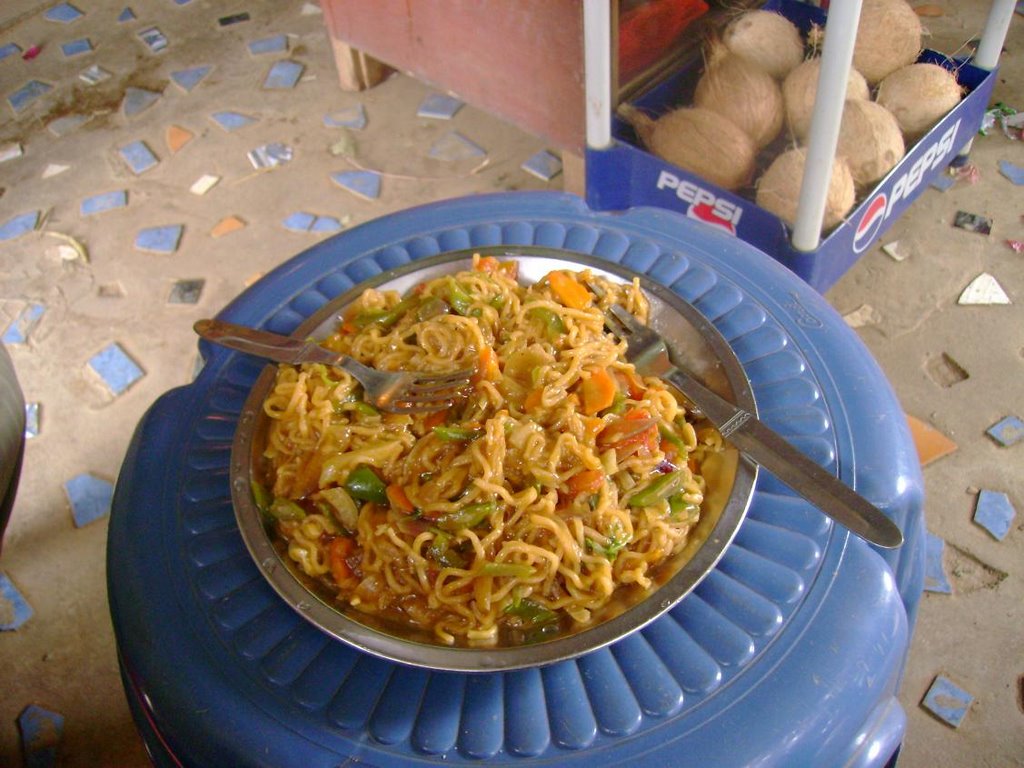 The maggi arrives and we get busy slurping it up. It's New Year's eve and I am in no mood to slug it out with this jungli Israeli maanav. We go our separate ways, taking leave abruptly.
Minding your manners
So usme kya galat keh diya usne, you may ask. Well nothing, perhaps. But there are certain unwritten rules when you are a visitor in a foreign country. You try to appreciate the local culture. You find good things to say to random locals. You hold your tongue when you sense unkind words rolling out.
Ah, but these Israelis aren't here for the 'incredible India' experience. They are on quite a different 'trip'. Although it may be wrong to stereotype, cheap drugs are one of the big attractions for young Israelis making their way to India. That may hold true for other nationalities as well, but with Israelis there's another peculiar feature. They tend to form 'communes'.
And I'm not saying this based on a couple of casual encounters, the phenomenon has been well documented.
An interesting article titled 'Israelis invade India' follows 23 year old Shai Levy's post-military service pilgrimage to India. Writer Dikla Kadosh notes:
Levi, 23, came to India to unwind, relax, and forget the horrors he witnessed during the height of the Palestinian intifada, when blood stained the streets of Israeli and Palestinian neighborhoods on a regular basis. He came to escape responsibility and the stress of Western life....
As for the connections they make with the Indian culture, Levi characterized them as mostly superficial. Although he found the people to be very open and easy to get along with, he noticed that Israelis tend to keep to their own kind, only interacting with Indians in matters of business. They communicate with Indians in English and barter, sometimes aggressively, over goods.
...Ramesh Choudharg, a room service attendant at the Hare Rama guest house where the Chabad center is located, had mixed feelings about the Israeli guests he encounters. "Sometimes they make big balagan,” he said, using a Hebrew word meaning 'mess'."
Naresh Fernandes, the editor of Time Out Mumbai wrote an article exploring the relationship between Indians and Israelis some years ago. He says:
Driving a hard bargain at the bazaar, he said, is the least of Israelis’ offenses in India. According to him, the perception Indians have of Israelis is that they are only interested in drugs and parties. The post-army twenty-somethings alternate between being lazy idlers, he said, and violent aggressors.
A Britisher whom I chatted up at Goa's Anjuna beach - practically taken over by Israelis - had an interesting observation. 'Norman' is a guy with tattoos all over his body, sitting at a beachside restaurant in an obviously elevated state. He loves to talk - in 10 minutes flat you know his entire life history (or at least the version he finds convenient to share).
Yes, he does drugs, but only to take away the pain of his 'broken back' and his wife who left him for another man and other life issues which require 'herbal medicine'. Given his propensity for story telling, we may have another Shantaram in the making.
But, I digress. The point Norman made about Israelis was this,"They're so aggressive.. so brazen.. they just sit around here with their chillums .. huge ones.. smoking pot in broad daylight." Whereas, we Britishers at least keep up appearances. "We're not so open.. almost inviting trouble.. I don't know how they do it.. how much they pay the cops!"
What's in it for them?
A young rabbi who runs 'Chabad House' in Mumbai, where young Israelis camp en route to Goa or Rajasthan explains...
“They need relief...They come here to do everything the army didn’t allow them to do. Their shoes had to be polished and tied – here they wear sandals. They had to cut their hair – here they grow their hair long.”
Holtzberg is not excusing their behaviour. He just understands the reasons behind it better than the Indians that come into contact with the hordes of escapists.
And here's what another fellow Israeli has to say:
Itzick Sabag, a 23-year-old Israeli who came to the United States after completing his army service and now lives in New York, is not surprised that Israelis have such a negative reputation in India. The type of person who goes there, he said, has no ambition or direction and is mainly interested in doing nothing. India is the perfect place to do just that.
“People go to different places for different reasons after the army,” he said. “They go to South America for hiking, climbing, outdoors stuff. They go to America to work or go to school. And they go to India to do drugs.”
So how many Israelis visit India anyways? In 2003, 32,157 visas were issued to Israeli nationals, making it no 15 among countries sending in maximum tourists to India. I could not locate a figure for subsequent years - as our Ministry of Tourism now tracks only the top 10 countries.
Israel is not one of them, yet its touristss are creating ripples...
The 'enclaves'
Not sheer numbers but the tendency to congregate in a few places is the problem. Daria Maoz chose to complete her doctorate thesis on Israeli backpackers in India. She observes:
The Israeli backpacker population is concentrated in a few small and clearly defined regions. "In some places the Israelis make up 90 percent of the tourist population...and when hundreds or even thousands of Israelis are concentrated in one village or neighbourhood you just can't ignore their very striking presence."
That's what happens in places like Bhagsu and Dharamkot, two not very large villages near Dharamsala, and in Bashisht and Old Manali, two neighborhoods of Manali, which like Dharamsala lies in the north of India. The situation is similar in the south of the country, especially in places like Goa's "Tel Aviv beach".
More Israeli enclaves include Kasol in Himachal Pradesh, Hampi in Karnataka. And where these enclaves spring up, here's what happens..
"The Israeli backpackers take over these areas and set up their own colonies," says Maoz. "In the last eight years they've turned those places into Israeli enclaves and in peak seasons they are flooded with thousands of Israeli backpackers. Some of them stay for long periods, even several years. Most of them stay a few weeks or months, but when they leave, other Israelis take their place creating permanent Israeli settlements with transient populations."
...According to Maoz, most Israeli backpackers treat the Indians as if their sole purpose in life was to serve them. They ignore the locals' needs and feelings, treat them and their traditions with contempt and regard the Israeli enclaves as playgrounds where they can do almost anything they desire. Uninhibited drug use is a prime example.
While writing her thesis, Maoz needed to 'observe' her subjects closely. She made several trips to India and adopted the backpacker lifestyle. She describes the enclaves as describes as a 'complete Israeli takeover of the local culture and space'.
"When you arrive at the Israeli enclaves in Dharamkot or Manali you feel as if you were in Israel itself...All you hear walking down the street is Hebrew and everyone you meet is Israeli. Even the rickshaws have signs posted in Hebrew advertising trance parties..."
Maoz believes the phenomenon creates a neo-colonial situation in the enclaves. The Israeli tourists, she says, reject the local culture, aren't interested in Indian food, in Indian traditions or the local lingo.
Even their interest in 'spirituality' is very superficial.
Two days after arriving they are already dressed in white and telling each other that the `energy is flowing' that they are living `here and now' and that their `chakras are open'. .. When it comes down to it, says Maoz, they are a lot more interested in trance parties and smoking drugs then in spiritual practices.
One of the strangest phenomena Maoz came across occurred at the Chabad House in Dharamsala.
Maoz visited the Dharamsala Chabad House on Rosh Hashanah and saw hundreds of Israeli backpackers taking part in a prayer service and festive dinner. She also saw how after dinner the backpackers headed off to a nearby site for a trance and drug party that lasted some 42 hours. A week and a half later she met them again at Chabad House where they had come for the pre-fast Yom Kippur meal. After dinner Maoz saw the backpackers pass a joint.
They called it the pre-fast joint.
All this doesn't go down well with the locals. But, it's paapi pet ka sawaal. Tourists bring in much needed business, so they grimace and bear it.
A restaurant owner in Dharamkot told her of an Israeli who drank five cups of tea, but when asked to pay the bill, which came to some five rupees or half an Israeli shekel, he refused claiming he had only drunk three cups. In the ensuing argument, the Israeli threatened the restaurant owner, telling him that he would organize a boycott of the restaurant...
An amusing form of 'resistance' is Indians who pass themselves off as spiritual teachers.
"The Israelis are looking for spirituality," one such spiritual guru, who worked as a schoolteacher in his home town, told Maoz, " so we sell them spirituality." Maoz says that during the peak seasons, Indians flow to the Israeli enclaves selling themselves as masters and babas (holy men), teaching Reiki, yoga, meditation and anything else Israelis care to learn.
And, her final conclusion:
One of the main findings of Maoz's research is that Israeli society has an interest in sending its young people to India. "Israeli society understands that after long, hard and frustrating military service and before integrating into society, Israeli youngsters need avenues to let off steam and to challenge accepted norms. Instead of having them do this it in Israel, they are sent to India."
Ah, cheaper and more effective than mass psychotherapy. Sow your wild oats and float on ye wild grasses in yon Himalayas. Come back a little more civilized!?
Well, as long as we can all live and let live. It's in the best interest of Israelis to be a little better behaved. Or the party may well get wound up... I mean, even Al Qaeda has taken note of the Israeli fancy for India. Although so far - thankfully - there have been just empty threats.
Let me conclude by saying that I have the greatest regard for Israel and the Israeli people. I would love to visit the country one day... Despite a horrific encounter with a snake shaped bread calld 'ziva' on Anjuna beach. I am sure it was about as authentic a representation of Israeli food as 'balti' cuisine is of India.
Until then, I shall continue chatting up Israeli backpackers, in part awe and part envy of their year long drifting voyage. To places in my own country I have never seen. But hope to find time to visit - someday.
And hey, if questions about the eradiaction of slums come up, I'll be ready with an inquiry into the resettlement of Palestinians... Peace be with you all. Shalom.
Wednesday, December 27, 2006
The Missing 'B' in Bschools
This column was published in Businessworld, issue dt 18 Dec 2006
The Missing 'B' in Bschools
by Rashmi Bansal
You have heard of The Monk Who Sold His Ferrari but what about the monk with an MBA? Eighteen monks from the Jade Buddha temple recently graduated from Shanghai’s Jiao Tong University’s Antai College of Economics and Management. They completed a six-month programme in ‘temple management’, which included subjects ranging from religious philosophy to managing temple finances and marketing religious products.
The results are quite evident. The temple now boasts of a ‘logo’, more shops and even a seminar series on Buddhism run by the head abbot. The seminar cost — $25,000 for a small group — is positioned as a ‘donation for enhancing one’s achievements and morality’.
The Antai programme is being seen as a success. Monks from 28 other temples in Shanghai are expected to attend in the near future. Are there questions about mixing the spiritual with the temporal? Well, yes. But the practical view prevails. “Many think that monks should just take care of the temple and have little contact with the outside world. But the reality is they must manage the temple and deal with money,” said Wang Fanghua, dean, Antai College, to Businessweek.
So, what next? Similar programmes for pundits, priests and imams? Well, maybe, but that is not the crux of this column. Whether you wish to treat a religious body as a ‘business’ is another debate altogether. What’s interesting is, here is a B-school programme which is helping folks to be more efficient in their current place of work, which is not necessarily a ‘corporate’. This is an extremely large segment, practically ignored by Indian B-schools.
Yes, of late, several B-schools have started ‘family business’ or FMB programmes. These courses take in students from family business backgrounds and expose them to modern management techniques and thinking processes. FMB programmes are structured differently from traditional MBAs, but they are two-year courses and suitable for younger members of medium to large family-owned enterprises. The heirs to the throne, so to speak.
NMIMS, Welingkar and Nirma Institute of Management’s FMB programmes fall under this category. SP Jain’s programme — the oldest one around — is slightly different. Here the students are actually expected to work alongside their studies. Classes are held for one week each month; and the rest are spent applying the acquired concepts to their business.
That is a great model, but it caters only to a fraction of a large potential market. While there are dozens of short-term certificates and diplomas for working executives, there are no such programmes for those who operate small businesses. Just like those monks, there are hundreds of owners of shops, trades and manufacturing units who could benefit, especially from fundas on marketing and accounting. Who doesn’t want to attract more customers, or benefit from better bookkeeping?
Of course, such courses need a different approach. As with the Jade Buddha temple, evidence of how the course actually helps you expand your business would be crucial. Less theory, more practice, an understanding of the problems facing small businesses, including addressing lack of confidence in the entrepreneur.
There are several reasons we won’t see such course anytime soon. We have no professors equipped to teach it. Most would consider it beneath their dignity, and none would be able to teach in any language other than English. It is not their fault, of course.
The MBA market here is modelled along global lines. The word ‘business’ in MBA is a misnomer. The programme is, perhaps, Masters in ‘Improvement of Personal Job Prospects’. The corporate giants who recruit don’t care what the student has learnt. Just that he should have the ability to learn it. And this suits B-schools perfectly. They can continue to think of the MBA programme as an art, and a science. That practical stuff? It is none of their business!
Note: Given the 700 word limit there were several points I could not dwell on in more detail. Here are some of those thought trails...
a) Our bschools and media (including business newspapers/ magazines) are obsessed with large business houses and multinationals. Whereas so much of what constitutes 'business' is happening in the informal sector, and at the level of individual entrepreneurs.
I think this segment should be covered in the media - as well as tracked/ studied by b schools.
b) Why are quality bschool education/ short term courses available only in English? That shuts out so many potential students. Unlike technical fields, like say engineering, a strong case can be made for teaching business management in regional languages. I can have a flourishing business as a Gujarati speaker who knows kaam chalau or even no English at all.
I guess this is really a problem of our education system as a whole, the obsession with teaching practically all professional courses only in English.
c) Of course, one may argue that concepts taught in an MBA are irrelevant to those with native business acumen. That in fact there is much that we b schoolers can learn from them.
I think at least one course which focuses on the traditional business communities of our country, the way in which they operate, advantages and disadvantages of traditional practices etc should be included in b school curriculum.
d) Lastly, family business MBA is a concept on which I really need to devote an entire column. One of these days, I shall...!
The Missing 'B' in Bschools
by Rashmi Bansal
You have heard of The Monk Who Sold His Ferrari but what about the monk with an MBA? Eighteen monks from the Jade Buddha temple recently graduated from Shanghai’s Jiao Tong University’s Antai College of Economics and Management. They completed a six-month programme in ‘temple management’, which included subjects ranging from religious philosophy to managing temple finances and marketing religious products.
The results are quite evident. The temple now boasts of a ‘logo’, more shops and even a seminar series on Buddhism run by the head abbot. The seminar cost — $25,000 for a small group — is positioned as a ‘donation for enhancing one’s achievements and morality’.
The Antai programme is being seen as a success. Monks from 28 other temples in Shanghai are expected to attend in the near future. Are there questions about mixing the spiritual with the temporal? Well, yes. But the practical view prevails. “Many think that monks should just take care of the temple and have little contact with the outside world. But the reality is they must manage the temple and deal with money,” said Wang Fanghua, dean, Antai College, to Businessweek.
So, what next? Similar programmes for pundits, priests and imams? Well, maybe, but that is not the crux of this column. Whether you wish to treat a religious body as a ‘business’ is another debate altogether. What’s interesting is, here is a B-school programme which is helping folks to be more efficient in their current place of work, which is not necessarily a ‘corporate’. This is an extremely large segment, practically ignored by Indian B-schools.
Yes, of late, several B-schools have started ‘family business’ or FMB programmes. These courses take in students from family business backgrounds and expose them to modern management techniques and thinking processes. FMB programmes are structured differently from traditional MBAs, but they are two-year courses and suitable for younger members of medium to large family-owned enterprises. The heirs to the throne, so to speak.
NMIMS, Welingkar and Nirma Institute of Management’s FMB programmes fall under this category. SP Jain’s programme — the oldest one around — is slightly different. Here the students are actually expected to work alongside their studies. Classes are held for one week each month; and the rest are spent applying the acquired concepts to their business.
That is a great model, but it caters only to a fraction of a large potential market. While there are dozens of short-term certificates and diplomas for working executives, there are no such programmes for those who operate small businesses. Just like those monks, there are hundreds of owners of shops, trades and manufacturing units who could benefit, especially from fundas on marketing and accounting. Who doesn’t want to attract more customers, or benefit from better bookkeeping?
Of course, such courses need a different approach. As with the Jade Buddha temple, evidence of how the course actually helps you expand your business would be crucial. Less theory, more practice, an understanding of the problems facing small businesses, including addressing lack of confidence in the entrepreneur.
There are several reasons we won’t see such course anytime soon. We have no professors equipped to teach it. Most would consider it beneath their dignity, and none would be able to teach in any language other than English. It is not their fault, of course.
The MBA market here is modelled along global lines. The word ‘business’ in MBA is a misnomer. The programme is, perhaps, Masters in ‘Improvement of Personal Job Prospects’. The corporate giants who recruit don’t care what the student has learnt. Just that he should have the ability to learn it. And this suits B-schools perfectly. They can continue to think of the MBA programme as an art, and a science. That practical stuff? It is none of their business!
Note: Given the 700 word limit there were several points I could not dwell on in more detail. Here are some of those thought trails...
a) Our bschools and media (including business newspapers/ magazines) are obsessed with large business houses and multinationals. Whereas so much of what constitutes 'business' is happening in the informal sector, and at the level of individual entrepreneurs.
I think this segment should be covered in the media - as well as tracked/ studied by b schools.
b) Why are quality bschool education/ short term courses available only in English? That shuts out so many potential students. Unlike technical fields, like say engineering, a strong case can be made for teaching business management in regional languages. I can have a flourishing business as a Gujarati speaker who knows kaam chalau or even no English at all.
I guess this is really a problem of our education system as a whole, the obsession with teaching practically all professional courses only in English.
c) Of course, one may argue that concepts taught in an MBA are irrelevant to those with native business acumen. That in fact there is much that we b schoolers can learn from them.
I think at least one course which focuses on the traditional business communities of our country, the way in which they operate, advantages and disadvantages of traditional practices etc should be included in b school curriculum.
d) Lastly, family business MBA is a concept on which I really need to devote an entire column. One of these days, I shall...!
Tuesday, December 26, 2006
Undergrad studies in America
If you've completed class 12 in India and gone on to do your undergrad education in the US, read on. I'd like you to share advice/ experiences which might help prospective students. This is for a feature in JAM magazine's forthcoming issue.
Some of the Qs we're seeking to answer:
- Ivy League colleges have long offered need-blind admission. How hard is it, though, as a foreign student? And are some Ivy League colleges more receptive to foreign students than others?
- Are there colleges outside the Ivy League which offer need-blind admissions/ merit scholarships for undergrad studies to foreign students? Mount Holyoke used to be one such college. A couple of my friends studied there - but that was a while ago.
- Assume you take a loan for undergrad studies in the US. What's the likelihood of your getting a job there in order to recover your investment?
You could share any fundas you have in 200-300 words. More is always welcome, of course. Email rashmi_b@yahoo.com.
Some of the Qs we're seeking to answer:
- Ivy League colleges have long offered need-blind admission. How hard is it, though, as a foreign student? And are some Ivy League colleges more receptive to foreign students than others?
- Are there colleges outside the Ivy League which offer need-blind admissions/ merit scholarships for undergrad studies to foreign students? Mount Holyoke used to be one such college. A couple of my friends studied there - but that was a while ago.
- Assume you take a loan for undergrad studies in the US. What's the likelihood of your getting a job there in order to recover your investment?
You could share any fundas you have in 200-300 words. More is always welcome, of course. Email rashmi_b@yahoo.com.
Friday, December 22, 2006
Lame Fame
Caught a bit of 'Fame X' on Sab TV. Judge Ganesh Hegde talks passionately about the days when he used to dance on the roads - so people would notice his talent. Motormouth Cyrus Broacha is sitting next to him, with a straight face. The kind you need to practice for several hours...
No, it's not going to make any major waves but there is enough interest in this whole 'mom, watch me get famous' business to produce some TRPs. Maybe not enough though, which is probably why Palash Sen walked out of the show. Blaming it on
'principles'.
However, there's an interesting twist to the 'fame game'. Even as channels produce more singing-dancing-tell a joke kind of shows to uncover new 'talent', there's a parallel route to getting famous. Creating a 'world record'.
Star News had an interesting story on this phenomenon. A 21 year old by the name Sania Sayyed in Khandwa (a small town in MP) is apparently attempting a record by singing for 131 hours straight. She had previously 'successfully' created a record for 65 hours of continuous singing. However, this was broken by one 'Deepak' who did 100 hours. Saniya is now attempting to 'win back' the record.
Simultaneously we have Aditi Gupta of Indore, a class 12 student who is attempting to 'dance non-stop' for 85 hours. Her mother proudly stated that during rehearsals Aditi demonstrated that she could dance continuously, all night, 3 nights in a row. This apparently convinced sponsors that she could achieve the 85 hour record.
Here's the thing: Sania does not sing that well, and Aditi is not a great dancer. I'm saying this based on the clips which appeared on TV. Or maybe by the time cameras captured their performance they were tired and listless, so it's not quite fair to comment.
The point is, creating a world record is not a smart career move which may get you noticed in Bollywood. It's something which, at best, gets you pics in your local paper. And felicitation from 'Agarwal Sweets' or equivalent.
Oh, of course it did get picked up by Star News, which must be the greatest moment in the lives of these anonymous young people and their families. Never mind if the channel did not give a very positive spin. Short of using the word 'shoshan' (exploitation) they pretty much painted a sorry picture of pushy parents and desperate youngsters.
In doing so, they provided the very oxygen that will lead more Saniyas and Aditis to attempt bizarre records. In the hope of creating some kind of unique identity for themselves. Something to be 'known for' even as their lives follow the mundanities of a million others. Something to tell their grandchildren.
At the end of the day we all want to feel we are more than a speck of sand in the universe... That our presence on this planet made some kind of difference. Hota hai ya nahin yeh alag baat hai, but hey - you can't blame them for trying!
It shows some kind of drive and determination - even if misdirected. Which is more than what could be said to exist in sleepy little towns, not too long ago!
No, it's not going to make any major waves but there is enough interest in this whole 'mom, watch me get famous' business to produce some TRPs. Maybe not enough though, which is probably why Palash Sen walked out of the show. Blaming it on
'principles'.
However, there's an interesting twist to the 'fame game'. Even as channels produce more singing-dancing-tell a joke kind of shows to uncover new 'talent', there's a parallel route to getting famous. Creating a 'world record'.
Star News had an interesting story on this phenomenon. A 21 year old by the name Sania Sayyed in Khandwa (a small town in MP) is apparently attempting a record by singing for 131 hours straight. She had previously 'successfully' created a record for 65 hours of continuous singing. However, this was broken by one 'Deepak' who did 100 hours. Saniya is now attempting to 'win back' the record.
Simultaneously we have Aditi Gupta of Indore, a class 12 student who is attempting to 'dance non-stop' for 85 hours. Her mother proudly stated that during rehearsals Aditi demonstrated that she could dance continuously, all night, 3 nights in a row. This apparently convinced sponsors that she could achieve the 85 hour record.
Here's the thing: Sania does not sing that well, and Aditi is not a great dancer. I'm saying this based on the clips which appeared on TV. Or maybe by the time cameras captured their performance they were tired and listless, so it's not quite fair to comment.
The point is, creating a world record is not a smart career move which may get you noticed in Bollywood. It's something which, at best, gets you pics in your local paper. And felicitation from 'Agarwal Sweets' or equivalent.
Oh, of course it did get picked up by Star News, which must be the greatest moment in the lives of these anonymous young people and their families. Never mind if the channel did not give a very positive spin. Short of using the word 'shoshan' (exploitation) they pretty much painted a sorry picture of pushy parents and desperate youngsters.
In doing so, they provided the very oxygen that will lead more Saniyas and Aditis to attempt bizarre records. In the hope of creating some kind of unique identity for themselves. Something to be 'known for' even as their lives follow the mundanities of a million others. Something to tell their grandchildren.
At the end of the day we all want to feel we are more than a speck of sand in the universe... That our presence on this planet made some kind of difference. Hota hai ya nahin yeh alag baat hai, but hey - you can't blame them for trying!
It shows some kind of drive and determination - even if misdirected. Which is more than what could be said to exist in sleepy little towns, not too long ago!
Thursday, December 21, 2006
IIT waalon ki chaandi
Are b schools redundant? Take a look at the latest on the IIT placement front.
Business Standard reports:
With the IITs just a week into their placements' process, the number of companies making placement offers this year has increased, almost doubling in a few cases. Moreover, these companies have already made huge offers to the students.
Besides, while the highest international offer has seen a 11 per cent increase this year, domestic offers have risen anywhere between 20-100 per cent.
For instance, at IIT Delhi an overseas offer of $100,000 (around Rs 45.50 lakh) was made by a US-based speciality fixed income manager Pimco. At IIT Bombay, the highest salary package offered so far is $92000 (around Rs 42 lakh) by Mercer Oliver Wyman - a Boston-based financial consulting firm.
The new logic seems to be: Why run after guys at IIMs/ other Bschools when guys from IITs can do pretty much the same job? The premise being that what you learn in a bschool isn't that important anyways... it's the raw material that gets in which is the key thing.
Since IITians constitute a healthy chunk of that raw material may as well go directly to IIT and pick 'em up two years earlier. Makes sense from a company point of view.
The question is: is this just a temporary demand-supply blip? ie Are companies adopting novel strategies in a year when demand for workers with certain kinds of skills has gone through the roof? Or, is this a trend for the long term.
First, we had Indian software companies which hire any old engineer (not just computer science/ IT) because all of them are numerical-minded, and beyond that, well they are malleable. Now you have funds and investment banks thinking the same way.
Of course, no one from IIT will join an Indian software company today because the 'quality of work' sucks. Wonder whether that sentiment would apply to the work they will get in these funds and i-banks, given the pay packets...
Putting things in perspective, today, we're only talking of a handful of students going the Pimco way. (The media needs to be careful about reporting the facts. As far as I know this is NOT the first time McKinsey is visiting the IIT B campus!).
In years to come, the numbers may swell. Much depends on how the first few batches of recruits shape up.
Interestingly, G Sinha, Professor in-charge, training and placement at IIT Kharagpur remarked to BS,"The institute does not have international placements as it is dedicated itself to the service of the nation."
Which is rummy and all that, but companies like Barclays Capital, Bain and Company, Opera Solutions and Lehman Brothers come to recruit students at IIT KGP. Just because they don't send them abroad from day 1 does not mean their job profile is closer to the objective of 'service of the nation'!
So honestly, I sense that IITs themselves are confused about what to do with this ardent courtship of its students by the free market. At the back of their mind lies the question, what about the 'T' in IIT. A question which surfaces every now and then, but is never satisfactorily answered...
Also read: Placement, as seen through the eyes of an IIT Madras student.
Business Standard reports:
With the IITs just a week into their placements' process, the number of companies making placement offers this year has increased, almost doubling in a few cases. Moreover, these companies have already made huge offers to the students.
Besides, while the highest international offer has seen a 11 per cent increase this year, domestic offers have risen anywhere between 20-100 per cent.
For instance, at IIT Delhi an overseas offer of $100,000 (around Rs 45.50 lakh) was made by a US-based speciality fixed income manager Pimco. At IIT Bombay, the highest salary package offered so far is $92000 (around Rs 42 lakh) by Mercer Oliver Wyman - a Boston-based financial consulting firm.
The new logic seems to be: Why run after guys at IIMs/ other Bschools when guys from IITs can do pretty much the same job? The premise being that what you learn in a bschool isn't that important anyways... it's the raw material that gets in which is the key thing.
Since IITians constitute a healthy chunk of that raw material may as well go directly to IIT and pick 'em up two years earlier. Makes sense from a company point of view.
The question is: is this just a temporary demand-supply blip? ie Are companies adopting novel strategies in a year when demand for workers with certain kinds of skills has gone through the roof? Or, is this a trend for the long term.
First, we had Indian software companies which hire any old engineer (not just computer science/ IT) because all of them are numerical-minded, and beyond that, well they are malleable. Now you have funds and investment banks thinking the same way.
Of course, no one from IIT will join an Indian software company today because the 'quality of work' sucks. Wonder whether that sentiment would apply to the work they will get in these funds and i-banks, given the pay packets...
Putting things in perspective, today, we're only talking of a handful of students going the Pimco way. (The media needs to be careful about reporting the facts. As far as I know this is NOT the first time McKinsey is visiting the IIT B campus!).
In years to come, the numbers may swell. Much depends on how the first few batches of recruits shape up.
Interestingly, G Sinha, Professor in-charge, training and placement at IIT Kharagpur remarked to BS,"The institute does not have international placements as it is dedicated itself to the service of the nation."
Which is rummy and all that, but companies like Barclays Capital, Bain and Company, Opera Solutions and Lehman Brothers come to recruit students at IIT KGP. Just because they don't send them abroad from day 1 does not mean their job profile is closer to the objective of 'service of the nation'!
So honestly, I sense that IITs themselves are confused about what to do with this ardent courtship of its students by the free market. At the back of their mind lies the question, what about the 'T' in IIT. A question which surfaces every now and then, but is never satisfactorily answered...
Also read: Placement, as seen through the eyes of an IIT Madras student.
Tuesday, December 19, 2006
The Indian Youth Market: a reality check!
The latest Business Today has an 8 page spread on the WCRR 'White Collar Richie Rich' kid. The article, titled 'Young, Rich and Restless' features snapshots of several brats in the 15-21 age group who are apparently spending on luxury brands, gizmos and anything else their heart desires, thanks to indulgent white-collar parents.
 So far, so good. The example of one Ashima Bagchi (17), who's been photographed with her 60 gb video ipod (Rs 26,000), Nokia N 91 (Rs 35,000), Guess wallet (Rs 4600), Guess timepiece (Rs 16,000), Swarovski bracelet and ring (Rs 18, 900) is a bit over the top. (How wannabe is a 12,600 rupee Louis Vuitton ipod case??!) But such brats do exist.
And surely one can find a few hundred similar examples in our metros. Ok, even a few
thousand. What shook me out of bedside-reading-mode and made me switch on my computer was this startling conclusion by BT:
 "According to data put together by the National Council of Applied Economic Research
(NCAER), the 'aspirational class' - primarily white collar professionals including entrepreneurs but excluding business families - numbers a whopping 81 million households. The 'rich' on the other hand are a mere 3.8 million households...
The 81 million households of aspirers earn a minimum of $45,000 (Rs 20.25 lakhs) per annum... Assuming one child in this age bracket - let's call her and her ilk White Collar Richie Rich (WCRR) - in every two of these households is in the 15-21 age bracket, you have a little over 40 million of them out there."
Wow. 81 million households in India earning Rs 20 lakhs a year??? When did that miracle take place?
Either I'm Rip Van Winkle or ... someone has goofed up bigtime.
First of all, NCAER defines its income pyramid as 'rich', followed by 'middle class' and then come 'aspirers', lower down the ladder. So at the very least we should be looking at data for 'middle class'.
Middle class is defined by NCAER as households earning $4,400-$21,800 a year. ie Rs 2-10 lakhs a year.
The NCAER estimate for 'middle class' in 2001-2 was 10.7 million households (scroll to pg 7 & 8 of the pdf I have linked to). Their estimate for 'middle class' in 2005-6 is 16.4 million households. Which would translate to approximately 65-80 million people.
The 'aspirers' are defined by NCAER as households with an annual household income of between Rs 90,000 and Rs 2 lakh. The NCAER estimate for 'aspirer' households is 41.3 million households in 2001-2. And 53.3 million households in 2005-6.
For more details, check this pdf file on NCAER's website which encapsulates a report titled 'The Great Indian Market'. The report was published in association with Business Standard in August 2005.
So, what happened?
I can only conjecture that some error of multiplication is responsible for Business Today's erroneous conclusions. eg the income range of '90-200 may have been multiplied by annual household income in '000 to reach a figure of 2,000,000 (20 lakhs) instead of 200,000 (2 lakhs).
Or perhaps the $4,400 figure minimum used to include households in the 'middle class' class was misread as $44,000. Whatever it is, the stats used to support the basic hypothesis are way off the mark.
Surely an alarm bell should go off in someone's head when concluding that close to 45% of India's 188.2 million households are earning a minimum of Rs 20 lakhs ($45,000) a year. That is the kind of prosperity you fondly hope the country will achieve in your lifetime!
The reality is, 132 million households earning less than Rs 90,000 per annum. That's 70% of the India - classified by NCAER as the 'deprived'. Better things are predicted: NCAER believes that by 2009-10, the deprived class will shrink to 114 million households. But there's still a long way to go!
The truth is out there
Coming back to the 'WCRR'. I do see a trend in 'kids with too much money to spend' but clearly it's still a small trend. 'Guess' and 'Tommy Hilfiger' showrooms are deserted at most times. Yes, one comes across the types who will spend Rs 30,000 on a shopping spree at Mango. But they constitute a small rivulet, not a mighty rupee-swollen river.
Sadly, after reading BT's super-buoyant report, more luxury brands will set up shop in India. Waiting, like Godot, for the mythical '40 million' WCRRs to charge in with their credit cards!
Let me add, however, that the Indian youth market is a very attractive one. (I will attempt my own back of the envelope calculation one of these days!). But it's marketers who focus on novelty and quality at fair prices who will see far more success than the likes of Guess. At least in the short and medium run.
Of course, luxury brands do need to drop anchor here. But they'll need to be very patient!
 So far, so good. The example of one Ashima Bagchi (17), who's been photographed with her 60 gb video ipod (Rs 26,000), Nokia N 91 (Rs 35,000), Guess wallet (Rs 4600), Guess timepiece (Rs 16,000), Swarovski bracelet and ring (Rs 18, 900) is a bit over the top. (How wannabe is a 12,600 rupee Louis Vuitton ipod case??!) But such brats do exist.
 And surely one can find a few hundred similar examples in our metros. Ok, even a few
thousand. What shook me out of bedside-reading-mode and made me switch on my computer was this startling conclusion by BT:
 "According to data put together by the National Council of Applied Economic Research
 (NCAER), the 'aspirational class' - primarily white collar professionals including entrepreneurs but excluding business families - numbers a whopping 81 million households. The 'rich' on the other hand are a mere 3.8 million households...
The 81 million households of aspirers earn a minimum of $45,000 (Rs 20.25 lakhs) per annum... Assuming one child in this age bracket - let's call her and her ilk White Collar Richie Rich (WCRR) - in every two of these households is in the 15-21 age bracket, you have a little over 40 million of them out there."
Wow. 81 million households in India earning Rs 20 lakhs a year??? When did that miracle take place?
Either I'm Rip Van Winkle or ... someone has goofed up bigtime.
First of all, NCAER defines its income pyramid as 'rich', followed by 'middle class' and then come 'aspirers', lower down the ladder. So at the very least we should be looking at data for 'middle class'.
Middle class is defined by NCAER as households earning $4,400-$21,800 a year. ie Rs 2-10 lakhs a year.
The NCAER estimate for 'middle class' in 2001-2 was 10.7 million households (scroll to pg 7 & 8 of the pdf I have linked to). Their estimate for 'middle class' in 2005-6 is 16.4 million households. Which would translate to approximately 65-80 million people.
The 'aspirers' are defined by NCAER as households with an annual household income of between Rs 90,000 and Rs 2 lakh. The NCAER estimate for 'aspirer' households is 41.3 million households in 2001-2. And 53.3 million households in 2005-6.
For more details, check this pdf file on NCAER's website which encapsulates a report titled 'The Great Indian Market'. The report was published in association with Business Standard in August 2005.
So, what happened?
I can only conjecture that some error of multiplication is responsible for Business Today's erroneous conclusions. eg the income range of '90-200 may have been multiplied by annual household income in '000 to reach a figure of 2,000,000 (20 lakhs) instead of 200,000 (2 lakhs).
Or perhaps the $4,400 figure minimum used to include households in the 'middle class' class was misread as $44,000. Whatever it is, the stats used to support the basic hypothesis are way off the mark.
Surely an alarm bell should go off in someone's head when concluding that close to 45% of India's 188.2 million households are earning a minimum of Rs 20 lakhs ($45,000) a year. That is the kind of prosperity you fondly hope the country will achieve in your lifetime!
The reality is, 132 million households earning less than Rs 90,000 per annum. That's 70% of the India - classified by NCAER as the 'deprived'. Better things are predicted: NCAER believes that by 2009-10, the deprived class will shrink to 114 million households. But there's still a long way to go!
The truth is out there
Coming back to the 'WCRR'. I do see a trend in 'kids with too much money to spend' but clearly it's still a small trend. 'Guess' and 'Tommy Hilfiger' showrooms are deserted at most times. Yes, one comes across the types who will spend Rs 30,000 on a shopping spree at Mango. But they constitute a small rivulet, not a mighty rupee-swollen river.
Sadly, after reading BT's super-buoyant report, more luxury brands will set up shop in India. Waiting, like Godot, for the mythical '40 million' WCRRs to charge in with their credit cards!
Let me add, however, that the Indian youth market is a very attractive one. (I will attempt my own back of the envelope calculation one of these days!). But it's marketers who focus on novelty and quality at fair prices who will see far more success than the likes of Guess. At least in the short and medium run.
Of course, luxury brands do need to drop anchor here. But they'll need to be very patient!
Monday, December 18, 2006
Remembering Sunil Mehta (1965-2006)
 Nasscom vice president Sunil Mehta passed away in Mumbai on Saturday following a cardiac arrest. He was 41.
CIOL reports: Mehta has been instrumental in some of Nasscom’s recent initiatives such as the online national registry of BPO employees and Nasscom Assessment of Competence (NAC) that involves tests to grade BPO applicants.
Like Kiran Karnik, the president of the industry body, he has also been quite vocal in denouncing the anti-outsourcing critics and also defended the country’s BPO industry in the light of the certain security breaches at call centers.
In his role, Mehta was responsible for leading Nasscom’s research initiatives. He also was in charge of Nasscom’s international public affairs and public relations.
I was flipping through the Economic Times this morning when I noticed the ad which carried the sad news. I read and re-read it a few times... It was just too shocking.
Sunil was an amazing human being, whom I was privileged enough to meet and get to know a little over the last two years. Of course, we planned to meet more often than we actually met.
Sunil had a wry sense of humour. He smiled a lot. And probably smoked more than he should have.
Sunil had a lot of fundas to share with me, having been an entrepreneur himself, before joining NASSCOM. After graduating from IIM A in 1988 and working briefly with Citibank, Sunil started a research company called INFAC. From 1989 to 2000, he ran this company, finally selling out to CRISIL.
We joked about the possibility of Rupert Murdoch buying out my company. "Then you too can join NASSCOM".
A little known facet of Sunil Mehta was his blog. It gives you a peek into his sharp and sensitive mind. No, I never got around to adding him to my blogroll...
At times like this, one is reminded of what is truly important in life. How little we know of what lies ahead. My deepest condolences to Sunil's family. Our thoughts and prayers are with them.
Goodbye, Sunil. You will be deeply missed.
Prayer Meetings:
Mumbai: Monday, 18th December 2006 from 5.30 to 7.30 pm.
Venue: 701, Horizon Apts, 9th Rd, near kaifi Azmi Garden, JVPD Scheme, Vile Parle (W), Mumbai. Ph 26701744
Delhi: Wednesday, 20th December 2006 from 11:00 a.m. to 12:00 noon
Venue: NASSCOM, International Youth Centre, Teen Murti Marg, Chanakyapuri, New Delhi. Phone: 91-11-23010199
Bangalore: Thursday, 21st December 2006
Time and venue to be confirmed. Check here.
Saturday, December 16, 2006
Maturity Milestones
The law considers you an adult at 18. You can vote. You can watch 'A' films. You can even marry (if you're a girl).
But there are many other milestones which mark one's movement towards maturity. My 7 year old daughter crossed one last week, when she asked for - and got - her very own email id.
I thought we'd let her use it under supervision. But here's what happened. Within two login sessions she had figured it all out. The third time I looked over her shoulder she scolded,"Mummy, don't see my password."
Such is life!
I gave her a short lecture on the importance of sending emails only to people she knows. Like her cousins, mamas and maasis. I gave her the analogy of the park. "You don't take chocolate from strangers, do you?"
But honestly, there's not much I can do. Sometime in the near future she will discover Yahoo messenger or Googletalk and, she could meet anyone online. She may think it's okay to say hello - after all 'hello' is not a chocolate. But hello can lead to anything..
OK, so I sound paranoid. But she is just 7 years old. I remember feeling like a full adult at 16. I thought I knew everything there was to know. I did not want any 'interference'.
For the current generation, the age of 'full adulthood' - in their minds - may be as early as 11 or 12.
Technology is racing ahead of biology. Sure, we will adapt and cope. But there is uncharted territory ahead!
But there are many other milestones which mark one's movement towards maturity. My 7 year old daughter crossed one last week, when she asked for - and got - her very own email id.
I thought we'd let her use it under supervision. But here's what happened. Within two login sessions she had figured it all out. The third time I looked over her shoulder she scolded,"Mummy, don't see my password."
Such is life!
I gave her a short lecture on the importance of sending emails only to people she knows. Like her cousins, mamas and maasis. I gave her the analogy of the park. "You don't take chocolate from strangers, do you?"
But honestly, there's not much I can do. Sometime in the near future she will discover Yahoo messenger or Googletalk and, she could meet anyone online. She may think it's okay to say hello - after all 'hello' is not a chocolate. But hello can lead to anything..
OK, so I sound paranoid. But she is just 7 years old. I remember feeling like a full adult at 16. I thought I knew everything there was to know. I did not want any 'interference'.
For the current generation, the age of 'full adulthood' - in their minds - may be as early as 11 or 12.
Technology is racing ahead of biology. Sure, we will adapt and cope. But there is uncharted territory ahead!
Thursday, December 07, 2006
JAM Engineering Survey - Topics for Write ups
Thanks to all those who sent in write ups on their respective branches. All six of you. Yes, we still have a very long way to go. We need write ups for the following branches:
- Aerospace Engineering
- Agricultural Engineering
- Architectural Engineering
- Automotive Engineering
- Ceramic Engineering
- Civil Engineering
- Computer Engineering (in any college outside Maharashtra)
- Electrical Engineering
- Electronics Engineering
- Electronics and Telecom Environmental Engineering
- Industrial Engineering
- Instrumentation Engineering
- Information Technology
- Manufacturing Engineering
- Marine Engineering
- Materials Engineering
- Mechanical Engineering
- Mining Engineering
- Nuclear Engineering
- Ocean Engineering
- Transportation Engineering
- Petro-chemical engineering
The articles we require are anything from 400-800 words, depending on how much you have to say! Once you express an interest in writing about a particular branch, we'll send you guidelines which give you an idea of the tone and content required.
We'd also like write ups on the following :
- Choosing which IIT to join
- Choosing which NIT to join
- Choosing an offbeat program in an IIT eg 5 year programs/ integrated courses/ humanities etc
Here, we'd like many different people to narrate their experiences and views. As there can be no 'right' answer.
Lastly, we would like write ups from every state on the peculiarities of the admission procedure. And any other things specific to studying engineering in that state.
As always, drop me a line at rashmi_b@yahoo.com
- Aerospace Engineering
- Agricultural Engineering
- Architectural Engineering
- Automotive Engineering
- Ceramic Engineering
- Civil Engineering
- Computer Engineering (in any college outside Maharashtra)
- Electrical Engineering
- Electronics Engineering
- Electronics and Telecom Environmental Engineering
- Industrial Engineering
- Instrumentation Engineering
- Information Technology
- Manufacturing Engineering
- Marine Engineering
- Materials Engineering
- Mechanical Engineering
- Mining Engineering
- Nuclear Engineering
- Ocean Engineering
- Transportation Engineering
- Petro-chemical engineering
The articles we require are anything from 400-800 words, depending on how much you have to say! Once you express an interest in writing about a particular branch, we'll send you guidelines which give you an idea of the tone and content required.
We'd also like write ups on the following :
- Choosing which IIT to join
- Choosing which NIT to join
- Choosing an offbeat program in an IIT eg 5 year programs/ integrated courses/ humanities etc
Here, we'd like many different people to narrate their experiences and views. As there can be no 'right' answer.
Lastly, we would like write ups from every state on the peculiarities of the admission procedure. And any other things specific to studying engineering in that state.
As always, drop me a line at rashmi_b@yahoo.com
Wednesday, December 06, 2006
Surf Excel - the 'other' CSR
Alok Mehta left the following comment on my 'youth brand universe' post
HLL is all over the town and its FM channels with its "Mumbai dhoyega, Mumbai jeetega" campaign, where users have to sms the no. of stains / spots they could remove using HLL's detregent and the "score" is added to a fund that can go upto Rs. 5 lacs to be used to help Mumbai's needy children.
No doubt HLL will be more than compensated for its 5 lacs - from the paybacks received from mobile service provider, leave alone the actual product sales. The cost of promotion on FM itself wil be more than 5 lacs. I'm sure a corporate the size of HLL can afford to give away 5 lacs to needy [ corporate social responsibility - thats another discussion topic altogether] without a sms campaign etc.
Prashant Jain, who works at Unilever replied:
As a person who has been closely associated with the campaign and as a fellow blogger, I would like to clarify some misconceptions that you seem to carry about the Surf Excel 10/10 donation drive. .. Firstly, HLL is not receiving any paybacks from mobile service providers. The SMSs sent by the consumers are charged at the circle rate and at no special rate. As far as revenues from product sales are concerned, this campaign is a very small part of a very large promotion exercise (the Surf Excel 10/10 campaign). HLL could have chosen to spend the money on this campaign instead of going out of its way to invest resources in this campaign.
This campaign is being run in 5 metros in partnership with some very well known NGOs who are doing exemplary work in the field of child education (Udayan in Kolkata, Pratham in Mumbai, Parikrma in Bangalore, Prayas in Delhi and Udavum Karangal in Chennai). This takes the donation amount to 25 laks (not a small amount by any standard)
You are right in saying that the cost of running the campaign is much more than 5 lakhs, but you seem to have construed wrongly the spirit of the campaign. It is not about the donation of the said amount. In its own small way, the campaign aims to sensitize these urban conglomerates towards the plight of the millions of underserved children. Radio and SMS were used as means to achieve the said end.
For your kind information, HLL does undertake huge CSR initiatives. Please visit www.hll.com to know more about the same. Do write to me at prashant.jain@unilever.com for any other queries regarding the campaign.
I feel compelled to comment on the subject. Not because I am an HLL shareholder, or the fact that the company has been and continues to be one of my clients. This post is trigerred by my own 'Surf Excel' experience which went something like this:
A couple of weeks ago my daughter and I were headed towards the local mall to pick up some groceries. At the signal, a child of about the same age as her pressed her nose against the window of our car.
"Mummy, give me 5 rupees.. to give her," said Nivedita.
"No..." I replied. "You can buy her some biscuits and give them on the way back."
Half an hour later, she actually remembered to buy those biscuits. What's more, when we passed the detergent counter she asked to buy Surf Excel . Why? Because we can send an sms and help some poor children. "I have see the ad..."
It struck me then that the Surf Excel campaign was indeed similar to say, the NDTV campaign to get a retrial for Jessica Lal. A chance for us, as individuals to feel we have made a difference to a problem that is so much larger than ourselves, it leaves us helpless.
This act of buying Surf Excel perhaps made Nivedita feel like she had done something for that little girl she saw on the road. I, older and cynical, did not really share that sentiment. But I bought Surf anyways. We're Tide loyalists, actually. No particular reason - just.
Will we buy Surf again? I cannot say. Did we send the sms? No - the pack is still lying unopened. Did we give the girl at the signal the biscuits? Sadly - she had disappeared.
Whatever folks like Alok and I may feel, efforts like this one will be increasingly adopted by companies. After all, those of us who have are gnawed by guilt about the have-nots from time to time. So in addition to Corporate Social Responsibility, which companies like HLL in any case undertake (less visibly) there will be a case for 'Consumer Social Responsibility'.Where you and me can can earn some pain-free 'I have done my tiny little bit for society' points.
In different ways, and with varying degrees of success, HLL has been trying to take a more 'social' stance through its advertising. The Lifebuoy ad, for example, depicts young boys and girls taking on the responsibility of cleaning up their neighbourhood. Again, it starts with the idea that "Kabhi kabhi sirf ek insaan,..." a single individual can make a difference.
Given that these brands are embedded in the Indian psyche, drumming in functional benefits is of hardly any use now. One has to fight it out on pricing, distribution and yes, retaining positive emotional appeal. HLL has thus taken the slightly bold route of retiring the footballer covered in mud and the tandurusti ki raksha karta hai jingle.
At my home, however, we now use Dettol.
What research says
A Stanford study recently found that despite surveys showing an eager customer base, people aren't putting their money where their mouths are and actually buying ethically produced goods.
One surprising discovery they made was that information on ethical issues and the availability of socially responsible products did not make a difference in consumer choice. Consumers made explicitly aware of a product's benefits to society or the environment were just as likely to choose the cheaper, more harmful brand as a control group given no information about the products...
The Stanford team found that people willing to pay more in the name of ethics do exist, but they're not who you think they might be. There is no group designated by nationality, age, gender, income, or education level that consistently buys ethical products more than any other. The authors write, "[c]ontrary to what some might believe, CnSR [consumer social responsibility] is not just the purview of wealthy, highly educated females in liberal Western democracies. Rather, it is something embedded in the psyche of individuals."
So I guess campaigns like Surf will satisfy some individuals urge to be ethical even as they leave others cold and unmoved. Which is the case with just about any kind of campaign, isn't it?
HLL is all over the town and its FM channels with its "Mumbai dhoyega, Mumbai jeetega" campaign, where users have to sms the no. of stains / spots they could remove using HLL's detregent and the "score" is added to a fund that can go upto Rs. 5 lacs to be used to help Mumbai's needy children.
No doubt HLL will be more than compensated for its 5 lacs - from the paybacks received from mobile service provider, leave alone the actual product sales. The cost of promotion on FM itself wil be more than 5 lacs. I'm sure a corporate the size of HLL can afford to give away 5 lacs to needy [ corporate social responsibility - thats another discussion topic altogether] without a sms campaign etc.
Prashant Jain, who works at Unilever replied:
As a person who has been closely associated with the campaign and as a fellow blogger, I would like to clarify some misconceptions that you seem to carry about the Surf Excel 10/10 donation drive. .. Firstly, HLL is not receiving any paybacks from mobile service providers. The SMSs sent by the consumers are charged at the circle rate and at no special rate. As far as revenues from product sales are concerned, this campaign is a very small part of a very large promotion exercise (the Surf Excel 10/10 campaign). HLL could have chosen to spend the money on this campaign instead of going out of its way to invest resources in this campaign.
This campaign is being run in 5 metros in partnership with some very well known NGOs who are doing exemplary work in the field of child education (Udayan in Kolkata, Pratham in Mumbai, Parikrma in Bangalore, Prayas in Delhi and Udavum Karangal in Chennai). This takes the donation amount to 25 laks (not a small amount by any standard)
You are right in saying that the cost of running the campaign is much more than 5 lakhs, but you seem to have construed wrongly the spirit of the campaign. It is not about the donation of the said amount. In its own small way, the campaign aims to sensitize these urban conglomerates towards the plight of the millions of underserved children. Radio and SMS were used as means to achieve the said end.
For your kind information, HLL does undertake huge CSR initiatives. Please visit www.hll.com to know more about the same. Do write to me at prashant.jain@unilever.com for any other queries regarding the campaign.
I feel compelled to comment on the subject. Not because I am an HLL shareholder, or the fact that the company has been and continues to be one of my clients. This post is trigerred by my own 'Surf Excel' experience which went something like this:
A couple of weeks ago my daughter and I were headed towards the local mall to pick up some groceries. At the signal, a child of about the same age as her pressed her nose against the window of our car.
"Mummy, give me 5 rupees.. to give her," said Nivedita.
"No..." I replied. "You can buy her some biscuits and give them on the way back."
Half an hour later, she actually remembered to buy those biscuits. What's more, when we passed the detergent counter she asked to buy Surf Excel . Why? Because we can send an sms and help some poor children. "I have see the ad..."
It struck me then that the Surf Excel campaign was indeed similar to say, the NDTV campaign to get a retrial for Jessica Lal. A chance for us, as individuals to feel we have made a difference to a problem that is so much larger than ourselves, it leaves us helpless.
This act of buying Surf Excel perhaps made Nivedita feel like she had done something for that little girl she saw on the road. I, older and cynical, did not really share that sentiment. But I bought Surf anyways. We're Tide loyalists, actually. No particular reason - just.
Will we buy Surf again? I cannot say. Did we send the sms? No - the pack is still lying unopened. Did we give the girl at the signal the biscuits? Sadly - she had disappeared.
Whatever folks like Alok and I may feel, efforts like this one will be increasingly adopted by companies. After all, those of us who have are gnawed by guilt about the have-nots from time to time. So in addition to Corporate Social Responsibility, which companies like HLL in any case undertake (less visibly) there will be a case for 'Consumer Social Responsibility'.Where you and me can can earn some pain-free 'I have done my tiny little bit for society' points.
In different ways, and with varying degrees of success, HLL has been trying to take a more 'social' stance through its advertising. The Lifebuoy ad, for example, depicts young boys and girls taking on the responsibility of cleaning up their neighbourhood. Again, it starts with the idea that "Kabhi kabhi sirf ek insaan,..." a single individual can make a difference.
Given that these brands are embedded in the Indian psyche, drumming in functional benefits is of hardly any use now. One has to fight it out on pricing, distribution and yes, retaining positive emotional appeal. HLL has thus taken the slightly bold route of retiring the footballer covered in mud and the tandurusti ki raksha karta hai jingle.
At my home, however, we now use Dettol.
What research says
A Stanford study recently found that despite surveys showing an eager customer base, people aren't putting their money where their mouths are and actually buying ethically produced goods.
One surprising discovery they made was that information on ethical issues and the availability of socially responsible products did not make a difference in consumer choice. Consumers made explicitly aware of a product's benefits to society or the environment were just as likely to choose the cheaper, more harmful brand as a control group given no information about the products...
The Stanford team found that people willing to pay more in the name of ethics do exist, but they're not who you think they might be. There is no group designated by nationality, age, gender, income, or education level that consistently buys ethical products more than any other. The authors write, "[c]ontrary to what some might believe, CnSR [consumer social responsibility] is not just the purview of wealthy, highly educated females in liberal Western democracies. Rather, it is something embedded in the psyche of individuals."
So I guess campaigns like Surf will satisfy some individuals urge to be ethical even as they leave others cold and unmoved. Which is the case with just about any kind of campaign, isn't it?
Goa trip update
This visit to Goa has been far different and far richer than five previous holidays combined. That’s because on a holiday I generally eat, drink, swim, bake and in general am loath to move my butt from the beach and do anything.
But this time, it was a journalistic trip. So the idea was to see and experience as much as possible in 72 hours. I chatted up strangers of all types and stripes and boldly went places I’ve never been before. Such as Anjuna police station. Don’t ask! I shall tell all in the days to come. Patience…
But this time, it was a journalistic trip. So the idea was to see and experience as much as possible in 72 hours. I chatted up strangers of all types and stripes and boldly went places I’ve never been before. Such as Anjuna police station. Don’t ask! I shall tell all in the days to come. Patience…
Friday, December 01, 2006
JAM does Goa
JAM magazine is bringing out a special feature on Goa and Goans. Apart from hippie-chic and where-to-go, what-to-do stuff, we want to meet and mingle with the other Goa. The cool people who live, work and study there.
So if you're a student at any of the following:
Goa College of Art
Goa College of Architecture
Goa Institute of Management
Goa College of Engineering
Goa Medical College
IHM Goa
Goa University
BITS Goa
Just an indicative list - you get the picture!
Drop me a line at rashmi_b@yahoo.com and JAM will drop by. We're in your city Dec 2-5.
Pssst: Don't forget to give a contact no!
So if you're a student at any of the following:
Goa College of Art
Goa College of Architecture
Goa Institute of Management
Goa College of Engineering
Goa Medical College
IHM Goa
Goa University
BITS Goa
Just an indicative list - you get the picture!
Drop me a line at rashmi_b@yahoo.com and JAM will drop by. We're in your city Dec 2-5.
Pssst: Don't forget to give a contact no!
Sorry state
A customer is unhappy with your service. Do you instantly say sorry and promise to look into the matter? Or do you promise to look into the matter and then decide whether you really owe an apology?
A smart company would go for option 1. But that doesn't always happen, does it? Govind has a take on customer relations after a less than satisfactory experience with Jet Airways.
A smart company would go for option 1. But that doesn't always happen, does it? Govind has a take on customer relations after a less than satisfactory experience with Jet Airways.
The Value of Liberal Arts
Business Standard asks K V Kamath, CEO & MD, ICICI Bank : Do you lack in any particular quality?
Kamath replies (after a long pause): I am probably too technical a person. By training I am an engineer and also did my MBA but I never had an exposure to liberal arts. I wonder sometime that if I had an exposure to liberal arts, probably I could have been a better person, better leader and achieved a little more than what I have (done).
Early in my career I used to feel that technical education is the best education but after 35 years of working I like to admit that I stand corrected.
Kamath was recently named BS 'Banker of the Year' and is widely credited with taking ICICI to new heights. So I'm not sure what 'more' he would or could have achieved. But I agree with his point on liberal arts. More of us should get that kind of 'broad based' education which does not necessarily lead to anything. At least, not directly.
I for one wish I had majored in English literature. Nope, I opted for Economics, the 'almost-a-science'. That's because switching to Arts after being the school topper type was itself a big thing. And in the end I chickened out of a lit major, accepting the argument that 'literature is something you can always pursue on your own'. In that you can read books on your own.
Unfortunately, you never read those kind of books. Or in that kind of way.
It did seem pointless - at the time - writing 3 foolscap sheets on what the motivations and mental state of fictional characters. What a particular novel, or poet was trying to say about the social conditions prevailing in the 18th or 19th century.
But, it was interesting. It made you think, and look for answers. Hidden meanings which may or may not have originally been there.
I guess I was also lucky in that we had some amazing teachers at Sophia College. Ms Colaco and Mrs Stevens, in particular, stretched our minds far beyond the syllabus. In the second year, they covered several works which were not prescribed. Simply because, without that exposure, we would not truly understand 'modern literature'.
Now I can't say that I have, till date, 'understood' T S Eliot's Wasteland. Or Waiting for Godot. But, I am glad I was exposed to those thoughts and ideas.
Similarly, the one year I spent in America as a senior in high school entailed a course in American literature. It was a requirement for graduation, so I had no choice. But I would have taken it, if I had one. John Steinbeck, Willa Cather and most of all The Great Gatsby. Just some of what I remember...
Also the play Our Town by Thornton Wilder, which is an American classic, but unheard of in our part of the world.
Anyhow, liberal arts is not just literature. It's history, philosophy, sociology, psychology, political science. I find that in India, even Arts has a 'caste system'.
The 'Eco' student will take a combination like Eco-Stats-Pol Science or Eco-Stats-Socio. In many cases, that's what the college offers - you have no choice. The 'soft' subjects are in a separate category and generally the two are not mixed up.
However, at Sophia, they actually forced you to opt for a mix. So if you wanted Eco and Stats you would have to choose one subject from the 'other group' - "English lit, French lit, History or Philosophy'. I think, partly, it was so that those departments.. would not become extinct. But whatever the reason, I am very glad!
Getting back to K V Kamath's statement, sadly, the class profile at bs schools is getting skewed more and more away from Arts. IIMA's class of 2006 had only 3% Arts students. And I bet almost all of them would be Economics graduates.
It's a similar story, practically everywhere.
I know, it's the old 'engineers fare better at CAT' argument. The point is most intelligent young people in India still opt for technical education at the class 12 stage itself. So changing the exam is not the answer.
What we need is liberal arts colleges which set standards of excellence which attract the brightest and the best. One Stephen's, an LSR and a Xavier's here and there is not enough.
National Law School is a case in point. Because it exists, it attracts a breed of students who would otherwise never have considered taking up law!
Lastly, if you plan to enter the media, a good liberal arts education is worth a lot more than a Bachelors in Mass Media. Journalism or film making are not subjects to study in a class. The projects you guys do by cutting and pasting from google are of no value.
Focus is not everything in life. As Prof Robert Allen notes "A liberal arts degree gives students general skills to go on to become lifelong learners... They pick up what they need along the way."
Another article on the subject notes:
The best education for an unpredictable future provides the capacity and the tools to gather, interpret, challenge, and create knowledge; to combine ideas in new ways; and to communicate effectively.
A tall order? Yes. But that's exactly what liberal arts can provide a student. This type of education is called liberal arts, because it liberates the mind. The "liberal" comes from the Latin, liber, meaning free--free from ignorance and intolerance and cultural isolation.
Of course, their definition of liberal arts includes music, art and even the natural sciences (physics, chemistry, biology). What we refer to as "Science" and is again, in India, considered far inferior to Engineering.
The bottomline is:
Grounding in the liberal arts offers a window on history, culture, and human beings, on methods of intellectual inquiry, that transcends any particular subject, problem, moment in time, or job.
Sounds like what I would want from an education!
Kamath replies (after a long pause): I am probably too technical a person. By training I am an engineer and also did my MBA but I never had an exposure to liberal arts. I wonder sometime that if I had an exposure to liberal arts, probably I could have been a better person, better leader and achieved a little more than what I have (done).
Early in my career I used to feel that technical education is the best education but after 35 years of working I like to admit that I stand corrected.
Kamath was recently named BS 'Banker of the Year' and is widely credited with taking ICICI to new heights. So I'm not sure what 'more' he would or could have achieved. But I agree with his point on liberal arts. More of us should get that kind of 'broad based' education which does not necessarily lead to anything. At least, not directly.
I for one wish I had majored in English literature. Nope, I opted for Economics, the 'almost-a-science'. That's because switching to Arts after being the school topper type was itself a big thing. And in the end I chickened out of a lit major, accepting the argument that 'literature is something you can always pursue on your own'. In that you can read books on your own.
Unfortunately, you never read those kind of books. Or in that kind of way.
It did seem pointless - at the time - writing 3 foolscap sheets on what the motivations and mental state of fictional characters. What a particular novel, or poet was trying to say about the social conditions prevailing in the 18th or 19th century.
But, it was interesting. It made you think, and look for answers. Hidden meanings which may or may not have originally been there.
I guess I was also lucky in that we had some amazing teachers at Sophia College. Ms Colaco and Mrs Stevens, in particular, stretched our minds far beyond the syllabus. In the second year, they covered several works which were not prescribed. Simply because, without that exposure, we would not truly understand 'modern literature'.
Now I can't say that I have, till date, 'understood' T S Eliot's Wasteland. Or Waiting for Godot. But, I am glad I was exposed to those thoughts and ideas.
Similarly, the one year I spent in America as a senior in high school entailed a course in American literature. It was a requirement for graduation, so I had no choice. But I would have taken it, if I had one. John Steinbeck, Willa Cather and most of all The Great Gatsby. Just some of what I remember...
Also the play Our Town by Thornton Wilder, which is an American classic, but unheard of in our part of the world.
Anyhow, liberal arts is not just literature. It's history, philosophy, sociology, psychology, political science. I find that in India, even Arts has a 'caste system'.
The 'Eco' student will take a combination like Eco-Stats-Pol Science or Eco-Stats-Socio. In many cases, that's what the college offers - you have no choice. The 'soft' subjects are in a separate category and generally the two are not mixed up.
However, at Sophia, they actually forced you to opt for a mix. So if you wanted Eco and Stats you would have to choose one subject from the 'other group' - "English lit, French lit, History or Philosophy'. I think, partly, it was so that those departments.. would not become extinct. But whatever the reason, I am very glad!
Getting back to K V Kamath's statement, sadly, the class profile at bs schools is getting skewed more and more away from Arts. IIMA's class of 2006 had only 3% Arts students. And I bet almost all of them would be Economics graduates.
It's a similar story, practically everywhere.
I know, it's the old 'engineers fare better at CAT' argument. The point is most intelligent young people in India still opt for technical education at the class 12 stage itself. So changing the exam is not the answer.
What we need is liberal arts colleges which set standards of excellence which attract the brightest and the best. One Stephen's, an LSR and a Xavier's here and there is not enough.
National Law School is a case in point. Because it exists, it attracts a breed of students who would otherwise never have considered taking up law!
Lastly, if you plan to enter the media, a good liberal arts education is worth a lot more than a Bachelors in Mass Media. Journalism or film making are not subjects to study in a class. The projects you guys do by cutting and pasting from google are of no value.
Focus is not everything in life. As Prof Robert Allen notes "A liberal arts degree gives students general skills to go on to become lifelong learners... They pick up what they need along the way."
Another article on the subject notes:
The best education for an unpredictable future provides the capacity and the tools to gather, interpret, challenge, and create knowledge; to combine ideas in new ways; and to communicate effectively.
A tall order? Yes. But that's exactly what liberal arts can provide a student. This type of education is called liberal arts, because it liberates the mind. The "liberal" comes from the Latin, liber, meaning free--free from ignorance and intolerance and cultural isolation.
Of course, their definition of liberal arts includes music, art and even the natural sciences (physics, chemistry, biology). What we refer to as "Science" and is again, in India, considered far inferior to Engineering.
The bottomline is:
Grounding in the liberal arts offers a window on history, culture, and human beings, on methods of intellectual inquiry, that transcends any particular subject, problem, moment in time, or job.
Sounds like what I would want from an education!
Thursday, November 30, 2006
Film Review: 'A Good Year' gets 2.5 stars
 If wishes were eccentric uncles, bankers would make wine. That, in a nutshell, is the one line plot summary of Ridley Scott's 'A Good Year'. So you don't have to fear spoiling your movie experience by reading this review. From the moment MaX Skinner, investment banker of low scruples and greed extraordinaire, inherits the French chateau inhabited by a once-dear uncle, you know.
Sod is gonna fall in love with the estate, with the idea of living the 'simple life', with France, and possibly a French girl. All of the above happen in due course, so all I can offer you is an opinion on whether it holds your interest.
The answer is yes, but not wholly, or in full measure. You don't come out of the theatre feeling either entertained or highly elevated. The problem is it's too predictable, and full of stereotypes.
Take Max Skinner. A bigger caricature of an investment banker I have scarcely seen. The guy walks into the dealing room, declares 'today is greedy bastard day' and proceeds to make a trade which is borderline illegal. The guy has no friends, no family, no love life, no other interests except making money.
I mean, sure, there might be some people as weird as him out there but there's hardly a moment when you feel anything for this character. And it's not clear why he is the way he is. Except for the fact that his parents died young and his only relative in the world was his old uncle.
 The moment our man steps into the chateau he is flooded by memories of summers spent as a boy with his uncle. And yet, he did not call or meet the man for the last ten years before he died. "Because I turned into an arsehole". Truth is, he's not all that lovable - even as a kid, in flashback.
 Anyhow, Max makes a trip to the chateau to assess how much he could sell it for. Thanks to a series of circumstances, including being stranded at the bottom of an empty swimming pool, he ends up staying a week. And you know.. the wine, weather and women factor works on him.
 There is a slight complication when 'Christy Roberts', Henry's illegitimate American daughter also shows up. But there are no villains in the piece - not even Monseuir et Mme Duflot who I truly thought were cheating the Skinners by bottling inferior wine under the Chateau Sauvignon label. Never mind - if u see the movie, you'll understand.
 And hey, you can see the film simply for:
- The gorgeous French countryside
- The gorgeous French girl Skinner falls for (Marion Cotillard)
- The glimpse of life in France which truly seems kinder, gentler and as full of sparkle as their wine.
The scene where the housekeeper Mmm Duflot does a li'l jig as she cleans the kitchen, the open air cafe where Max and his girl go on their first date, and the restaurant she runs for a living - all of them make you want to cash out your Provident fund and queue up for an immigrant visa to France.
Alas, the many stupidities of the film bring you back to earth whenever you get slightly intoxicated. Russell Crowe looks old, overweight and unshaven. His secretary "Jemma" aka Jasminder who hogs a fair bit of screen time, is horrendous. You'll be able to tell from the moment she opens her mouth "Oh, she's Indian". The vaguely familiar actress is 'Archie Panjabi' - best known as the sister in 'Bend it like Beckham'.
 Speaking of weird names, could the makers of the film find no better nom de film for the French girlfriend than 'Fanny Chanel'?? I mean, really, that's the sort of thing you expect from James Bond...
 Net: net, you can watch 'A Good Year', but you don't have to. Especially if you're on the right side of 25. For the yuppie types, 'A Good Year' is not compelling but neither is it dangerous. You won't be inspired to run off and settle down on a farm in Satara anytime soon.
Given real estate prices in Mumbai right now, my 'kindly old uncle kicks the bucket' fantasy involves a 2000 sq ft 'chateau' in Le Malabar Hill... Sadly, no such uncles!
Website reviewers wanted
JAM magazine recently undertook a comparative review of newly launched Indian social networking sites. The list includes Minglebox, Yaari, Go,Yaar! and Humsubka.
The article was written by a lay user and inveterate orkutter, who took the trouble of registering and using all 4 sites over a week's time. You can read his analysis here.
If you are a net addict who fancies doing a similar job on a different family of websites - dating, classifieds, buying stuff online, whatever - do get in touch with me. The id is rashmi_b@yahoo.com.
Also, if you're an orkutter who'd like to write a regular column for JAM on... orkutting!... drop me a line.
The article was written by a lay user and inveterate orkutter, who took the trouble of registering and using all 4 sites over a week's time. You can read his analysis here.
If you are a net addict who fancies doing a similar job on a different family of websites - dating, classifieds, buying stuff online, whatever - do get in touch with me. The id is rashmi_b@yahoo.com.
Also, if you're an orkutter who'd like to write a regular column for JAM on... orkutting!... drop me a line.
Tuesday, November 28, 2006
Youth brand universe
John Abraham is sitting in a cafe. He puts on a pair of sunglasses. A girl pulls up her chair and sits behind him. Then another, and another. John tilts to the left; the girls tilt too. Then to the right, and so do the girls.
He grins and pulls off his glares. It's an ad for Fastracks' new 'biker collection'. And they pull it off without showing a single bike, which I think is tres cool. Because that would be the obvious thing to do!
What's more, your 'biker' collection now reaches out to a much larger group of people. The message is, you don't have to be a biker, but wear these glares and girls will think you are!
Now of course, whether the glasses sell or not depends on many other factors - designs, pricing, accessibility. But the advertising is just right. A worthy follow up to the original Titan Fastrack watches ad which was quite a hit.
It's also interesting because this is more of a 'brand building' kind of effort - even though it uses a Bollywood star. An effort that a number of companies seem to have simply given up on.
What we see generally see is :
a) celebrity driven advertising
b) product-benefit driven advertising
In category 1, lame attempts are made to be 'creative' with the same set of stars. The latest ad with the overused Abhishek Bachchan, for example is 'American Express'.
The Big Idea is AB jr being referred to as 'Big B' because he now has an Amex card ('membership changes everything'). There's not much to be said about that idea, or the small Big B's acting - in the commercial. Perhaps it works anyways, at least in terms of making the Amex profile in India more 'youthful'.
But it's not good advertising.
In category 2, one of the lamest ads on TV right now is Stayfree 'drymax'. I mean, sure, you want users of 'Whisper' to sit up and take notice that there is a better sanitary napkin.
But who leaves a Stayfree on a table, so that water is accidentally spilled... And the napkin miraculously soaks it all up! Do users really need a product demo? I just don't think you build a brand in a sensitive category in this very in-your-face way.
Aside: My 7 year old thinks it's a 'diaper for adults'... Yes, I have given her the explanation, but!
 Lastly, we have the 'let me bribe you into buying my brand' variety of advertising. Chlormint, which tried valiantly to be cheeky and cool with its advertising (but did not quite succeed) is going that way.
"Buy a Chlormint and sms the code to 8558. You can win Rs 1 lakh a day and a Nokia phone every hour".
The irony is that the sms will cost more than the Chlormint... which sells for all of 50 paise (ie 1 cent!). It's clear that some brand manager has done complicated calculations to arrive at a winning formula.
My back of the envelope estimate:
30 crore Chlormints being sold with this offer over 2 months. That means around 50 lakh Chlormints a day. At a conservative estimate 3-5% of users will send an sms. Which would work out, on an average to 2 lakh smses.
The cost of sending the sms varies from Rs 1 to Rs 3 (Airtel users are getting fleeced the most!)Of that Chlormint is likely to be getting a revenue share of 40-50%.
Which means the Rs 1 lakh a day giveaway pays back for itself - at the very least. If the amount of smses or % of people who sms is greater, then sone pe suhaaga. Thoda advertising cost bhi cover ho jayega.
It sounds like a lottery scheme to me, which could possibly get Chlormint into trounle. Because as far as I know, in India, only the government is allowed to conduct lotteries (yes, that's terribly weird and rather unethical but we'll get into that another day).
Besides, I see one GIANT loophole in the Chlormint scheme. The lucky number is printed outside the wrapper. I bet smart paanwallahs and kirana store owners around the country will be busy smsing all the numbers on all the Chlormints they have in stock.
The smartest ones would be smsing from Reliance CDMA, which costs only 15 paise!
And finally, what happens when the promo is over? Coz efforts of this kind don't have a lasting effect. So you're back to thinking of more promos. When you should be thinking about creating products people want to buy. And brands, which stand for something.
He grins and pulls off his glares. It's an ad for Fastracks' new 'biker collection'. And they pull it off without showing a single bike, which I think is tres cool. Because that would be the obvious thing to do!
What's more, your 'biker' collection now reaches out to a much larger group of people. The message is, you don't have to be a biker, but wear these glares and girls will think you are!
Now of course, whether the glasses sell or not depends on many other factors - designs, pricing, accessibility. But the advertising is just right. A worthy follow up to the original Titan Fastrack watches ad which was quite a hit.
It's also interesting because this is more of a 'brand building' kind of effort - even though it uses a Bollywood star. An effort that a number of companies seem to have simply given up on.
What we see generally see is :
a) celebrity driven advertising
b) product-benefit driven advertising
In category 1, lame attempts are made to be 'creative' with the same set of stars. The latest ad with the overused Abhishek Bachchan, for example is 'American Express'.
The Big Idea is AB jr being referred to as 'Big B' because he now has an Amex card ('membership changes everything'). There's not much to be said about that idea, or the small Big B's acting - in the commercial. Perhaps it works anyways, at least in terms of making the Amex profile in India more 'youthful'.
But it's not good advertising.
In category 2, one of the lamest ads on TV right now is Stayfree 'drymax'. I mean, sure, you want users of 'Whisper' to sit up and take notice that there is a better sanitary napkin.
But who leaves a Stayfree on a table, so that water is accidentally spilled... And the napkin miraculously soaks it all up! Do users really need a product demo? I just don't think you build a brand in a sensitive category in this very in-your-face way.
Aside: My 7 year old thinks it's a 'diaper for adults'... Yes, I have given her the explanation, but!
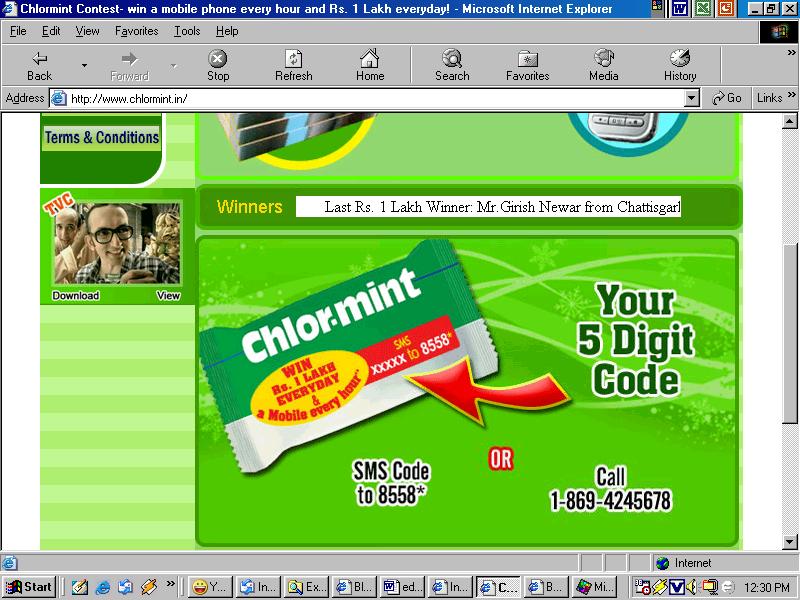 Lastly, we have the 'let me bribe you into buying my brand' variety of advertising. Chlormint, which tried valiantly to be cheeky and cool with its advertising (but did not quite succeed) is going that way.
"Buy a Chlormint and sms the code to 8558. You can win Rs 1 lakh a day and a Nokia phone every hour".
The irony is that the sms will cost more than the Chlormint... which sells for all of 50 paise (ie 1 cent!). It's clear that some brand manager has done complicated calculations to arrive at a winning formula.
My back of the envelope estimate:
30 crore Chlormints being sold with this offer over 2 months. That means around 50 lakh Chlormints a day. At a conservative estimate 3-5% of users will send an sms. Which would work out, on an average to 2 lakh smses.
The cost of sending the sms varies from Rs 1 to Rs 3 (Airtel users are getting fleeced the most!)Of that Chlormint is likely to be getting a revenue share of 40-50%.
Which means the Rs 1 lakh a day giveaway pays back for itself - at the very least. If the amount of smses or % of people who sms is greater, then sone pe suhaaga. Thoda advertising cost bhi cover ho jayega.
It sounds like a lottery scheme to me, which could possibly get Chlormint into trounle. Because as far as I know, in India, only the government is allowed to conduct lotteries (yes, that's terribly weird and rather unethical but we'll get into that another day).
Besides, I see one GIANT loophole in the Chlormint scheme. The lucky number is printed outside the wrapper. I bet smart paanwallahs and kirana store owners around the country will be busy smsing all the numbers on all the Chlormints they have in stock.
The smartest ones would be smsing from Reliance CDMA, which costs only 15 paise!
And finally, what happens when the promo is over? Coz efforts of this kind don't have a lasting effect. So you're back to thinking of more promos. When you should be thinking about creating products people want to buy. And brands, which stand for something.
Subscribe to:
Posts (Atom)