"I hate Hindi ma'am... " is the new refrain at our dinner table.
"She pinches... and hits," says my daughter. Everyone? "Yes, but she hits me more. Because she gives a lot of work and I can't complete it in one period".
For a day or two I thought it was one of those things... it would pass. But today, Nivedita declared she would rather change her school than attend Hindi period with this ma'am. I really will have to do something. But what?
Yes, I will go and meet the principal but will he really take action? There's always the secret fear that your child will end up being treated worse after you complain.
People talk about bad bosses, but there is nothing quite as cruel as a bad teacher. The power a teacher has over a young mind is immense. And this power is often abused by those who are not temperamentally or attitudinally suited to the job.
Teachers who, in fact, see their jobs as mere jobs. And not a responsibility which comes with some sacred covenants.
And parents, who leave no stone unturned to admit their child to a good school. The 'best' school. Who's to say that every teacher in that school is competent as well as sensitive? Because all it takes is one Hindi ma'am...
And all said and done, parents are in a weak position. We pay for the services of a school, we form part of the community. But in most schools, we have little say in the way things are done. Or not done.
The attitude is,"If you have problems here, feel free to take your child elsewhere." Because there are enough contenders for that forsaken seat.
And the same problems pretty much plague schools everywhere. Not municipal schools or government schools but private schools, brand name schools as well.
The Hindi ma'am problem started when the original Hindi teacher - a very personable lady - suddenly quit to join a rival school. In mid-session. Since then there have been 3 different teachers, creating anxiety and confusion.
As one teacher elaborates,"Schools don't want to hire us on a permanent basis. They take in teachers on contract - for 3 months, 6 months." So teachers too have no qualms hopping around. And often, no choice either.
In this merry-go-round, secondary school teachers end up teaching primary kids. Both kinds of teaching require different skills. And completely different levels of patience.
When the school is charging parents a fairly large fee, I see no reason why it should shortchange it teachers - and students - in this manner.
If things do not change, I am wholly willing to yank my daughter out of this school. The question is, are the other choices any different? I guess that is a question that can be answered only after a great deal of R & D.
If the answer remains "no", then the only consolation is "we survived". So will she. It makes me really sad. And mad. But do I have the energy to fight it?
Monday, November 27, 2006


Friday, November 24, 2006
Why D schools are the future
 There is a never ending stream of news about Bschools. For a change, Businessweek.com turns the spotlight on the world's top Dschools ie institutes which teach design.
Although the schools listed are predominantly American, there is healthy international representation. Among institutes of repute from England, Netherlands, Germany, Italy and China, India too gets two well deserved mentions - NID and IDC.
Both deserve to be right up there because they are amazing institutions which have produced some outstanding graduates. I only wish there were more like them! Because there is a huge difference between 'design' and 'art'. In India, we often confuse the two.
Those who study commercial art are basically trained to work in advertising/ media. So they produce campaigns, make artworks, learn typography/ photography/ illustration. Yes, they are talented and creative. But within a given framework.
Design graduates, on the other hand, approach their work differently.
A few years ago, two NID students worked on a project to redesign JAM magazine. For them, the issue was not about tweaking the logo, changing the template and a few fonts. They looked at the magazine at a more fundamental level. From the customer's point of view.
Of course, not all their suggestions could be implemented. But the thinking that went behind the re-design they attempted was remarkable.
The point I am making is that even as b schools proliferate, the need of the hour is D schools. As customers become more demanding, and constantly seek something new and exciting, the importance of product design cannot be over emphasised.
Take the ipod - it's not just a pretty gadget. The clickwheel is a fundamental design choice, one which defines the brand. No, a design genius at Apple did not invent it - someone at a company called Synaptics working for Apple did.
But, you get the idea. Design is mega important. And good design is not just about looks. That's styling. Great design is good looking and provides a better user experience.
Well, the corporate world is realising that the design and business functions need to collaborate at an early stage of the product development cycle. One fallout of this is increased interaction between bschools and dschools.
A course called Strategy for Product and Service Development has been introduced at INSEAD in collaboration with design students from the Art Center in Pasadena . As INSEAD graduate Sameer Agrawal, who now works with GE, recalls
At the start of the class we had to decide what to work on. Each of us had a minute to pitch an idea to develop. You could see the difference.
MBA pitches dwelt on the market: how big it was, how little it had been served. Most designers said: "Here is how I use the product today. Here is why it sucks and how it can be better. Here's how I want to do it.
His perception of designers was: "Here's my product, make it look sexy". Now, he sees see design as "a philosophy that people learn in order to understand how products are used..."
Similarly, Mozilla was searching for a way to make Firefox more popular. The company's 's business development team turned to Stanford University. Not to the bschool but Hasso Plattner Institute of Design on the campus.
The course was team-taught by Stanford profs and industry professionals. Each student worked in a team that included a B-schooler, a computer science major, and a product designer. And each team used design thinking to shape a business plan for Mozilla.
Apparently, it made a big difference.
A B-school class would have started with a focus on market size and used financial analysis to understand it. This D-school class began with consumers and used ethnography, the latest management tool, to learn about them. Business school students would have developed a single new product to sell.
The D-schoolers aimed at creating a prototype with possible features that might appeal to consumers. B-school students would have stopped when they completed the first good product idea. The D-schoolers went back again and again to come up with a panoply of possible winners.
Businessweek notes that the power of this new approach, called design thinking, to promote innovation and open up business opportunities is attracting the
attention of corporations around the globe.
Design has evolved from a narrow discipline dealing with the form and function of products into a major new approach to developing business models. As business increasingly turns to India and China to provide low-cost, high-quality goods and services, companies have to focus on innovation to be competitive.
That driving need makes design thinking the hottest trend in business culture today. If engineering, control, and technology were once the central tenets of business culture, then anthropology, creativity, and an obsession with consumers' unmet needs will inform the future.
The bottom line is, India needs more D schools. A great D school is multi disciplinary - combining engineering, business, design, and social sciences. And hence IITs are ideally placed to house design schools on campus. But while we've seen Schools of Management spring up at all IIT campuses, design has flourished only at IIT B.
IIT Guwahati is the only other IIT with a design school, others have been contemplated starting one but not taken the plunge.
Then there are recent institutes such as Srishti School of Art and Design in Bangalore. But the school, although well reputed, is not considered in the NID/ IDC league.
Although industry does flock to NID and IDC, for some reason, the contribution of these graduates remains underhyped. Bet you can name a dozen IIT or IIM grads but only a couple from NID - if at all. And none from IDC. Is it lack of PR, or humility.
Or a potent combo of both?
Maybe we'll wake up when some foreign company swoops down on NID and offers a $100,000 salary. Actually, salaries are going up... but unfortunately the idea of design as a career will never really catch the fancy of the media. Or the general public.
That's because unlike the MBA - you need to possess something tangible for a design education. That something rare and elusive called 'Talent'.
Thursday, November 23, 2006
Making hay while dotcom shines
The Info Edge IPO has made Sanjeev Bikhchandani India's first dotcom millionaire. Well, at least the first created by a stock exchange listing.
As co-founder of naukri.com Sanjeev currently holds 44% of the company, estimated to be worth Rs 717 crores. The share price, on the first day of listing itself rose 85%,which means there is new confidence in 'dotcom' as a category.
No doubt this news must be exciting for the many many young people out there who have recently embarked upon dotcom ventures. But I do wish to put Sanjeev's success story in perspective. It has taken 16 long years.
Early on, while working at GlaxoSmithkline Sanjeev realised that employees love talking about jobs and career movement. "That jobs are an extremely high interest information category for almost all people and headhunting had tremendous potential".
In his own words
I started out as a partnership firm in 1989, where I was a sleeping partner. By 1990 I had concluded that there was probably a large, highly fragmented database of jobs out there with HR managers and headhunters which, if someone were to aggregate and keep current, would be a very valuable resource.
We set up office in the servant's quarter above the garage in my father's house, paying my father a rent of Rs 800. For the first few years we did salary surveys and built and marketed a database of pharmaceutical trademarks.
Though the company was kept afloat, I was unable to draw a salary and we ran the house on my wife's salary. To meet my personal expenses, I would teach at business schools as visiting faculty on weekends.
It was in response to a Department of Telecom's (DoT) advertisement to launch a videotex service in Delhi that I prepared a database of jobs. It was a pay-to-view model, where initially the employer would be allowed to host his job free and we would earn from the revenue share the DoT would give us. But the project never took off.
But, Sanjeev did not give up...
Turning point
It was on my visit to IT Asia in 1996 that I came to know of the World Wide Web. To register my website and get a domain name, I had to take help from my brother, who lived in the US and has a stake in the company.
The naukri.com site was set up in March 1997 as a division of InfoEdge. What was interesting was that I could not get any domain name I wanted (all such names which had the word job were already registered) and had to settle down with the Hindi term "naukri", which actually makes it different from other jobsites today. At this point I was joined by Anil Lall, the chief technical officer and V N Saroja, chief operating officer.
With the recession, I had to take up a part-time job, but in the same domain area. Between 1996 and 2000, I also worked at The Pioneer. Initially, the consulting editor of Avenues -- the careers supplement of The Pioneer -- I was instrumental in working out an investment package with a consortium of four financial institutions --ICICI, IDBI, IFCI and UTI.
In the morning, I used to work for naukri.com, go to The Pioneer during the day and then get back to naukri.com in the evening.
Naukri.com became profitable from the second year. Eventually, Sanjeev quit the Pioneer and joined naukri.com on a fulltime basis. The firm took in a round of venture capital from ICICI in 2000 and well, the rest is history.
The point is Sanjeev had an idea - but it was a little ahead of its time. It took him 7 years to realise that this idea could work - although in a different form than what was originally imagined.
But the internet was a facilitator. It was not the idea itself. Today, many folks jump into dotcom with offerings that do not serve a strong need. Or a large enough market. The rash of Indian social networking sites is, I think, a case in point.
What's more, how many will stick to the idea they have for 5, 10, 15 years? Constantly looking for new ways and means to make it work??
Another illustrative story is that of Nirmal Jain of India Infoline. He was featured in a recent issue of Businessworld, among India's new billionaires. His 26% holding in the company is worth Rs 215 crores (over Rs 2 billion).But it wasn't a smooth journey for him either.
As the BW article noted:
Nirmal Jain made the biggest gamble of his life in 1999, when he was running Probity Research, a stockmarket research firm with revenues of nearly Rs 1 crore. But Jain was dissatisfied. A steady but small business was no fun. So, he took the huge volumes of research data, their chief source of revenue, and put it on the Internet. Convinced that it was a foolish move, many of his core team members quit.
But Jain had just discovered the power of the Internet. It offered him a bigger scale than his firm could ever reach otherwise. Thus, India Infoline was born in May 1999.
Then came the dotcom bust. Suddenly, all the funding disappeared, the dotcom business was stigmatised and, worse still, the stockmarket also took a downturn. His business was struggling to survive, and it was the darkest time of his life. But Jain was not ready to give up just yet.
He drastically scaled down operations and stripped the profile of all frills, focusing on financial services and e-broking. He went without a salary for nearly a year-and-a-half, trying to keep his company afloat.
Things finally began to look up in 2003, when the market went positive. India infoline’s e-broking platform found many takers, and the company began doing well. It is making consolidated profits of Rs 49 crore today.
Again, a real world business that migrated and scaled up drastically through the power of the internet. And one that required doggedness and perseverance through tough times.
And on a personal note, both Nirmal and Sanjeev are my seniors from IIM A. Although I don't know them, their stories are inspiring. For entrepreneurs like me who have stuck it out... but not yet made billions :)
Those of you thinking of striking out on your own should remember: "Success" may take longer than you anticipate. And the journey itself should be your reward.
Or, you may be in for disappointment.
As co-founder of naukri.com Sanjeev currently holds 44% of the company, estimated to be worth Rs 717 crores. The share price, on the first day of listing itself rose 85%,which means there is new confidence in 'dotcom' as a category.
No doubt this news must be exciting for the many many young people out there who have recently embarked upon dotcom ventures. But I do wish to put Sanjeev's success story in perspective. It has taken 16 long years.
Early on, while working at GlaxoSmithkline Sanjeev realised that employees love talking about jobs and career movement. "That jobs are an extremely high interest information category for almost all people and headhunting had tremendous potential".
In his own words
I started out as a partnership firm in 1989, where I was a sleeping partner. By 1990 I had concluded that there was probably a large, highly fragmented database of jobs out there with HR managers and headhunters which, if someone were to aggregate and keep current, would be a very valuable resource.
We set up office in the servant's quarter above the garage in my father's house, paying my father a rent of Rs 800. For the first few years we did salary surveys and built and marketed a database of pharmaceutical trademarks.
Though the company was kept afloat, I was unable to draw a salary and we ran the house on my wife's salary. To meet my personal expenses, I would teach at business schools as visiting faculty on weekends.
It was in response to a Department of Telecom's (DoT) advertisement to launch a videotex service in Delhi that I prepared a database of jobs. It was a pay-to-view model, where initially the employer would be allowed to host his job free and we would earn from the revenue share the DoT would give us. But the project never took off.
But, Sanjeev did not give up...
Turning point
It was on my visit to IT Asia in 1996 that I came to know of the World Wide Web. To register my website and get a domain name, I had to take help from my brother, who lived in the US and has a stake in the company.
The naukri.com site was set up in March 1997 as a division of InfoEdge. What was interesting was that I could not get any domain name I wanted (all such names which had the word job were already registered) and had to settle down with the Hindi term "naukri", which actually makes it different from other jobsites today. At this point I was joined by Anil Lall, the chief technical officer and V N Saroja, chief operating officer.
With the recession, I had to take up a part-time job, but in the same domain area. Between 1996 and 2000, I also worked at The Pioneer. Initially, the consulting editor of Avenues -- the careers supplement of The Pioneer -- I was instrumental in working out an investment package with a consortium of four financial institutions --ICICI, IDBI, IFCI and UTI.
In the morning, I used to work for naukri.com, go to The Pioneer during the day and then get back to naukri.com in the evening.
Naukri.com became profitable from the second year. Eventually, Sanjeev quit the Pioneer and joined naukri.com on a fulltime basis. The firm took in a round of venture capital from ICICI in 2000 and well, the rest is history.
The point is Sanjeev had an idea - but it was a little ahead of its time. It took him 7 years to realise that this idea could work - although in a different form than what was originally imagined.
But the internet was a facilitator. It was not the idea itself. Today, many folks jump into dotcom with offerings that do not serve a strong need. Or a large enough market. The rash of Indian social networking sites is, I think, a case in point.
What's more, how many will stick to the idea they have for 5, 10, 15 years? Constantly looking for new ways and means to make it work??
Another illustrative story is that of Nirmal Jain of India Infoline. He was featured in a recent issue of Businessworld, among India's new billionaires. His 26% holding in the company is worth Rs 215 crores (over Rs 2 billion).But it wasn't a smooth journey for him either.
As the BW article noted:
Nirmal Jain made the biggest gamble of his life in 1999, when he was running Probity Research, a stockmarket research firm with revenues of nearly Rs 1 crore. But Jain was dissatisfied. A steady but small business was no fun. So, he took the huge volumes of research data, their chief source of revenue, and put it on the Internet. Convinced that it was a foolish move, many of his core team members quit.
But Jain had just discovered the power of the Internet. It offered him a bigger scale than his firm could ever reach otherwise. Thus, India Infoline was born in May 1999.
Then came the dotcom bust. Suddenly, all the funding disappeared, the dotcom business was stigmatised and, worse still, the stockmarket also took a downturn. His business was struggling to survive, and it was the darkest time of his life. But Jain was not ready to give up just yet.
He drastically scaled down operations and stripped the profile of all frills, focusing on financial services and e-broking. He went without a salary for nearly a year-and-a-half, trying to keep his company afloat.
Things finally began to look up in 2003, when the market went positive. India infoline’s e-broking platform found many takers, and the company began doing well. It is making consolidated profits of Rs 49 crore today.
Again, a real world business that migrated and scaled up drastically through the power of the internet. And one that required doggedness and perseverance through tough times.
And on a personal note, both Nirmal and Sanjeev are my seniors from IIM A. Although I don't know them, their stories are inspiring. For entrepreneurs like me who have stuck it out... but not yet made billions :)
Those of you thinking of striking out on your own should remember: "Success" may take longer than you anticipate. And the journey itself should be your reward.
Or, you may be in for disappointment.
Case Study Competition fundas
If you're a bschooler who's participated/ won at a Case Study Competition please get in touch with me. I am particularly interested in knowing about competitions with a decent prize money pile and especially where live cases have been offered by companies. Biz plan contest veterans also welcome.
Secondly, if any of you have worked on a project/ report during your MBA which has been bought by a corporate, let me know. The id is rashmi_b@yahoo.com.
Secondly, if any of you have worked on a project/ report during your MBA which has been bought by a corporate, let me know. The id is rashmi_b@yahoo.com.
Wednesday, November 22, 2006
Raj Thackeray: "Mee more fun"
Civic polls are coming up in March 2007. Which is why all political parties are gunning for the youth. The battle is especially fierce - and visible - outside Chetana college in Bandra (E). 'Bal Thackeray neighbourhood.'
 And here's a novel strategy. From the party which "seeks to project itself as a political force suited to the new era".
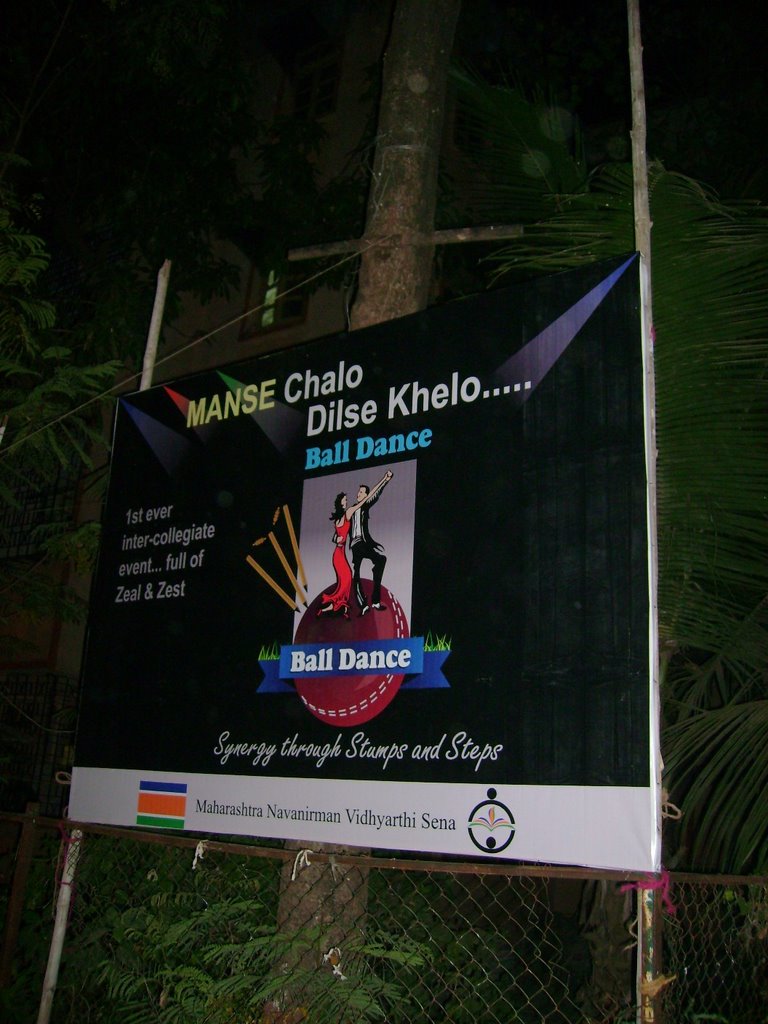
Raj Thackeray's 'Maharashtra Navnirman Sena' has put up little hoardings all over Mumbai advertising Ball Dance - "1st ever inter-collegiate event full of zeal and zest". The picture shows a boy and a girl, in Western outfits, holding each other and... dancing, in ye olde English ballroom dance style.
Ah, just what the youth of the country needs. And so "new era". You see, it is Western, without being vulgar. Which makes the MNS 'different' from the violently-opposed-to-Valentine's-Day Shiv Sena and ABVP types.
A second hoarding clarifies that the competition is actually about dance AND cricket. 'Ball' + 'Dance' - so clever no, wink wink.
Never mind issues - jobs, education, housing and all that jazz. Woh to sabhi politician log bolte hain. Kuch karte nahin. The youth is cynical. Unconvinced by promises, unmoved by rhetoric. So Raj Thackeray is probably being smart in seeking to project his party as 'the fun guys'.
No, this not how it should be. But this is how it is... What next? A kabaddi and karaoke competition by the rival camp?
 And here's a novel strategy. From the party which "seeks to project itself as a political force suited to the new era".
 Raj Thackeray's 'Maharashtra Navnirman Sena' has put up little hoardings all over Mumbai advertising Ball Dance - "1st ever inter-collegiate event full of zeal and zest". The picture shows a boy and a girl, in Western outfits, holding each other and... dancing, in ye olde English ballroom dance style.
Ah, just what the youth of the country needs. And so "new era". You see, it is Western, without being vulgar. Which makes the MNS 'different' from the violently-opposed-to-Valentine's-Day Shiv Sena and ABVP types.
A second hoarding clarifies that the competition is actually about dance AND cricket. 'Ball' + 'Dance' - so clever no, wink wink.
Never mind issues - jobs, education, housing and all that jazz. Woh to sabhi politician log bolte hain. Kuch karte nahin. The youth is cynical. Unconvinced by promises, unmoved by rhetoric. So Raj Thackeray is probably being smart in seeking to project his party as 'the fun guys'.
No, this not how it should be. But this is how it is... What next? A kabaddi and karaoke competition by the rival camp?
Friday, November 17, 2006
Why you should pay notice
The debate started here, with Nirav Mehta writing about two guys from his QA team disappearing without notice. And the recruiting company LioNBridge justifying it. Nirav believes this attitude reflects 'lack of ethics'
Vulturo responded with an impassioned piece on his own blog. His argument is:
Your employees are not your slaves... If you are unable to retain your employees, its your problem. Either you are lousy, or it is that they simply don’t wanna work for you. There’s no way you can force them too. Cribbing about it isn’t going to help either.
The answer to not giving a notice period, according to Vulturo, is that the employer can deduct that month's salary from the employees dues.
Vulturo reflects the attitude of most young workers today. They realise 'we are an asset' and not beholden to anyone for a job. There are plenty of opportunities out there - if I can bend the rules, I do. So what?
Such practices (encouraging the new employees to leave the company without proper notice) are bad for the industry in the long-term. says Ashish, who runs his own company - Tekriti Software. And I, on his side of the fence, would agree.
But the argument I would put forth against not giving a notice is a bit different. I would say follow the rules, out of enlightened self interest.
The world is a complex mesh of relationships. And the working world is no different. At the beginning of your career, it may not be so evident. But 10-15 years down the line you will find that it is the relationships you have built - with bosses, peers, subordinates, even suppliers - which really matter.
In the longer run, it's not just about WHAT you know but WHO you know and what they think of you. Do people trust you? Do they like you? If a background check were to be conducted, would your former employers and co workers refer to you positively?
I am not joking when I say the past comes back to haunt you. Recently, a company in the US contacted me for a reference check on someone who briefly worked with me at JAM. A decade ago. The guy had embellished his CV - claiming to have worked at JAM for 1.5 years when the actual duration was 6 months.
What's more, he did not leave on a good note. Neither did he keep in touch. I sent a one liner back, with his actual period of employment, as an answer. I don't know if my one line affected his career or not - frankly I don't care.
Similarly, I find many of the people who have worked with JAM come back requiring recommendation letters when they apply to universities abroad. Or even ISB. And I have, as a policy, decided I will give these letters only to those who I feel good about.
After all, a recommendation letter is not a right but a privilege.
What I am saying is that neither Infosys, nor Nirav's company or Ashish's or mine can stop attrition. People are free to choose employment as and where they wish. Yes, we will all work towards the three important points which Vulture mentioned:
- Brand Value
- Job Content, Ownership, Work Environment (and other unquantifiable attributes)
- Remuneration
But a notice period is above and beyond all this.
Leaving without notice period, to my mind, reflects lack of common courtesy. And it is a behaviour that we as a company do not encourage. If you were already employed somewhere, but willing to join me tomorrow, I would look at it in an unfavourable light.
Other companies are free to have their own policies. And you are free to behave boorishly if you wish. But ten years from now, you may regret this impulsive behaviour.
"Every action has an equal and opposite reaction", as Newton once said. It may take a long time for the other party to find an opportunity to react but destiny generally provides for one.
I mean, God forbid if you harbour dreams of starting your own company... Your former boss - who you so unceremoniously walked out on - is now the CEO of a large company. Which could have been a potential client.
The guy who ended up doing all your work when you scampered off? He ended up at Wharton and is now a venture capitalist you're chasing. Without much success.
And the very notice period you once disdained, is now something you expect from those working with you. In fact, it's a cause you're passionate about :)
So, collect good karma and maintain that positive vibe. Isi mein samjhdaari hai, aur success bhi.
Vulturo responded with an impassioned piece on his own blog. His argument is:
Your employees are not your slaves... If you are unable to retain your employees, its your problem. Either you are lousy, or it is that they simply don’t wanna work for you. There’s no way you can force them too. Cribbing about it isn’t going to help either.
The answer to not giving a notice period, according to Vulturo, is that the employer can deduct that month's salary from the employees dues.
Vulturo reflects the attitude of most young workers today. They realise 'we are an asset' and not beholden to anyone for a job. There are plenty of opportunities out there - if I can bend the rules, I do. So what?
Such practices (encouraging the new employees to leave the company without proper notice) are bad for the industry in the long-term. says Ashish, who runs his own company - Tekriti Software. And I, on his side of the fence, would agree.
But the argument I would put forth against not giving a notice is a bit different. I would say follow the rules, out of enlightened self interest.
The world is a complex mesh of relationships. And the working world is no different. At the beginning of your career, it may not be so evident. But 10-15 years down the line you will find that it is the relationships you have built - with bosses, peers, subordinates, even suppliers - which really matter.
In the longer run, it's not just about WHAT you know but WHO you know and what they think of you. Do people trust you? Do they like you? If a background check were to be conducted, would your former employers and co workers refer to you positively?
I am not joking when I say the past comes back to haunt you. Recently, a company in the US contacted me for a reference check on someone who briefly worked with me at JAM. A decade ago. The guy had embellished his CV - claiming to have worked at JAM for 1.5 years when the actual duration was 6 months.
What's more, he did not leave on a good note. Neither did he keep in touch. I sent a one liner back, with his actual period of employment, as an answer. I don't know if my one line affected his career or not - frankly I don't care.
Similarly, I find many of the people who have worked with JAM come back requiring recommendation letters when they apply to universities abroad. Or even ISB. And I have, as a policy, decided I will give these letters only to those who I feel good about.
After all, a recommendation letter is not a right but a privilege.
What I am saying is that neither Infosys, nor Nirav's company or Ashish's or mine can stop attrition. People are free to choose employment as and where they wish. Yes, we will all work towards the three important points which Vulture mentioned:
- Brand Value
- Job Content, Ownership, Work Environment (and other unquantifiable attributes)
- Remuneration
But a notice period is above and beyond all this.
Leaving without notice period, to my mind, reflects lack of common courtesy. And it is a behaviour that we as a company do not encourage. If you were already employed somewhere, but willing to join me tomorrow, I would look at it in an unfavourable light.
Other companies are free to have their own policies. And you are free to behave boorishly if you wish. But ten years from now, you may regret this impulsive behaviour.
"Every action has an equal and opposite reaction", as Newton once said. It may take a long time for the other party to find an opportunity to react but destiny generally provides for one.
I mean, God forbid if you harbour dreams of starting your own company... Your former boss - who you so unceremoniously walked out on - is now the CEO of a large company. Which could have been a potential client.
The guy who ended up doing all your work when you scampered off? He ended up at Wharton and is now a venture capitalist you're chasing. Without much success.
And the very notice period you once disdained, is now something you expect from those working with you. In fact, it's a cause you're passionate about :)
So, collect good karma and maintain that positive vibe. Isi mein samjhdaari hai, aur success bhi.
Thursday, November 16, 2006
JAM Engineering College Survey - III
The ambitious task we undertook of rating 300-400 engineering colleges based primarily on student feedback is well under way.
As I mentioned before, this task can only be satisfactorily completed with your help and support. Over 2000 of you have filled out our questionnaire, several of you have also helped in getting your friends, batchmates, juniors and seniors to do so. The url, once again is www.jammag.com/engg.
Your college can be included ONLY if we get a minimum of 30 valid responses. So far only about 25 colleges have reached that magic number and about 50 are half way there.
Which is why I am appealing to the rest of you, to help us spread the word. Become a JAM SURVEY EVANGELIST.
What's in it for you? You will get a referral code when you forward our survey to yor class/ department/ college/ company egroup. If at least 10 of those bandas/ bandis fill out the form you will get a T shirt as a token of our appreciation. There is a referral code to help us track this :)
In addition, we are looking for REGIONAL SURVEY CO-ORDINATORS
This will be a paid position and will involve the same work but spread over a much wider list of colleges. ie. You could help us to get the survey completed through your friends/ contacts in all colleges in West Bengal, Andhra Pradesh or Tamil Nadu.
Again, it's more of an online based job but we're looking for folks who pride themselves as networkers. The kind with bulging IM and Orkut lists :)
For either position please email me at rashmi_b@yahoo.com. My colleague Namrata, who currently eats, sleeps and breathes this project, will send you the necessary details.
Lastly, we are looking for short write ups on the various branches of engineering.
eg What is mechanical, what do you actually study. What did you like/ hate about it. Possibility of joining a core job. Prospect of going abroad/ switching fields. Basically an intro to each branch of engineering from you, who have actually spent time studying the subject. Written in an informal non-Education Times vein.
The articles should be around 500-700 words and could be from current students or graduates, even the older variety. A small sum will be paid to you for each article selected for publication in the book.
But please first email me and get a green signal to begin work. This is to prevent multiple write ups on the same topic.
Please put in your subject line which of the above 3 opportunities you're interested in. More than one is possible but do commit only if you are committed!
As I mentioned before, this task can only be satisfactorily completed with your help and support. Over 2000 of you have filled out our questionnaire, several of you have also helped in getting your friends, batchmates, juniors and seniors to do so. The url, once again is www.jammag.com/engg.
Your college can be included ONLY if we get a minimum of 30 valid responses. So far only about 25 colleges have reached that magic number and about 50 are half way there.
Which is why I am appealing to the rest of you, to help us spread the word. Become a JAM SURVEY EVANGELIST.
What's in it for you? You will get a referral code when you forward our survey to yor class/ department/ college/ company egroup. If at least 10 of those bandas/ bandis fill out the form you will get a T shirt as a token of our appreciation. There is a referral code to help us track this :)
In addition, we are looking for REGIONAL SURVEY CO-ORDINATORS
This will be a paid position and will involve the same work but spread over a much wider list of colleges. ie. You could help us to get the survey completed through your friends/ contacts in all colleges in West Bengal, Andhra Pradesh or Tamil Nadu.
Again, it's more of an online based job but we're looking for folks who pride themselves as networkers. The kind with bulging IM and Orkut lists :)
For either position please email me at rashmi_b@yahoo.com. My colleague Namrata, who currently eats, sleeps and breathes this project, will send you the necessary details.
Lastly, we are looking for short write ups on the various branches of engineering.
eg What is mechanical, what do you actually study. What did you like/ hate about it. Possibility of joining a core job. Prospect of going abroad/ switching fields. Basically an intro to each branch of engineering from you, who have actually spent time studying the subject. Written in an informal non-Education Times vein.
The articles should be around 500-700 words and could be from current students or graduates, even the older variety. A small sum will be paid to you for each article selected for publication in the book.
But please first email me and get a green signal to begin work. This is to prevent multiple write ups on the same topic.
Please put in your subject line which of the above 3 opportunities you're interested in. More than one is possible but do commit only if you are committed!
Tuesday, November 14, 2006
"They showed no remorse"
Standing in a pool of blood, near seven freshly dead bodies, they threatened the survivors. Three of them tried to wrench off the number plate of the car before giving up and scooting from the scene of the accident.
21 year old Alister Pereira's drunken driving disaster has shocked and ughed Mumbai. Accidents happen, we all know. But this? 'Another case of spoilt young brats bereft of values'.
"We didn't mean to do it, but hey..." They were just a bunch of labourers, y'know. How hard will it be to buy our way out of it?
You feel disgusted when you read those words, but it's the plain and ugly truth. In 1999, 21 year old Sanjeev Nanda ran over and killed 6 people. Including 3 policemen! He was drunk and at the wheel of an unregistered BMW.
Witnesses and families of the dead were paid off. The wheels of justice decided to halt and let Sanjeev and his friends alight. Unscathed.
And, four years after Salman Khan's famous 'hit and run' accident, he is none the worse for the wear. His rash driving, possibly under the influence of alcohol, killed one person and injured four.
A trial began. It drags on. A key witness has turned hostile. Some have 'disappeared'. For all practical purposes, Salman is a free man. As Alister can soon hope to be. Remorse, or no remorse, money and influence will bail him out.
And there will be more Sanjeevs and Salmans and Alisters. Unless justice is delivered without regard to who you are and how fat your wallet is.
The conviction of Priyadarshini Mattoo's killer is one such landmark case. But can the media and the family pursue justice so doggedly every time?
They were just labourers, after all...
21 year old Alister Pereira's drunken driving disaster has shocked and ughed Mumbai. Accidents happen, we all know. But this? 'Another case of spoilt young brats bereft of values'.
"We didn't mean to do it, but hey..." They were just a bunch of labourers, y'know. How hard will it be to buy our way out of it?
You feel disgusted when you read those words, but it's the plain and ugly truth. In 1999, 21 year old Sanjeev Nanda ran over and killed 6 people. Including 3 policemen! He was drunk and at the wheel of an unregistered BMW.
Witnesses and families of the dead were paid off. The wheels of justice decided to halt and let Sanjeev and his friends alight. Unscathed.
And, four years after Salman Khan's famous 'hit and run' accident, he is none the worse for the wear. His rash driving, possibly under the influence of alcohol, killed one person and injured four.
A trial began. It drags on. A key witness has turned hostile. Some have 'disappeared'. For all practical purposes, Salman is a free man. As Alister can soon hope to be. Remorse, or no remorse, money and influence will bail him out.
And there will be more Sanjeevs and Salmans and Alisters. Unless justice is delivered without regard to who you are and how fat your wallet is.
The conviction of Priyadarshini Mattoo's killer is one such landmark case. But can the media and the family pursue justice so doggedly every time?
They were just labourers, after all...
Friday, November 10, 2006
Mood I gets Rs 75 lakhs sponsorship: for what?
 TOI reports: Mood Indigo - which is due to take place from Dec 26-29 - has garnered a healthy Rs 75 lakh sponsorship so far. This outstrips the nearest rival, IIT Delhi by 50%.
I find this news a bit disconcerting. I mean, just last year, Mood I created a record by attracting Rs 50 lakhs in sponsorship money. As recently as 2002, Mood I made do with Rs 34 lakhs sponsorship. Now, with more than double the budget in 4 years, how much 'bigger and better' can we expect it to get?
The USP of IIT fests over local college fests is the pro-nites, where students can expect top quality artistes to perform. eg Indian Classical Nite, Indipop Nite, Professional Play performance and LiveWire, the rock competition where pro bands also perform. There are artiste fees as well as light, sound and stage costs.
Mood I also gives better cash prizes (Rs 3 lakhs) last year.
So yes, a Mood I certainly requires a bigger budget than say, a Malhar or an Umang. But in 2002 - with Rs 34 lakhs - we had a successful Mood I. Take inflation into account, or the desire to do something more, and I can see the budget going up by 10-20%.
This 50% jump in a single year? Astounding.
Caveat emptor
Now IIT Bombay can very well say hey, if sponsors are willing to pay us this money, what's your problem? So here's a bit of free advice to these companies - do take a more careful look at what exactly you are buying.
While Mood I may be the college fest with the most extravagant scale, does it really deliver on numbers. The organisers claim it attracts 50,000 students a year. But how true is that claim?
Overall, I would estimate at max 20,000 unique visitors. Break up as follows:
IIT- B students : 4000 in number and fairly immune to advertising. (and 10-20% 'go home' during the fest period!).
Outstation participants: 3000-4000 in number (my guesstimate, and this is on the generous side).
Local participants: 3000-4000 per day. More on the day of Livewire.
The local participation is where Mood I miserably fails to make an impact. Ask a random college student if he/ she is going to Mood I and chances are you will hear the answer "no".
Various reasons given:
- IIT is too far
- It's the fag end of the year - already attended many fests
- We're having vacations
- The place is not so happening during the day
Of course, die hard fest types do attend, esp those into literary events. And pro nites attract crowd, but again in limited numbers. The 'aam' college student whom sponsors would like to connect with are more likely to have attended the likes of Malhar, Umang or their own college festival.
Never mind if it did not attract folks from all over India, or even all over the city. But 5000-6000 eyeballs are there to be addressed and you can be the title sponsor of 15-20 such festivals for Rs 75 lakhs.
With the same money you can reach out to over 1 lakh students - 5 times what I estimate you reach through Mood I. And these are students who are more brand conscious, who spend more on everything from cellphones to branded apparel. College name be damned.
Yet sponsors would rather plonk their money with a single prestigious festival.
So, good for IIT Bombay. And good luck to the BPO company which is one of the major sponsors of Mood I. Coz I doubt if anyone attending Mood I fits their target audience!
Lastly, I am under the impression that all the money raised towards IIT fests is used towards the event organisation. That's how it used to be. Maybe times have changed and some of the cash goes in the institute corpus, towards improving infrastructure etc.
In which case it's festival as an excuse for fund raising - fair enough. However, that's not the impression one gets from the TOI report.
One final observation: I noticed from the Mood I website that outstation participants are being charged for their accomodation. The deposit for the 'mattress and bucket' is Rs 400, of which Rs 100 is refundable if you leave on the specified date and without damaging any property.
You also have to pay for your own food, at a nominal rate, but never the less.
Pataa nahin bhai, jis zamaane mein hum outstation fests mein jaate the... we paid for nothing more than our train tickets. Guess 'hospitality' is not dependent on how big your budget is!
Wednesday, November 08, 2006
Like.com - a really big idea!
New technology is great. But figuring how this technology can actually make a difference to people's lives - and therefore acquire monetary value - is not always easy.
Riya.com is one such fascinating story. A few months ago, I heard of this guy - Munjal Shah - who had developed a 'face recognition' software. It sounded like a cool thing, but I never tried downloading or using or finding out more about it.
I mean I mentally bookmarked it as 'must try one day' because the thought of organising my digital photos weighs on my mind every now and then. But I just never get around to it.
But that was Riya 1.0. Ten months later, this post by Peter Rip of Crosslink Capital (which funded Riya) makes perfect sense:
... we had to have a sound business model... Munjal knew first-hand the mortality rate of dot-coms (and more recent social networking and photo sites) that preceded him. We have one and it will be apparent in due course.
Well, here it is. And what a superb and unique model! Riya has just launched a website called Like.com.
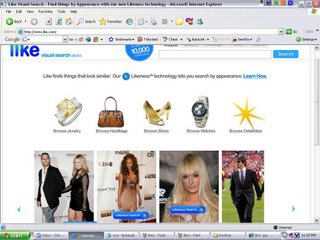 Like.com is the world's first visual search engine. We focused visual search on items that are hard to describe linguistically. Like solves this problem. All you have to do is a "Likeness search" on a photo and Like will show you items that look similar.
And here's the real consumer insight. Millions of people around the world want to buy stuff they've seen other people wearing. And especially celebrities. But searching for something like the 'shoe that Paris Hilton wore at the London Fashion Week day 2' is impossible. Or well, it used to be.
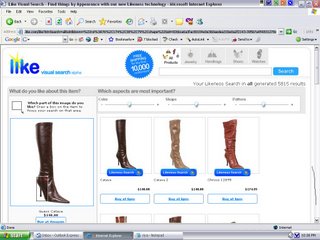 Like.com lets you do that - and more. You can actually zoom in on a particular feature of a shoe you like - such as the heel - and ask to find something similar. And boy, does it work. I tried a few searches and the results were amazing!
What's more, in some time Like.com will allow you to upload your own photos and search for similar stuff available.
Like.com is smartly focussing on jewellery, shoes , handbags and watches - stuff that does not require trial and which millions do buy online already.
Of course hum bechare Indians ka koi khaas fayda nahin hai. I mean Indian women, for all their love of fashion, are not yet into high end handbags or shows in large enough numbers. And definitely, not online.
But who knows, in the longer run? Or even, now for that matter.
If I were an Indian retailer like Globus or Shopper's Stop or even a smaller boutique on Hill Road it would make sense to digitise a large part of my
inventory. Even if I don't sell online I might attract buyers to my shop coz they know I have a style/ item they have found through photo search.
Stores like Roopam targetting the NRI wedding market will definitely benefit. Not only do they have a rather extensive catalogue
they sell online as well.
I am sure there would be tons of women searching for outfits similar to Aishwarya's in Umaro Jaan right now :). In fact the volume of search for a particular item would indicate how much consumer demand there is for it. And a smart retailer could stock up accordingly.
Lastly, like.com will make life more difficult for desi fashion designers. One click and we'll be able to see the source of 'inspiration' for their latest collection. Even if it's an obscure Moroccan designer they've copied stitch by stitch!
Bottomline is, I like Like.com, even though I can't really use it yet. It adds something unique to the internet user experience, and solves a real problem. One which I could not even articulate but which existed nevertheless!
And, it's what you can really call an advance in technology. Which is more than can be said of most web applications which are simply me-toos.
Besides, the possibilities of how the software can be used are endless. Because a picture speaks more than a thousand words. And across languages and cultures! I bet there's lots more in store.
Riya.com is one such fascinating story. A few months ago, I heard of this guy - Munjal Shah - who had developed a 'face recognition' software. It sounded like a cool thing, but I never tried downloading or using or finding out more about it.
I mean I mentally bookmarked it as 'must try one day' because the thought of organising my digital photos weighs on my mind every now and then. But I just never get around to it.
But that was Riya 1.0. Ten months later, this post by Peter Rip of Crosslink Capital (which funded Riya) makes perfect sense:
... we had to have a sound business model... Munjal knew first-hand the mortality rate of dot-coms (and more recent social networking and photo sites) that preceded him. We have one and it will be apparent in due course.
Well, here it is. And what a superb and unique model! Riya has just launched a website called Like.com.
 Like.com is the world's first visual search engine. We focused visual search on items that are hard to describe linguistically. Like solves this problem. All you have to do is a "Likeness search" on a photo and Like will show you items that look similar.
And here's the real consumer insight. Millions of people around the world want to buy stuff they've seen other people wearing. And especially celebrities. But searching for something like the 'shoe that Paris Hilton wore at the London Fashion Week day 2' is impossible. Or well, it used to be.
 Like.com lets you do that - and more. You can actually zoom in on a particular feature of a shoe you like - such as the heel - and ask to find something similar. And boy, does it work. I tried a few searches and the results were amazing!
What's more, in some time Like.com will allow you to upload your own photos and search for similar stuff available.
Like.com is smartly focussing on jewellery, shoes , handbags and watches - stuff that does not require trial and which millions do buy online already.
Of course hum bechare Indians ka koi khaas fayda nahin hai. I mean Indian women, for all their love of fashion, are not yet into high end handbags or shows in large enough numbers. And definitely, not online.
But who knows, in the longer run? Or even, now for that matter.
If I were an Indian retailer like Globus or Shopper's Stop or even a smaller boutique on Hill Road it would make sense to digitise a large part of my
inventory. Even if I don't sell online I might attract buyers to my shop coz they know I have a style/ item they have found through photo search.
Stores like Roopam targetting the NRI wedding market will definitely benefit. Not only do they have a rather extensive catalogue
they sell online as well.
I am sure there would be tons of women searching for outfits similar to Aishwarya's in Umaro Jaan right now :). In fact the volume of search for a particular item would indicate how much consumer demand there is for it. And a smart retailer could stock up accordingly.
Lastly, like.com will make life more difficult for desi fashion designers. One click and we'll be able to see the source of 'inspiration' for their latest collection. Even if it's an obscure Moroccan designer they've copied stitch by stitch!
Bottomline is, I like Like.com, even though I can't really use it yet. It adds something unique to the internet user experience, and solves a real problem. One which I could not even articulate but which existed nevertheless!
And, it's what you can really call an advance in technology. Which is more than can be said of most web applications which are simply me-toos.
Besides, the possibilities of how the software can be used are endless. Because a picture speaks more than a thousand words. And across languages and cultures! I bet there's lots more in store.
Tuesday, November 07, 2006
Wanted : fundas on importing from China
Am looking to import a reasonably large quantity of tech-related novelty items from China/ Taiwan. If anyone out there has experience of the same - and especially through alibaba.com - do get in touch with me at rashmi_b@yahoo.com!
Bigg Boss: You'll soon be watching
Seven years after 'Big Brother' debuted in Netherlands, the series hits India. Of course, it's been suitably 'Indianised'.
a) The name has been changed to 'Bigg Boss' . I guess the Orwellian connotation of 'Big Brother' would be lost in a country where bade bhaiyya is generally a benvolent and I-will-take-care-of-you type figure.
And the extra 'g' in Big is a nod to numerology - a fixation in Indian television that refuses to go away!
b) Instead of ordinary unknowns, we have a houseful of small time actors , fading/ faded models and a couple of novelty items. So it's essentially an Indian version of Big Brother VIP.
Now this I think was a smart move because until now, so called 'reality shows' have really been talent shows. Indian Idol, Fame Gurukul, Sa re ga ma - all of them promise to make a star out of an unknown quantity.
That's a sentiment the Indian viewer can identify with, and the tears and drama that go along with the format are an added bonus. But at the end of the day, the person who wins is judged on performance. Kisi ko life mein aagey badhne ka chance milta hai..
Big Brother/ Bigg Boss is a far more faltu concept - it's pure voyeurism. For viewers to get hooked to a bunch of unknowns would not be impossible but would be far more risky from a TRP point of view. Here, when you cast a Rakhi Sawant and a Bobby Darling not to mention Carol 'LIFW wardrobe malfunction' Gracias ) you know idiotic antics will occur.
And there - you have your 'real life soap opera'.
The question is - have they been given 'scripts' or is it all completely natural? Well, as the official website declares:
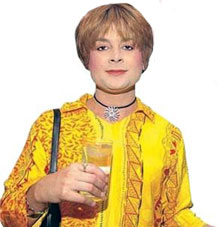 Bobby is perhaps Bigg Boss’s most controversial contestants. Openly gay he is sure to court much attention through his loud personality and his need for constant attention. One thing if for sure, if an over exuberant Bobby Darling starts arguing with a tired and cross Rakhi Sawant, then fireworks will fly and the Bigg Boss producers might just have some entertainment coming their way.
That’s probably why he was invited on in the first place.
But I suspect the more staid participants have been given broad outlines of the characters they must play. Although not actual lines to deliver.
So Aryan Vaid may be a flirt in real life but he's also probably been instructed to keep up the good work. The bit about him 'proposing' to Anupama Varma, and Kashmira Shah's sob story of how she used to get a 'rotten orange' for Xmas because her mother was too poor... methinks yeh sab pehle se hi planned tha.
So yes, I sat through an entire episode last night. And to be honest, the two specimens - Rakhi Sawant and Bobby Darling - were the most interesting. In a gosh, how-much-more-stupid can they get?
 I know now that the Rakhi babe has two tattoos - one on her arm and one on her stomach. She takes her role as an item girl really seriously and is not averse to dancing in front of a cow in the hope that the animal will get excited enough to give out some milk (one of the tasks assigned by Bigg Boss to the contestants).
Bobby on the other hand is a beautiful porcelain doll with a gruff voice. He/ she/ whatever has appealed to viewers not to be voted out because he/ she really needs the money for a sex change operation.
Not to worry because Deepakji is really not likable from any point of view and will definitely be shown out.
Expect some controversy!
Although Big Brother has been a hit in close to 70 countries, there are cultural nuances when it comes to 'success':
Some versions have been filled with sex-crazed housemates, whereas others decided to base the conflict within their programs around difficult or romantic personalities, as in Brazil, Mexico, Thailand, Philippines or Spain.
With the passing of time, it has been demonstrated that the most successful versions were the ones that emulated a soap opera, whereas the versions where the principal attraction was sex have been eliminated, as in Hungary or Poland.
The amount of sex shown on the televised versions around the world depends on local and national television censorship rules, with some countries editing out all sex and nudity, while others broadcast what is considered to be borderline pornography.
Now we know in India, sex will definitely NOT be shown but am sure it will occur and be alluded to in some way. The participants were all asked to take HIV tests before the show began to create some hype on that front, you see.
Controversy is the best way to raise awareness - and TRPs. And around 4-5 weeks into the series I am sure one will be created. The likes of Sushma Swaraj and Pratibha Naithani need just a little bit of flame to get down on the streets and start a 'fire'.
So needle them gently with some sex or nudity on air and voila, they will demand a ban on the show. "Yeh Bhartiya sanskriti ke khilaaf hai" - and there you have it. Millions of eyeballs will immediately be added on to Bigg Boss!
Leap of faith
At the end of the day, Sony - which is now trailing behind both Star and Zee - had to take a risk. Their last 'success' was Jassi Jaisi Koi Nahin, since then nothing has really clicked.
Zee has taken the route of beating Star at its saas-bahu game. Goodbye Parvati and Tulsi, every auntie I know is currently hooked to the saga of Saloni (Saat Phere) and Jai/ Bani (Kasamh Se).
I caught an episode of Saat Phere last night. It rivals Chronicles of Narnia in the fantasy department. Mohan Bhandari is sitting on the sofa when the bahu comes and asks, 'Papaji mujhe bachche ke liye nappies kharidni hain. Kuch paise chahiye".
Papaji looks away. Neena Gupta aunty pipes in,"Hum bachche ke liye potliyaan silenegey... Aise hi nahin itne bachche bade kiye".
Apparently the family does not have enough money to buy nappies but the women sit there, resplendent in silks and laden with jewellery in a house whose living room rivals the lobby of a 3 star hotel.
So the choice is fantasy staged in true blue soaps or 'reality' staged in a neo-soap like Big Boss.
I think the youth of India will prefer the latter. It remains to be seen however, if they will manage to snatch away the television remote.
Bottomline: Bigg Boss may be trivial, perfectly "yeww" in parts. But even discussing how much you supposedly hate it... is fodder for canteen conversation. And in a have-voice-will-give-opinion era, no one wants to be left out!
Sony Entertainment Television, Mon-Fri, 10 pm
a) The name has been changed to 'Bigg Boss' . I guess the Orwellian connotation of 'Big Brother' would be lost in a country where bade bhaiyya is generally a benvolent and I-will-take-care-of-you type figure.
And the extra 'g' in Big is a nod to numerology - a fixation in Indian television that refuses to go away!
b) Instead of ordinary unknowns, we have a houseful of small time actors , fading/ faded models and a couple of novelty items. So it's essentially an Indian version of Big Brother VIP.
Now this I think was a smart move because until now, so called 'reality shows' have really been talent shows. Indian Idol, Fame Gurukul, Sa re ga ma - all of them promise to make a star out of an unknown quantity.
That's a sentiment the Indian viewer can identify with, and the tears and drama that go along with the format are an added bonus. But at the end of the day, the person who wins is judged on performance. Kisi ko life mein aagey badhne ka chance milta hai..
Big Brother/ Bigg Boss is a far more faltu concept - it's pure voyeurism. For viewers to get hooked to a bunch of unknowns would not be impossible but would be far more risky from a TRP point of view. Here, when you cast a Rakhi Sawant and a Bobby Darling not to mention Carol 'LIFW wardrobe malfunction' Gracias ) you know idiotic antics will occur.
And there - you have your 'real life soap opera'.
The question is - have they been given 'scripts' or is it all completely natural? Well, as the official website declares:
 Bobby is perhaps Bigg Boss’s most controversial contestants. Openly gay he is sure to court much attention through his loud personality and his need for constant attention. One thing if for sure, if an over exuberant Bobby Darling starts arguing with a tired and cross Rakhi Sawant, then fireworks will fly and the Bigg Boss producers might just have some entertainment coming their way.
 That’s probably why he was invited on in the first place.
But I suspect the more staid participants have been given broad outlines of the characters they must play. Although not actual lines to deliver.
So Aryan Vaid may be a flirt in real life but he's also probably been instructed to keep up the good work. The bit about him 'proposing' to Anupama Varma, and Kashmira Shah's sob story of how she used to get a 'rotten orange' for Xmas because her mother was too poor... methinks yeh sab pehle se hi planned tha.
So yes, I sat through an entire episode last night. And to be honest, the two specimens - Rakhi Sawant and Bobby Darling - were the most interesting. In a gosh, how-much-more-stupid can they get?
 I know now that the Rakhi babe has two tattoos - one on her arm and one on her stomach. She takes her role as an item girl really seriously and is not averse to dancing in front of a cow in the hope that the animal will get excited enough to give out some milk (one of the tasks assigned by Bigg Boss to the contestants).
Bobby on the other hand is a beautiful porcelain doll with a gruff voice. He/ she/ whatever has appealed to viewers not to be voted out because he/ she really needs the money for a sex change operation.
Not to worry because Deepakji is really not likable from any point of view and will definitely be shown out.
Expect some controversy!
Although Big Brother has been a hit in close to 70 countries, there are cultural nuances when it comes to 'success':
Some versions have been filled with sex-crazed housemates, whereas others decided to base the conflict within their programs around difficult or romantic personalities, as in Brazil, Mexico, Thailand, Philippines or Spain.
With the passing of time, it has been demonstrated that the most successful versions were the ones that emulated a soap opera, whereas the versions where the principal attraction was sex have been eliminated, as in Hungary or Poland.
The amount of sex shown on the televised versions around the world depends on local and national television censorship rules, with some countries editing out all sex and nudity, while others broadcast what is considered to be borderline pornography.
Now we know in India, sex will definitely NOT be shown but am sure it will occur and be alluded to in some way. The participants were all asked to take HIV tests before the show began to create some hype on that front, you see.
Controversy is the best way to raise awareness - and TRPs. And around 4-5 weeks into the series I am sure one will be created. The likes of Sushma Swaraj and Pratibha Naithani need just a little bit of flame to get down on the streets and start a 'fire'.
So needle them gently with some sex or nudity on air and voila, they will demand a ban on the show. "Yeh Bhartiya sanskriti ke khilaaf hai" - and there you have it. Millions of eyeballs will immediately be added on to Bigg Boss!
Leap of faith
At the end of the day, Sony - which is now trailing behind both Star and Zee - had to take a risk. Their last 'success' was Jassi Jaisi Koi Nahin, since then nothing has really clicked.
Zee has taken the route of beating Star at its saas-bahu game. Goodbye Parvati and Tulsi, every auntie I know is currently hooked to the saga of Saloni (Saat Phere) and Jai/ Bani (Kasamh Se).
I caught an episode of Saat Phere last night. It rivals Chronicles of Narnia in the fantasy department. Mohan Bhandari is sitting on the sofa when the bahu comes and asks, 'Papaji mujhe bachche ke liye nappies kharidni hain. Kuch paise chahiye".
Papaji looks away. Neena Gupta aunty pipes in,"Hum bachche ke liye potliyaan silenegey... Aise hi nahin itne bachche bade kiye".
Apparently the family does not have enough money to buy nappies but the women sit there, resplendent in silks and laden with jewellery in a house whose living room rivals the lobby of a 3 star hotel.
So the choice is fantasy staged in true blue soaps or 'reality' staged in a neo-soap like Big Boss.
I think the youth of India will prefer the latter. It remains to be seen however, if they will manage to snatch away the television remote.
Bottomline: Bigg Boss may be trivial, perfectly "yeww" in parts. But even discussing how much you supposedly hate it... is fodder for canteen conversation. And in a have-voice-will-give-opinion era, no one wants to be left out!
Sony Entertainment Television, Mon-Fri, 10 pm
Monday, November 06, 2006
4 stars to 'The Departed'
 The name 'Martin Scorcese' was a familiar one but to be honest, I had never actually seen a film made by him. "The Departed" was a first and it certainly won't be the last.
It's a film which takes the movie-set-in-a-mafia milieu to a new level. Instead of a cops vs robbers story, it's a tale of two cops - Billy Costigan (Leonardo di Caprio) and Jack Sullivan (Matt Damon).
Costigan is the 'good guy' who is convinced that he will serve his country better by getting chucked out of the police force. Thing is, he has the perfect 'family background' - crime inclined cousins and an uncle who once worked for mafia boss Frank Costello (Jack Nicholson). So he makes a convincing entry into life on the other side of the tracks, although actually operating as an undercover.
Sullivan, on the other hand, appears to be the classic good guy but is not. He owes a childhood debt to Costello, who was 'like a father' to him. When he joins the state police force, his allegiance is clearly elsewhere.
The fun begins when both sides realise there is a mole on the other side but don't know who. There are many classic 'Hindi movie' moments like for example, both guys falling for the same girl. And Sullivan being made in charge of finding the mole in the police department a.k.a. himself!
Complication: The only two people who know Costigan's real identity are Captain Queenan (Martin Sheen) and Sergeant Dignam (Mark Wahlberg). One dies, the other resigns. Our man is out in the cold, without an identity. Without giving anything more away, lemme just say you will be hooked to the twists and turns in the film.
There is a lot of violence, throughout. The scene where Costello and his men break Costigan's already broken arm to check if he is carrying a wire is truly chilling.
Even then, the final 10 minutes come as a surprise although considering the title of the movie- they shouldn't!
Concepts like 'good' and 'evil' get turned around on their head and in such a scenario, you can scarcely expect a happy ending.
The director's touch is evident - the film remains taut and never get cheesy. Leonardo 'babyface' di Caprio has grown up - and how. I can finally think of him without automatically associating the word 'titanic'. Mark Wahlberg as the foul-mouthed sergeant is extremely good and Jack Nicholson, of course, outstanding. Actually, all of the actors are excellent.
The most interesting thing is that 'The Departed' is a remake of the Hong Kong film 'Infernal Affairs'. Yet, those who have seen both say there definitely is 'originality' in this version. Looks like Scorcese is walking a path similar to that of Indian directors remaking old classics like Don, Umrao Jaan etc.
'The Departed' is of course a cross cultural transplantation but the trend is to take an idea and refine it/ give it your own unique touch. For example, setting the story in Boston, with an Irish mafia - as opposed to New York and its done-to-death Italian gangs. Of course, there will be people who prefer this or that version .
The point is, we could well have an Indian director also doing the honours.. coz neither the Chinese or English versions will reach the Indian masses.
An aside
I happened to see 'The Departed' on a Saturday night at Cathay Cine Leisure. The ticket at this upscale theatre on Singapore's Orchard Road cost $ 9 SGD. ie approximately Rs 250. This is the same price at which you'd get a ticket at INOX or PVR on a Saturday nite.
But consider the fact that 1 Singapore Dollar = 28 Indian rupees and you realise prices are shockingly high in India. The mall-multiplex culture is in fact fast
becoming a 'dollar economy'. Whatever supposed cost advantage is becoming less attractive as we expect to lead 'international quality' lifestyles on rupee salaries in India. Which means compensations are rapidly galloping..
The trouble is that while we may feel we are in London or Singapore while on the plush carpeted hallways of an INOX where a popcorn and Coke costs Rs 75 ($3 SGD), the moment we step out of the cocoon we are back to the Indian side of the economy. Potholed roads, population pressure and non-functioning essential services (we have a 3 hour daily power cut in New Bombay!) and of course, people, just too many people everywhere.
So yes, when more than one friend in Singapore mentioned India has beome 'expensive', I would agree. A parallel 'cheap' India still exists but those of us with the right education and employabliity are rapidly distancing ourselves from it. When was the last time you went to buy wholesale to save a few bucks. Or shopped at the chaotic Dadar market?
The upside is, Singapore will not seem 'expensive' - it did when I visited 5 years ago. Now, I am so inured to spending 200 bucks on taxi in Mumbai or 500 rupees on a meal the mental conversion calculator does not send up red flags that often!
Of course, I am sure the same would not apply if I went to Europe... which I plan to next year. Sigh!
P.S. Am back in India and will be posting as usual, interspersed with some more 'Snapshots from Singapore'.
Wednesday, October 25, 2006
Singapore snapshot - 1
 Whether on Orchard Road, at the Singapore Zoo or Jurong Bird Park - look left, look right and chances are you willl bump into an Indian tourist. It's kind of strange and ironic then, to see a taxi painted with signage of 'Incredible India' zoom past.
 Almost as if to tell us hey, whatcha doin' here?
Trouble is, it's cheaper and easier to fly out of India on a holiday than within the country. Take Kerala - hotels are astronomically priced. Or the North east - costs the same or even more than travelling to south east Asia. And figuring out the logistics is far tougher.
Of course, the "Incredible India" taxi is not aimed at us, but at Singaporeans and other visiting foreigners. "Discover Hong Kong" and "Visit Malaysia" have also taken over taxis, so chalo hum logon ne bhi aath das paint karwa li. Good to see our Tourist Promotion Board making some efforts.
Now if only we could learn a thing or two from all these countries on how to improve the actual India experience. The proof of the pudding for the tourist is in the taxi he hails in India - not the one painted like a peacock in Singapore.
Will there be a day when a first time visitor can expect to land at Mumbai airport and hail a clean, air conditioned cab which does not charge three times the actual fare?
Friday, October 20, 2006
Happy Diwali and...
you may not hear from me for a while. Am in Singapore - on vacation - for the next 2 weeks. May/ may not blog. Definitely will not answer email :) Hoping to de-addict myself from the digital world.
Have a safe and happy Diwali and a prosperous New Year!
Have a safe and happy Diwali and a prosperous New Year!
Tuesday, October 17, 2006
Kentucky Fried disowns the chicken.
 Economic Times reports:
 Burdened with a name and an international legacy that's enough to drive away a third of Indian consumers who happen to be vegetarian, KFC is desperately repositioning itself as any other fast food chain serving "irresistibly tasty food" and not just chicken. Its research showed that nearly 97% of urban Indians eat out in groups of three or more, and at least one of them a vegetarian, would mind going to a place that specialised in non-vegetarian food.
I'm sorry, this makes no sense to me.
McDonald's stands for burgers and fries. Subway for sandwiches and Pizza Hut for pizza. These places can attract vegetarians by having separate cooking/ assembly areas. But KFC stands for chicken. You can shorten your name to KFC but the C still stands for chicken.
This is the very reason it's had to much success, in countries like China. A country where KFC is opening 250 outlets every year! As Time magazine notes:
KFC outlets outnumber Golden Arches by more than 3 to 2 in the mainland... Part of KFC's triumph can be attributed to its first-mover advantage. At the same time, KFC had something other than the novelty factor going for it—the main item on the menu was familiar to Chinese. "You don't have to be a genius to sell chicken in China," says Jim Bryant, who brought Subway sandwich shops to China.
Getting back to India. Yes, we have a lot of vegetarians. A recent CNN IBN-Hindu poll placed the 'veg' population at 31%. Another 9% will eat only egg from the non-veg list.
That leaves 60% of the population which eats non-veg. And chicken is a universal favourite.
I hear what the research is saying. But the idea of ordering veg pulav at a Kentucky Fried Chicken, according to a young colleague, is like asking a Demonic Resurrection fan about Ravi Shankar's cassette!
What's more, this guy has been a loyal KFC customer in the Gulf (he still salivates over their all-you-can-eat-for-20dhs offer). But he's none too happy with his Indian KFC experience.
"When you bite into the chicken leg you would expect a certain amount of meat to be seen, the white fleshy part but no, instead you hit the bone. THERE IS NO FLESH ON THIS ONE..."
There could be a pricing issue as well. 4 pieces of chicken, coleslaw and two cold drinks cost 275 bucks.
If I were KFC I would concentrate on this core audience. Nahin to woh murga bhi haath se nikal jayega...!
Because vegetarians like me are unlikely to walk in there and order that veg pulao. The big problem I have - which I am sure turns on chicken lovers - is the smell. So much fried chicken under one roof, with people going crunch-crunch-crunch does nothing for my appetite. Especially when there are so many other options!
Monday, October 16, 2006
Yabba 'dabba' do
Much has been written about Mumbai's dabbawalas. They've been the subject of documentaries, got invited to Prince Charles and Camilla's wedding and lecture students at bschools.
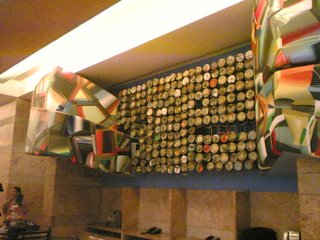 Now those humble but iconic aluminium dabbas are part of a sculpture! Yup, that's a picture of an installation at the Grand Hyatt hotel in Mumbai. Pretty cool, I thought.
On the other hand, I'm not sure about the long term prospects of dabbawalas. Yes, as the BBC notes, every morning 65-year-old Dhondu Chaudhary picks up a lunchbox from Arpana Rao's home in the suburbs of Mumbai.
Mrs Rao relies on Mr Chaudhary to get her husband's daily lunch delivered to Mumbai's financial district where he works. That is about an hour away from her home - and looking after her new baby means she barely has time for herself, let alone find the time to deliver a tiffin, or lunchbox, to her husband's office.
But, er, for how long? This model where ladies lovingly cook lunches for their toiling husbands will eventually die out, I think. But that won't be the end of 'home cooked tiffins'. Housewives and small businesses operating on a commercial basis will grow in number and use the dabba distribution method.
Meeanwhile, the dabbawalas realise they must do something to 'change with the times'. So they have launched a website - mydabbawala.com, making it easier for prospective customers to contact them. Not a very well designed - or functional - site but a small step forward.
You can 'apply dabba online' - which currently means you can email them your interest in their services. But why not go a step further and have a listing of those from whom you can actually order a lunch. Assuming you are a young bachelor, have a wife who can't/ won't cook for you or happen to be a wife in need of a dabba at office?
That would increase 'dabba traffic' much faster. The listing could be on the basis of kind of food served - veg/ non veg, Punjabi, Gujarati, Goan etc. Day-wise menus and prices could be given as well. In fact, in the longer run, the dabbawalas could install a payment gateway and charge a small fee for every monthly order processed through their site.
Lastly, I have no idea why they are selling a mug with a butterfly design on their website. Given all the amazing publicity they've got - wouldn't it make sense to sell dabbas as tourist souvenirs? Not just on the website but on Colaba Causeway.
I'm sure it'd get listed by Lonely Planet and those crazy foreigners will find some novel use for 'em. Just like the imaginative mind which conjured that sculpture!
 Now those humble but iconic aluminium dabbas are part of a sculpture! Yup, that's a picture of an installation at the Grand Hyatt hotel in Mumbai. Pretty cool, I thought.
On the other hand, I'm not sure about the long term prospects of dabbawalas. Yes, as the BBC notes, every morning 65-year-old Dhondu Chaudhary picks up a lunchbox from Arpana Rao's home in the suburbs of Mumbai.
Mrs Rao relies on Mr Chaudhary to get her husband's daily lunch delivered to Mumbai's financial district where he works. That is about an hour away from her home - and looking after her new baby means she barely has time for herself, let alone find the time to deliver a tiffin, or lunchbox, to her husband's office.
But, er, for how long? This model where ladies lovingly cook lunches for their toiling husbands will eventually die out, I think. But that won't be the end of 'home cooked tiffins'. Housewives and small businesses operating on a commercial basis will grow in number and use the dabba distribution method.
Meeanwhile, the dabbawalas realise they must do something to 'change with the times'. So they have launched a website - mydabbawala.com, making it easier for prospective customers to contact them. Not a very well designed - or functional - site but a small step forward.
You can 'apply dabba online' - which currently means you can email them your interest in their services. But why not go a step further and have a listing of those from whom you can actually order a lunch. Assuming you are a young bachelor, have a wife who can't/ won't cook for you or happen to be a wife in need of a dabba at office?
That would increase 'dabba traffic' much faster. The listing could be on the basis of kind of food served - veg/ non veg, Punjabi, Gujarati, Goan etc. Day-wise menus and prices could be given as well. In fact, in the longer run, the dabbawalas could install a payment gateway and charge a small fee for every monthly order processed through their site.
Lastly, I have no idea why they are selling a mug with a butterfly design on their website. Given all the amazing publicity they've got - wouldn't it make sense to sell dabbas as tourist souvenirs? Not just on the website but on Colaba Causeway.
I'm sure it'd get listed by Lonely Planet and those crazy foreigners will find some novel use for 'em. Just like the imaginative mind which conjured that sculpture!
Shiro pic
 On second thought, this one pic from my digicam was not sooo bad. So putting it up for those who'd like some idea of what it's like inside Shiro!
Thursday, October 12, 2006
Get blown away at Shiro: Mumbai's trendy new nightspot
I don't go gaga over nightspots too often. That's because I rarely visit them.
Well, cosmic forces combined to take me to a place so amazing I feel compelled to write about it. Coz there are clubs and there are lounges and there is Shiro. The moment you enter, your jaw will drop and you'll say "Wow!"
Never heard of it? Well, neither had I. Which is why I first took a peek into the Hard Rock Cafe located in the same mill compound. Verdict: yummy. But having been to a couple of Hard Rocks in other parts of the world, we thought let's give this Shiro place a chance.
And what do you know. Inside a plain, unmarked wooden door lies a world in itself.
The very first thing that hits you is a 50 foot high stone sculpture - whoa! Coupled with the soothing sound of water, dim lighting and oodles and oodles of space. So much space that you suddenly feel "this can't be Bombay.. it just can't".
We were led upstairs (yes, there are two levels) where the two of us chose a luxurious sofa to loll on. Right opposite, on the wall, was a fantastic wall sculpture - the kind you might see in Khajuraho - except these weren't kinky and the faces are all south East Asian.
In a corner there's bamboo shoots gently swaying, look above and there's a 100 ft high ceiling. Giant red lamps dangle from the ceiling - more for decor than lighting. The seating area to the side of us resembles a 4 poster bed with gauzy, golden curtains. The 'table' in front of me is a low wooden chest.
Close your eyes and gurgling water and soothing music give you a sensory massage. In 10 minutes you are completely relaxed. Ah, now for the menu.
There's a wide and interesting range of drinks, although gven the lighting, it takes effort to squint at the menu. Cocktails with names like Balinese beach and Shanghai sunset. Margaritas nicknamed 'irresistible concubines'. And something called shochutinis (martinis made with Japanese rice wine). Prices range between Rs 250-475.
I tried out the wine cocktail 'fortified with vodka' in cranberry-black currant flavour (Rs 325). Very nice.
There is a wide range of eats of the Japanese-Korean variety. The menu includes stuff like Norwegian salmon (5 pieces for Rs 500), sashimi platters (Rs 700 to Rs 1850, depending on number of pieces). There were many items on the menu mentioned as "bulgogi in bao" ie chicken bulgogi in bao, beef bulgogi in bao. Pata nahin kya hai but sounded intriguing!
There are a decent number of vegetarian options but only if you like tofu/ shitake mushrooms (which are an ingredient in almost everything here).
My friend tried chi-chow dumplings (which are like chicken momos, Rs 250) while I, the ghaas-phoos lover went for mixed veg dumplings with glass noodles (Rs 175). When it came, I could hardly tell what I was eating (did I mention the lighting is dim!). Whatever it was - accha tha. Service was cool but then, being a weeknight there wasn't much crowd.
The bottomline however is, food and drink is incidental to the experience. It's the ambience which is mindblowing.
Is it a replica of the famous Buddha Bar in Paris? Well, from the pics of Buddha Bar I checked out on the net it does not seem like an exact copy. There are no Buddhas per se, at Shiro, just a predominantly Far Eastern theme with an emphasis on the Japanese.
The idea and the overall atmosphere may well match - but who cares?
Although it's a really really romantic place, Shiro is essentially designed for large groups. The best seating in the house is what I call the 'boudoirs' - the area which resembles a canopy bed although with low L shaped sofas.
Yes, it is expensive (factor in VAT and service tax also!) but completely worth it. This is the place to see/ be seen at for some time to come. If you're going on a weekend better make a booking!
Sorry, I have no pictures to put up yet. I did take some with my camera phone but those do no justice to the place. We did in fact seek permission for JAM magazine to shoot some pictures... but they are yet to grant the same.
We're told there is a PR agency which is very selective about who gets to review the place. Aha. But what about people like me... We didn't need a freebie invitation. We came, enjoyed the experience and want to write about it.
Yes, I understand they want to slowly build up this place. Keep it mysterious and exclusive for a while. That way everyone wants to come here. And you don't depend on minor celebrities to endorse you to be seen as 'happening'. In short, no hangers-on who don't pay because they grace your club with their presence!
All I would say is, a write up in Bombay Times is not necessarily the best thing for a really cool place today. Yeah, they did feature Shiro yesterday, on some obscure page (bet you didn't notice it!). With a picture which looked like it was shot by an amateur (if you put on the flash, how can you capture the atmosphere!).
Aap hamein gale lagayein ya nahin, hum to aapke chahne wale ho haye. So, no hard feelings. The pics will happen. Watch this space!
Shiro, Bombay Dyeing Mill Compound, Pandurang Budhkar Marg, Worli, Mumbai. tel : 022-24383008
Well, cosmic forces combined to take me to a place so amazing I feel compelled to write about it. Coz there are clubs and there are lounges and there is Shiro. The moment you enter, your jaw will drop and you'll say "Wow!"
Never heard of it? Well, neither had I. Which is why I first took a peek into the Hard Rock Cafe located in the same mill compound. Verdict: yummy. But having been to a couple of Hard Rocks in other parts of the world, we thought let's give this Shiro place a chance.
And what do you know. Inside a plain, unmarked wooden door lies a world in itself.
The very first thing that hits you is a 50 foot high stone sculpture - whoa! Coupled with the soothing sound of water, dim lighting and oodles and oodles of space. So much space that you suddenly feel "this can't be Bombay.. it just can't".
We were led upstairs (yes, there are two levels) where the two of us chose a luxurious sofa to loll on. Right opposite, on the wall, was a fantastic wall sculpture - the kind you might see in Khajuraho - except these weren't kinky and the faces are all south East Asian.
In a corner there's bamboo shoots gently swaying, look above and there's a 100 ft high ceiling. Giant red lamps dangle from the ceiling - more for decor than lighting. The seating area to the side of us resembles a 4 poster bed with gauzy, golden curtains. The 'table' in front of me is a low wooden chest.
Close your eyes and gurgling water and soothing music give you a sensory massage. In 10 minutes you are completely relaxed. Ah, now for the menu.
There's a wide and interesting range of drinks, although gven the lighting, it takes effort to squint at the menu. Cocktails with names like Balinese beach and Shanghai sunset. Margaritas nicknamed 'irresistible concubines'. And something called shochutinis (martinis made with Japanese rice wine). Prices range between Rs 250-475.
I tried out the wine cocktail 'fortified with vodka' in cranberry-black currant flavour (Rs 325). Very nice.
There is a wide range of eats of the Japanese-Korean variety. The menu includes stuff like Norwegian salmon (5 pieces for Rs 500), sashimi platters (Rs 700 to Rs 1850, depending on number of pieces). There were many items on the menu mentioned as "bulgogi in bao" ie chicken bulgogi in bao, beef bulgogi in bao. Pata nahin kya hai but sounded intriguing!
There are a decent number of vegetarian options but only if you like tofu/ shitake mushrooms (which are an ingredient in almost everything here).
My friend tried chi-chow dumplings (which are like chicken momos, Rs 250) while I, the ghaas-phoos lover went for mixed veg dumplings with glass noodles (Rs 175). When it came, I could hardly tell what I was eating (did I mention the lighting is dim!). Whatever it was - accha tha. Service was cool but then, being a weeknight there wasn't much crowd.
The bottomline however is, food and drink is incidental to the experience. It's the ambience which is mindblowing.
Is it a replica of the famous Buddha Bar in Paris? Well, from the pics of Buddha Bar I checked out on the net it does not seem like an exact copy. There are no Buddhas per se, at Shiro, just a predominantly Far Eastern theme with an emphasis on the Japanese.
The idea and the overall atmosphere may well match - but who cares?
Although it's a really really romantic place, Shiro is essentially designed for large groups. The best seating in the house is what I call the 'boudoirs' - the area which resembles a canopy bed although with low L shaped sofas.
Yes, it is expensive (factor in VAT and service tax also!) but completely worth it. This is the place to see/ be seen at for some time to come. If you're going on a weekend better make a booking!
Sorry, I have no pictures to put up yet. I did take some with my camera phone but those do no justice to the place. We did in fact seek permission for JAM magazine to shoot some pictures... but they are yet to grant the same.
We're told there is a PR agency which is very selective about who gets to review the place. Aha. But what about people like me... We didn't need a freebie invitation. We came, enjoyed the experience and want to write about it.
Yes, I understand they want to slowly build up this place. Keep it mysterious and exclusive for a while. That way everyone wants to come here. And you don't depend on minor celebrities to endorse you to be seen as 'happening'. In short, no hangers-on who don't pay because they grace your club with their presence!
All I would say is, a write up in Bombay Times is not necessarily the best thing for a really cool place today. Yeah, they did feature Shiro yesterday, on some obscure page (bet you didn't notice it!). With a picture which looked like it was shot by an amateur (if you put on the flash, how can you capture the atmosphere!).
Aap hamein gale lagayein ya nahin, hum to aapke chahne wale ho haye. So, no hard feelings. The pics will happen. Watch this space!
Shiro, Bombay Dyeing Mill Compound, Pandurang Budhkar Marg, Worli, Mumbai. tel : 022-24383008
Wednesday, October 11, 2006
Faltugiri
I don't know about Gandhigiri, but faltugiri must surely be our national pastime.
Why else would someone spend time and energy trying to take Google to court for an 'I hate India' community on orkut with 100 odd members? What's more something like this makes front page news in all national dailies?? Hindustan Times reports:
The Bombay Hight Court's Aurangabad bench has served a notice to Google for allowing a hate campaign against India on its social networking site www.orkut.com. The order was issued on Monday by justices A P Deshpande and R M Borde in response to a public interest suit filed by a junior advocate in Aurangabad, Yugant Marlapalle. His petition said that a community called 'We hate India", which has anti-India propaganda and a picture of the Indian flag being burnt, has been created on orkut.
Um, 103 odd members is hardly a 'hate campaign'. It's a whisper in a room with no people!
Type the word 'hate' in the Orkut communities 'search' box and this is the top 5:
# 1 I hate to wake up early 82,269 members
Community for those who can't stand waking up early in the morning!
# 2 I hate ekta kapoor 32,552 members
isnt there anything left in life of women apart from plotting against each other & sleeping around with there husband's friends????? may god help me out!!!!!!! --
# 3 I Hate Himesh Reshammiya 23,133 members
Save the humanity, Please don't sing
# 4 I HATE EXAMS! 15,014 members
Y do we have to take EXAMS ..they really suks sometimes..
i don't care if u don't agree with me..this community showup the feelings about taking freakin exams ..if some one doesn't like it i must say "WHO INVITED U"
# 5 Himesh Reshamiya Hate Club 11,034 members
Are you fed up with all those noisy,crappy songs of Himesh Reshamiya.Do you feel like taking off the cap from his head(he wears it to hide stolen music cds from Pakistan and smuggle them to India)and show the whole world that he is only bald and nothing else...blah blah blah...then please join this community..
If there's anyone who should be suing it's Himeshbhai. But even he is smart enough to know... these are just kids with frustrations in life - or just plain keeda.
Actually most of the "i hate" this that or the other sites seem to have been created/ populated by Indians. I mean sue, American teens are more into myspace but there are a lot of Brazilians on orkut as well.
I tried typing in the word 'odio' (hate in Portuguse) and could not find 20,000 members in an "I hate Ronaldinho for not winning the world cup" community... I could be wrong but I think Brazilians are more laid back and happier online citizens.
Meanwhile we Indians are venting at:
- I Hate Discussion After Exams 10,198 members
this is the community of the students who are really embarresed of discussions about Question paper that some people do after each damn exams....
- I hate Kareena Kapoor 8,374 members
Why do you hate Kareena Kapoor? I hate her for her arrogance and lack of abilities. As if you need more reasons!!
- I hate Shahrukh Khan 5,384 members
there maybe be plenty of fans of SRK (shahrukh khan) but this community is for his haters.
- I hate to study 4,780 members
I know, even you hate to study!! what say? Join in..!
- I hate Arjun Singh 3,594 members
You get the picture.
So why bother if one LiTtL3 DeViL in Karachi, Pakistan has started an 'I hate India' community? This is the last message posted there:
Yaar it's boring community
This is the way to hate someone?
Lagta hay salay Galian nikal nikal kar thuk chukay hain.
Ha jeee---What is the end result???
Aur kya bhai. Flag it for google and forget about it. Please, don't go around creating 'I hate Pakistan' communities (there are already 10 such lame efforts, no need to add to the idiocy!)
There is enough hate in the real world, to keep us busy for a long time. And enough far more important cases in our court we need to attend to.
However, frivolous as it may seem to me, perhaps Google will have to respond. The Washington Post recently reported
Google Inc., which refused in the past year to hand over user search data to U.S. authorities fighting children's access to pornography, said yesterday that it was complying with a Brazilian court's orders to turn over data that could help identify users accused of taking part in online communities that encourage racism, pedophilia and homophobia.
There are some legitimate concerns, and google will have to address them. But a couple of hundred looneys here and there should not be one of them.
Why else would someone spend time and energy trying to take Google to court for an 'I hate India' community on orkut with 100 odd members? What's more something like this makes front page news in all national dailies?? Hindustan Times reports:
The Bombay Hight Court's Aurangabad bench has served a notice to Google for allowing a hate campaign against India on its social networking site www.orkut.com. The order was issued on Monday by justices A P Deshpande and R M Borde in response to a public interest suit filed by a junior advocate in Aurangabad, Yugant Marlapalle. His petition said that a community called 'We hate India", which has anti-India propaganda and a picture of the Indian flag being burnt, has been created on orkut.
Um, 103 odd members is hardly a 'hate campaign'. It's a whisper in a room with no people!
Type the word 'hate' in the Orkut communities 'search' box and this is the top 5:
# 1 I hate to wake up early 82,269 members
Community for those who can't stand waking up early in the morning!
# 2 I hate ekta kapoor 32,552 members
isnt there anything left in life of women apart from plotting against each other & sleeping around with there husband's friends????? may god help me out!!!!!!! --
# 3 I Hate Himesh Reshammiya 23,133 members
Save the humanity, Please don't sing
# 4 I HATE EXAMS! 15,014 members
Y do we have to take EXAMS ..they really suks sometimes..
i don't care if u don't agree with me..this community showup the feelings about taking freakin exams ..if some one doesn't like it i must say "WHO INVITED U"
# 5 Himesh Reshamiya Hate Club 11,034 members
Are you fed up with all those noisy,crappy songs of Himesh Reshamiya.Do you feel like taking off the cap from his head(he wears it to hide stolen music cds from Pakistan and smuggle them to India)and show the whole world that he is only bald and nothing else...blah blah blah...then please join this community..
If there's anyone who should be suing it's Himeshbhai. But even he is smart enough to know... these are just kids with frustrations in life - or just plain keeda.
Actually most of the "i hate" this that or the other sites seem to have been created/ populated by Indians. I mean sue, American teens are more into myspace but there are a lot of Brazilians on orkut as well.
I tried typing in the word 'odio' (hate in Portuguse) and could not find 20,000 members in an "I hate Ronaldinho for not winning the world cup" community... I could be wrong but I think Brazilians are more laid back and happier online citizens.
Meanwhile we Indians are venting at:
- I Hate Discussion After Exams 10,198 members
this is the community of the students who are really embarresed of discussions about Question paper that some people do after each damn exams....
- I hate Kareena Kapoor 8,374 members
Why do you hate Kareena Kapoor? I hate her for her arrogance and lack of abilities. As if you need more reasons!!
- I hate Shahrukh Khan 5,384 members
there maybe be plenty of fans of SRK (shahrukh khan) but this community is for his haters.
- I hate to study 4,780 members
I know, even you hate to study!! what say? Join in..!
- I hate Arjun Singh 3,594 members
You get the picture.
So why bother if one LiTtL3 DeViL in Karachi, Pakistan has started an 'I hate India' community? This is the last message posted there:
Yaar it's boring community
This is the way to hate someone?
Lagta hay salay Galian nikal nikal kar thuk chukay hain.
Ha jeee---What is the end result???
Aur kya bhai. Flag it for google and forget about it. Please, don't go around creating 'I hate Pakistan' communities (there are already 10 such lame efforts, no need to add to the idiocy!)
There is enough hate in the real world, to keep us busy for a long time. And enough far more important cases in our court we need to attend to.
However, frivolous as it may seem to me, perhaps Google will have to respond. The Washington Post recently reported
Google Inc., which refused in the past year to hand over user search data to U.S. authorities fighting children's access to pornography, said yesterday that it was complying with a Brazilian court's orders to turn over data that could help identify users accused of taking part in online communities that encourage racism, pedophilia and homophobia.
There are some legitimate concerns, and google will have to address them. But a couple of hundred looneys here and there should not be one of them.
Subscribe to:
Posts (Atom)