Chhote chhote sheheron se, khali bore dopaharon se, Bunty aur Babli jhola utha ke chale...
What is it that defines a 'chhota sheher'? By population, Indore city is a large town of 1.8 million residents - double the size of Chandigarh.
And yet, Chandigarh is not a city you associate with being a 'small town'. It's almost 'metro' in its attitude and way of life. Indore, on the other hand, is still a chhota sheher at heart.
I would define a chhota sheher as one where the residents are still very worried about log kya kahenge. Many choices an individual makes are within certain 'acceptable' boundaries. Boundaries set by the elders and some amorphous being known as 'society'.
One important point to note here is the large population of banias in Indore - traders and businessmen from the Jain, Maheshwari and Agrawal community. That partly explains why Indore is far more 'traditional' than Chandigarh!
Punjabis are far more freewheeling and freespending, while banias tend to be quite attached to prathas- or social conventions.
Which is why my cousin's mother-in-law - a sweet old lady - found me rather vexing. No sari, bangles, no sindoor, no toerings... "Kam se kam bindi to pehen ni chahiye", she murmured, after silently observing my kurta-and-jeans-clad frame for two days.
Kam se kam logon ko pataa to chale you are a 'decent married woman' is what she meant. But was too polite to declare, in so many words.
As they say - in Indore, do as the Indoreans do. Which is why a hoarding for Dena Bank featuring Juhi Chawla - without any bindi in Mumbai - has a prominent red dot painted on - in Indore!
Ek alag soch
'Progress' is a strange creature. Mother-in-law does not mind my cousin taking guitar lessons or choosing to have only one child (a daughter). But, she insists that bahu wear only saris. Bahu would much prefer to switch to salwar-kameez - but accepts silently.
Meanwhile, Indore is on the radar of all consumer marketers. But does junta here think and behave like Mumbai or Delhi? Not yet.
Both Dominos and Pizza Hut set up shop here... and subsequently shut down. "Sau rupaye ka pizza kaun lega?" reasons Lucky, a young nephew studying 'MFA' at the local Vaishnav university.
Ditto with the Lee-Levis variety of outlets which he says, hardly any students patronise. The unbranded options give them more bang for the buck and offer acceptable quality/ variety.
That ain't good news for all the malls and multiplexes which will soon throw open their doors in Indore. But perhaps housed in a mall - with a concentrated 'feel-good' ambience - the same brands may have better luck. And hopefully, sales.
As of now, Lucky is quite kicked with the local 'Vishal Megamart' (a chain which offers 'Fashion Street' kind of clothing in a/c environs). For now, 'value' scores over 'snob value'. But values can, and do, change over time.
What is 'value' anyways?
Consumers are complex creatures. That's evident from the consumerism practiced at this cousin's home.
A battered and seldom-used semi-automatic washing machine stands in one corner. The television is an ancient model of BPL and there's no cable connection. "Bachchon ki padhaai affect ho jayegi", is one reason. 350 bucks a month is too much to shell out - is the other.
However, the same household has a computer, with a broadband internet connection. Why? "Bachchon ki padhaai ke liye zaroori hai". Even though they aren't planning to take up 'hi-fi' careers, an investment in a computer is seen as 'worth it'.
And now, jijaji wants to buy a laptop. "Kaun sa brand achcha rahega?" he asks. I wonder why he needs one. The answer is surprising but simple: dhande ke liye.
You see, jijaji is an 'investment advisor' and although he has a loyal client base, there's a whole lot of competition now from new players. The likes of Citibank, HDFC Bank and HSBC have set up shop and their army of young, locally recruited MBAs is on the prowl.
These MBAs wear suits and ties and make jazzy presentations on laptops. "Is liye mujhe bhi laptop lena padega," he grins. "Impression jamaane ke liye".
What the Citis and HDFCs can't do is offer the 'personalised' service many clients require. For example, there are ladies who will specifically ask jijaji to come to their homes after their husbands have left for work - they wish to make certain 'private investments'.
Yup, these housewives want to make FDs or post-office savings - of money received from the maaika, or quietly salted away from the household budget. Like many other clients, these women use our address to receive their official correspondence.
"Hamare ghar mein roz ke itne courier aate hain ki sab delivery waalon se acchi khaasi jaan pehchaan ho gayi hai," says my cousin dryly. The perils of 'customer relationship management'!
The future
And yet, the picture I have painted so far does not tell the complete story. Although still small and not very visible, a 'new' Indore is coming up.
The new Indore consists of nuclear families, multi storeyed apartments, women clad in Babli kurtas and an emerging professional class.
This Indore houses a 'Bombay hospital' and an 'IIM'. Of course, IIM is only technically part of Indore - physically it's 16 kms outside of it and mentally, a completely different world.
But there are local MBA schools like 'Prestige'and 'IMS' which, by Indore standards, are decent. The students may not be CAT-level but speak fairly good English and don't look all that different from college kids in Delhi or Mumbai. They also have more 'freedom'.
Lucky explains the difference thus: "On Valentine's Day, Prestige had an 'official program' where students even auctioned roses...At our college (Vaishnav) when a group of boys and girls went to the local ice cream parlour a professor jumped onto a scooter, located us and dragged us back to the campus".
That's not to say Lucky is bechaara. He has plenty of friends who are girls - but no girlfriend. And, that's a conscious choice. Shaadi to arranged hi karni hai, he reasons. So, bekaar ke lafdon mein kyun padna?
It remains to be seen how long young people like Lucky - who still form the majority - continue to think this way. Until then, Indore's 'small town' status will remain safe. And so will the sale of bindis!
Wednesday, November 16, 2005


Tuesday, November 08, 2005
It's broke, but why fix it?

The state of a taxicab can describe the state of a nation. Take Mumbai . The average taxi is a musty, dusty, crusty old vehicle. The below average ones actually appear to be held together by Scotch tape.
Some of the door handles will fall off if you try to use them, while others refuse to work at all. The same holds for windows as well.
Andar ka haal bhi kuch behaal hi hai. I mean it's better than your local train but if you view taxis as an alternative to using your own car then hell! The hygiene and comfort levels just don't match up.
However, the taxi does manage to get you from point A to point B. In doing so, the driver will dart in and out of traffic, without a care for 'rules'. But that's India for you - things get done despite the general chaos.
And although the taxi itself may be old and decrepit, the driver is usually warm and friendly. Just like India, as a country.
Yahaan sab kuch theek to nahin chalta magar as most foreigners will tell you at the end of a visit "the people are wonderful."
Across the world
To extend the theory, let's take the Tokyo cabbie - hyperefficient, but completely impersonal and exorbitantly priced. Sounds like Japan to me. The drivers actually wear gloves ...
The Singapore cabbie is polite, hard-working and operates a very clean and efficient service. As the urban legend goes, they also act as informal spies for the government - so watch what you say in the back seat! So Singapore.
The Kuala Lumpur taxi is a fine car but the cabbie himself is rude and surly and may not take you where you wish to go. Just like Malaysia itself - a fine showpiece of a country from the outside. Scratch below the surface and you see the social fabric is certainly not made of lycra.
Bangkok taxis are cheap, cheerful and yet - Toyotas! Which kind of encapsulates Thailand - First World goods and services at third world prices.
London's traditional 'black cabs' are old and stately looking although comfortable and modern on the inside. The London taxi is a 'symbol' of a kinder, gentler era - just like the symbolic presence of a Royal Family within a democracy. How very British!
New York taxis, of course, are known for their polyglot driver population - reflecting a country that welcomes immigrants.
"Taxi cabs are both loved and hated by New Yorkers" says the NY.com website. Ditto America's sentiments towards immigrants.
The Crux
If a taxicab reflects the state of a nation, one can argue that changing the taxicab could potentially alter the state of that nation. or at least serve as an important symbol of 'change'.
It could soon be curtains for the yellow-and-black Premier Padmini cabs that have ruled the Mumbai city roads since 70s, to well into the 90s. Instead, one could well see the Singapore-styled wireless cab network where the operative words could be... "Make a call, choose your cab, and it is at your door.
The Fulora Foundation and the Western India Automobile Association plan to create a GPRS-run fleet management system that gives "real-time vehicle status, city-wide low-cost service stations and an emergency response system"
The blueprint allows for cab services to be differentiated into mini cabs, medium-sized cabs and luxury cabs, with different rates. This transportation model is expected to increase the demand for call taxis and therefore, the cabbies' income.
In an interview to the Hindu, Sanjay Ubale (Secretary of Special Projects, Govt of Maharashtra) observed that "Singapore had the same cab transport system that India now has. They changed and the drivers' income has seen a 20-fold jump."
That was 6 months ago. But black & yellow khataaras continue to rule. Mr A L Quadros, general secretary of the Bombay Taximen's union visited Singapoor, came back and declared,"Nahin chalega".
Nahin chalega ya phir hum nahin chalne denge? Quadros and co would rather eke out a living in cabs that will one day fall completely apart than switch over to more modern vehicles. Or use technology to unclog the roads of parked taxis and make them available on call instead.
The path to progress in this country must always be littered with protest. The taxicab's journey into the future won't be an exception!
Sunday, November 06, 2005
Head vs Heart vs Hair
Mere paas Lexus hai, bangla hai, dollar hai... tumhare paas kya hai?
Mere paas? Mere paas baal hai.
That, in a nutshell, is the reason call-centre worker Shyam manages to win back his lady love Priyanka in the Book That Must Not Be Called Literature . But which every-under-25 is going to read anyways.
Chetan Bhagat's "One Night at the Call Centre" is a book that I would classify as 'flick-lit'. Why?
Well, often a movie gets just 3 stars out of 5 but junta goes to see it because it's 'good timepass'. The same applies to this book. It has its flaws but in the end the reader gets his 95 bucks worth.
And, it's 'flick-lit' because I bet it's going to be made into a movie some day. Just like Five Point Someone. Note in particular the climactic scene where hero-on-motorbike chases the Qualis with Priyanka in it and proposes to her at a red signal.
Sigh! It's like Chetan envisioned the Bollywood screenplay even as he typed out those paras in MS Word.
Hairy thought
Warning: spoilers ahead for those who have not read the book.
But let's get back to the hair - and how it won Shyam the woman of his dreams. Priyanka, bowing to her mum's wishes gets engaged to one Ganesh Gupta - engineer at Microsoft, owner of Lexus and of Amaarikan style bungalow with in-house swimming pool.
Fortunately, Shyam locates some pics of Ganesh on the internet which show his emerging bald patch. You see, in the original pics shown by the ladkewallahs, this fact had been cleverly hidden by a 'touch up'.
Priyanka doesn't like the fact that Ganesh has been deceptive and decides this isn't the guy for her. Which is fine, people break off engagements for even more trivial reasons.
The babe's not happy about being under pressure to tie the knot with a total stranger in less than a month. If you ask me she's practically looking for an excuse to get out. And there are residual feelings for ex-boyfriend Shyam anyways.
But my question is this: What if Ganesh had been a little more studly?
What if he had a wonderful, full head of hair? (Think 'Monsoon Wedding' and Parvin Dabas). Would Priyanka still have ditched the NRI groom for the 'man she loved'?
Chetan said in an interview that he really agonised about whom Priyanka should choose in the end. He asked around and most girls said they would go for love over money/ comfort/ status/ meri-mummy-ki-choice.
This is what Bollywood believes too but honestly, I could never understand how Kajol could prefer Prabhu Deva to Arvind Swamy in 'Sapnay'.
I think women are romantic creatures - but on the other hand, practical too. There are enough instances in real life where they make rational decisions about whom-to-marry.
It's not impossible to fall out of love with the idea of love and fall in love with a 'suitable boy'. For every Priyanka, there is a Manasi...
Mansi has a fascination for grooms from IIT. Her current boyfriend, a graduate from IIT now earns more than Rs 5 lakhs per year. She recently met another eligible bachelor, also an alumnae from IIT who claims to earn more than Rs 12 lakhs per year. Mansi who is apparently very serious about her boyfriend says, "Had the guy who earned Rs 12 lakhs shown interest in me, I would have ditched my boyfriend."
But of course, this is a book. And like I said, it's written to be made into a movie. And books and movies need 'happy endings'.
So Shyam gets Priyanka - and Ganesh should go get a hair transplant. And maybe, in a further quest for coolness, start working at Google!
Saturday, November 05, 2005
Ask not what your country...

Bihar, to most of us, serves as a glaring illustration of exactly what is wrong with India. Even more so, at election time.
But can we, the urban 'elite', DO something about it? The answer is - it's never easy, but you can make a difference.
This piece I wrote on ADR (Association for Democratic Reform) shows you what kind of commitment and perseverance it takes. But, pay-offs do come.
And yes, it is a matter of great pride that the founding trustees of ADR were professors and alumni of my own alma mater IIM Ahmedabad.
A few good men
B-schools are not known for people fighting to clean up politics. But some do
published Businessworld, dt Nov 7
The political and commercial morals of the US are not merely food for laughter, they are an entire banquet, commented the inimitable Mark Twain. That being the case, the state of Bihar - as it goes to the polls - would certainly qualify as a public orgy. Affidavits filed with the Election Commission in October 2005 reveal that one in three candidates fielded by major political parties have chargesheets pending against them.
But there's a story behind the statistics. A story of how a few good men can take on a mighty messed-up system, and make a difference.
The story begins in August 1999, when a group of intellectuals got off their armchairs and formed the Association for Democratic Reforms (ADR) in Ahmedabad. The 11 founding members included eight professors of the Indian Institute of Management-Ahmedabad (IIM-A), two IIM-A alumni and a professor from the National Institute of Design, Ahmedabad.
The challenge before them: to make the voting public think, and thinking people vote.
ADR decided to start by addressing an issue, which almost inevitably cropped up in the post-prandial conversations on problems facing India: the criminalisation of politics. Public interest litigation (PIL) was the chosen route.
In December 1999, Kamini Jaiswal filed a PIL on behalf of ADR in the Delhi High Court, seeking disclosure on criminal charges faced by candidates, as well as their financial and educational history. The PIL was upheld, but the Congress, Samata Party and the Union of India appealed against the judgement.
In May 2002, the Supreme Court again upheld the PIL and on 28 June 2002, the Election Commission issued a directive implementing the judgement. With remarkable alacrity, 21 political parties met on 8 July 2002 and unanimously 'rejected' the court orders. They decided to pass an ordinance to circumvent the judgement.
Founder-trustee and IIM-A 1984 alumnus Ajit Ranade recalls the tensions prevailing at the time: "A group of us met President A.P.J. Abdul Kalam and explained the situation to him. Kalam returned the ordinance but the Cabinet sent it back unchanged. He had no choice but to sign it the second time."
ADR and several other organisations moved court once again. In March 2003, the Supreme Court ruled in their favour, linking its judgement to the citizens' 'fundamental right to know'.
It was a well-earned victory, but even before the formal judgement came in, ADR had initiated its first ever 'election watch'. The battleground: the post-Godhra Gujarat elections of September to December 2002. ADR issued 40 advertisements appealing to the public for information and collected over 1,000 affidavits filed by candidates.
Names of 138 candidates with criminal records were released and widely reported in the print and electronic media as well as disseminated to political parties, bureaucrats and NGOs.
The 'election watch' movement has now spread across the country. In every state, ADR ties up with local NGOs and citizens' groups to help in collecting, compiling and disseminating information among public.
In Mumbai, ADR worked closely with AGNI; in Bihar it is collaborating with Lok Samvad, a network of NGOs it has identified and trained. Says Bibhu Mohapatra, ADR's full-time co-ordinator: "The affidavits are written in a language that is gobbledegook to the lay person." ADR's task is to simplify the data and amplify it through the media so that voters can make more informed choices.
Of course, critics argue, many candidates file false or incomplete affidavits. Mere criminality is not a ground for disqualification of candidates and, sadly, criminals often romp home victorious anyway. Counters Trilochan Sastry, a founding member of ADR and now a professor at IIM, Bangalore: "But there are many early signs of change." For example, MPs are paying up their electricity and telephone bills as liabilities must be disclosed.
Founder-trustee and IIM-A professor Jagdeep Chhokar believes the idea is to build up pressure on parties themselves to field cleaner candidates and the indication is that "it's happening". Rome wasn't rebuilt in a day, and one thing ADR is not short on is patience.
Fighting long drawn-out court battles, travelling through cities like Bhagalpur and Begusarai and taking on the establishment are not the general domain of IIM professors or alumni. Thinking 'out of the box' is an old management dictum. In this case, the pandora's box that is Indian democracy has actually been opened.
For more info log on to www.adrindia.org
Wednesday, November 02, 2005
Diwali - then and now
Zamaana badal gaya, as they say. Aur uske saath Diwali bhi.
Ab Diwali greetings ko le lo. Greeting cards have gone the Siberian Crane way - they're a rare sighting. Instead it's the Diwali SMS or now, MMS. Aur ismein bhi alag alag type ke log-baag hain.
a) Wholesale variety: These are the folks who message their entire phonebooks, coz after all they're on a 50 p per sms plan - may as well make use of it. Never mind if some of the recipients are clueless about who the hell the sender is...
b) Designer variety: Ordinary 'happy diwali' and 'best wishes for the new year' messages won't pass muster with this lot. They take extra time and effort to come up with something creative. Or, wait for someone else to - and then promptly forward it!
c) Reply-only variety: Yeh log khud message nahin bhejte but if they receive one, will take the trouble to reply. I fall in this category :)
d) Bhayaanak variety: "Happy Diwali. Have you filed your Income Tax Return for AY 05-06? If not pls file it by 31st Oct 05..." Yup, the I-T dept just discovered the joys of spamming!
Diwali - Then & Now
Other ways in which Diwali has changed for People Like Us...
* Then: Rui ki battiyan, mitti ke diye.
* Now: Wax waale bane banaye khareed liye.
* Then: Ghee waale laddoo-barfi-halwe khaane ke din.
* Now: Chocolate hampers, sugar-free mithai are in.
* Then: Atom bombs, 10,000 ki ladis were cool.
* Now: Anaars, chakris and phuljhadis rule.
* Then: Problem - is saal client ko kya gift bhejna hai
* Now: Solution - Hamari company mein ab gift lena manaa hai!
* Then: Saal mein ek baar bacchon ke kapde aate the
* Now: Ab to har hafte mall visit mein Diwali manaate hain
I'm not nostalgic about the old days - except for the home made samosas and gulabjamuns which sadly, are missing from the Diwali mithai ki plates that neighbours now exchange.
In every other way, now is an improvement on then. And yes, the gap between the 'haves' and the 'have-nots' remains. But there is more awareness - more efforts to contribute to charity. More than one yuppie couple I know has taken the trouble to make a donation of toys and sweets to an orphanage.
So things are different - but it's still Diwali
Until next year, wish you peace and khushhaali!
The unholy 'jehadi'
Traditionally, you wake up on Diwali morning and the first thing you look at is a silver coin or rupee note. It is believed that "Laxmiji ke darshan' on the day of Laxmi puja brings prosperity and luck in the coming year.
Additionally, you wake up on Diwali morning and the papers are full of stories of children who will never see their parents again. Of entire families wiped out by Saturday's serial blasts in Delhi.
'Jehadis' have planned and executed this unimaginably evil act during the very month of Ramzan when they are enjoined by their God to undertake fasting and penance to purify themselves.
Can the elders, leaders and imams of their community please stand up and declare strongly and clearly, that they will burn in hell?
So far I've seen one picture of Shabana Azmi in some kind of protest march and I'm afraid she is not the kind of person whom the average jehadi looks up to for career guidance.
Saturday, October 29, 2005
Nach Baliye : Star One does it again!


Nach Baliye was promoted as the 'Next Big Thing' on Star One and holy cow - it seems to be working.
Unlike Indian Idol and Fame Gurukul this reality-cum-talent show format appears to be an original idea. As the official website notes:
Nach Baliye is a show that brings two unique things to Indian television:
1. The competition between real- life couples (all from the television world)
2. The participants competing on a skill, they are not known for (none are professional dancers)
I would add, the show brings out how far folks will go to win prize of Rs 50 lakhs. So over the last week we had the 'comedy round' where Rajeshwari and Varun Badola gave an outstanding 'role reversal' performance.
A sporting Varun donned ghaghra, choli, chotis et al to play the woman while Rajeshwari played the man - their performance floored both judges and the audience!
Why it all works
The real-life couple bit was, I think, a masterstroke. Real life couples have emotions between them anyways hence they hug cry on camera without inhibitions. Or any kind of 'distance'.
The whole idea of the new generation of 'reality' shows is to create an 'emotional infection'. While the characters in a soap opera act and evoke emotions, reality shows set up a showdown of some kind which induce emotions, spontaneously.
In Nach Baliye, for example, it's the long drawn out sequence on Thursdays where couples are asked to move one by one into the 'suraksha chakra'. Those who make it to the next round are relieved and happy, while those left behind start looking tense and even tearful.
The suspense stretches on and on before the results are finally announced - just to add to the anxiety of all parties.
Of course, the judges also add the 'emotion' element to the contest with their sometimes-outlandish behaviour (Saroj Khan got up and gave what looked like a 'paanch sau ka note' to Varun and Rajeshwari, and their choreographer. Why? Because that's what her guruji used to do when she gave an outstanding performance!).
'It could be me'
The other master stroke by the producers was the inclusion of some older couples like Sachin-Supriya and Archana Puran Singh- Parmeet Sethi. The viewer was not expecting much from them, so when Sachin and Supriya put up a dazzling performance in the first two rounds it came as a pleasant surprise.
Everyone likes to root for the underdog and a 40+ couple is - in such a contest - definitely just that. The fact that Supriya-Sachin, through their hard work and dedication, managed to pull off such a feat gives some pride and hope to the vast middle aged couple audience . "Dekho ji," you can hear the Mrs saying and abhi-to-hum-jawaan-hai Mr nodding happily.
On the other hand, I don't particularly care for the Archana-Parmeet jodi (for one I think Archana's sticky-stick parrot green and orange outfit in the last episode was just not suiting her age - or less-than-svelte size).
But hey, that's a very personal opinion.
Other points to note
On the cheesy side, the costume designer emplpyed for the compere Sangeeta 'Des Mein Nikla Hoga Chaand' Ghosh seems to have been given one simple brief: friend-of- the-bride-look at Punju wedding.
On a more positive note, the importance given to the choreographers is heartening. After all, they really have a lot of contribution in the success/ failure of the contestants. Right from choice of song to steps to amount of practice! So it's good that the winning choregrapher gets a Rs 20 lakhs prize.
The strangest thing of all was the message flashed before what is ostensibly a 'family' show which read: "This show may be unsuitable viewing for children". OK, so they had something called a 'sensuous round' but if it's really unsuitable then telecast it after 11 pm!
I'm guessing the message was put in just in case some mahila manch type protested 'you are corrupting our children'. But these days things seem quiet on that front - how many channels can those poor souls battle? They've simply given up.
Soap Opera element
On camera, it's all we-are-one-big-happy-family and its-only-a-contest. But after Sai and Shakti were voted out they shared some grouses with Midday:
- Some couples took as many as 5 'retakes' to get their act perfect - isn't this supposed to be a 'reality' show?
- Some couples made a big deal about their 'injuries' and got unnecessary sympathy from the judges(Archana danced with a neck brace, Shilpa with a broken tooth)
Sai and Shakti had earlier alleged that the older couples were being 'favoured' by judges.
Maybe they are just poor losers but, this could be just the beginning. As more couples bow out the bitching might escalate and we might enjoy an added dose of 'reality'. Which, in turn, will probably fuel more enthu among the viewing public to send in SMS votes.
Bottomline: Indian junta is gleefully swallowing reality shows - but they prefer the naach-gaana routine to 'Survivor' type adventure.
The caveat is that me-too won't work - a Nach Baliye copy for example will bomb. Channels will have to scratch their heads and come up with formats that are interesting and original. And the stakes are high enough now to make that happen!
Thursday, October 27, 2005
Home 'too sweet' home
We once shifted into a house where the previous occupant had left behind a fridge magnet which read "A clean house is a sign of a misspent life".
And I would partly agree. I mean, sure, you don't want to live in a dirty house but I do so hate picture-perfect living spaces. They look so very unlived in!
So let me modify that to an 'immaculately interior-decorated' home, to me, is a sign of a misspent life.
When I step into a house where everything matches with everything else, not a cushion is out of place - and it's not even a formal dinner party - I feel a small, inward cringe. If the home is truly outstanding, I even feel a little bit like a kid in a china shop.
Growing up, there was one home of this kind in our building. In a colony of scientists where the prevailing fashions were divans and rexine sofas, this one home had carefully laid out expensive antique furniture. It reminded me of a museum no one ever visited.
The aunty in this house was rumoured to be related to the Nizam of Hyderabad - no idea if there was any truth in it. The kids were the only I knew outside Enid Blyton books who actually went to boarding school.
The lasting impression I have of this 'lovely' home : cold and unwelcoming. A very personal - and perhaps biased - impression but hard to erase.
I mean it's personal choice, how much time and energy (and money) you want to invest in home decor but I would much rather eat, read or sleep than bother about putting together a living room that could make it to the centrespread of 'Inside Outside' magazine.
But if I really really had to put my passion into a building project (assuming I ever have that kind of money!) - 'Amazing Vacation Homes' (Discovery Travel & Living) would be the way to go. Amen.
Wednesday, October 26, 2005
Blog Quake Day
There is no visible outpouring of grief and relief for the victims of the Kashmir earthquake - unlike what happened when the same tragedy hit Gujarat.
Why this is the case is a matter of debate. But I'll save that for some other day.
Right now, I have decided to send a donation to 'SOS Children's Villages of India' - an organisation my dad has been supporting for many years with annual contributions.
The SOS Srinagar village has offered to provide long-term care to over 100 children who have lost both their parents in the earthquake. SOS India looks after 2 lakh children through its 37 SOS Villages and 122 community projects. And I like their philosophy.
SOS gives the children, a closest alternative toa natural family i.e. a SOS family where they find a mother, brothers and sisters to grow up with. Within the security of a family, children can grow-up into independent and responsible citizens of society.
What SOS believes in is not running an orphanage but giving orphans the chance to grow up in a 'family' atmosphere.
A SOS family consists of 9 or 10 children who live together with their 'SOS Mother' in a family home. A family home has 3 rooms for children, a room for the Mother, a large living room, a kitchen and a garden.Each Village has between 10 to 20 family homes. The incharge of the Village is a Director, a father figure who has a team of co-workers to run the administration, guide and help the mothers and children.
Heck, like regular parents they even worry about getting the kids married
SOS Children's Villages of India not only commits itself for taking total care of children when they are brought home in its Villages but settle them through marriages. The marriage cell at National Co-ordination Office was established to provide support to the Villages for organizing marriages of the youth.
So, that's where my money is going for now. Because all things being equal, my heart always goes out to the suffering of children the most.
Email: soscvi@vsnl.com; Website: www.soscvindia.org
Thursday, October 20, 2005
The Fame Game

In a couple of hours from now the winners of the Fame Gurukul contest will be announced and I have little doubt that 'jodi no 1' is going to be Qazi and Ruprekha.
Why? Well, there were only 3 choices. The boy-boy jodi of Rex and Qazi will never get enough votes. Rex and Ruprekha? Well, going by the Indian Idol precedent the winner is going to be the better looking one.
My daughter Nivedita puts it quite simply. "Mummy", she said, "I want to vote for Qazi. Why? "Because he is nice, he has curly hair.". Rex? "No, he is fat..."
Uh huh. So it's really not about singing talent, which incidentally, all the three finalists on Fame Gurukul don't rate highly on, in my book. The talent on Indian Idol was far better).
Draamebaazi and crocodile tears are what sustained interest in Fame - and of course, the antics of Qazi.
Qazi is one of those 'born performers'. He knows what buttons to push with an audience - that's how he's logged in 60 lakh votes already.
The voting decision is based on a 'blink' moment, who people feel they 'like' more. It could be Qazi's 'puppy dog eyes', his silly grin. The fact that he's a Hrithik look-alike and dance-alike could have worked against him but surprisingly hasn't.
The multi-channel blitz
What is interesting about Fame is how Sony has managed to raise a mediocre show to a much higher level through a series of alliances.
Most visible (and relevant) was the MTV-Fame Gurukul tie up where V J Sophie took viewers 'behind the scenes', right after the original show aired on Sony.
Then there's what appears to be a TV Today tie-up - the show was 'aired' on Red FM 93.5 and tonight Aaj Tak devoted its entire "Aapka sawaal" show to the question of 'who will be the next Fame jodi'.
A mini-site has been set up on Sify where you can watch videos of shows you might have missed etc.
The idea being, wherever you turn you have Fame Gurukul pouring out of your ears - so like it or not, you can't ignore it. Of course, all this must have cost Sony big bucks but that's what it will take from now on to build big shows.
On a final, and personal note, I also like the fact that Qazi is a Kashmiri. His winning Fame Gurukul would, I think, bring in a much-needed connect between the youth of Kashmir and the mainstream of India.
So yes, my vote was with Qazi and Ruprekha - and it would surprise me greatly if results turn out differently. Let's wait and see... !
Update: Qazi and Ruprekha DID win.
The amount of time Mandira "dunno-why-she-is-popular" Bedi took to announce the winners truly got on my nerves! It was timed perfectly though... 10.30 pm onwards 'AajTak' flashed the Qazi-Ruprekha 'fame jodi' as Breaking News. (!) The channel had already thoughtfully lined up the families of the winners - in Srinagar and Kolkata - to gush about their honhaar bachche.
So a non-event became national 'breaking news' and gets a full half-hour show devoted to it as well.
The ratings which come in (likely to be good - as there was no interesting 'real news' on other channels at the time) will lead to many more such 'advertorial' tie-ups. Be sure that Nach Balliye will use a similar strategy, with Star News in its own channel portfolio.
The ultimate irony, isn't it? 'Reality shows' and their contestants becoming more real and newsworthy for viewers ... than reality itself.
Kadwa chauth
'Karva chauth' is a festival which really really gets my goat. I mean why, why in this day and age does it still remain the 'done thing' for millions of women - including the younger generation - in north India?
In India and Nepal, Hindu married women observe a fast on Krishna Chaturthi of Kartik (October-November) . The only aim of this fast is to save the husband from an untimely death and have a long married life.
After taking bath in the early morning, before sunrise, women should undertake a vow for welfare of the husband, sons and grandsons. Shiv, Parvati, Kartikeya, Ganesh and the moon (Chandrama) are worshipped. The fast is broken only after seeing the moon.
The origins of this festival are murky. One story that is always related on this day...
A lady called Veeravati broke her fast and her husband died. She preserved the body of her husband and he came back to life the next Karva Chauth. It is believed that a Pati-Vrat woman has the power to confront the God of Death, Yama.
I would have thought that modern young women would gradually lose interest in a festival with such retro contours:
The fast is a rigorous one as the wife does not even drink water on this day. In the evening, all married women, dressed in gorgeous wedding garments and jewelery, undertake worship. As the moon rises, they bow down at the feet of their husbands and give the decorated plate with fruit and other material to their mother in law. This festival deepens the relation between the wife, the husband and the mother in law.
However, interest in the festival has in fact increased.
Bollywood has had several poignant 'karva chauth' sequences (remember Shahrukh and Kajol in DDLJ) and of course beauty parlours and other commerical estabishments have jumped into the fray offering 'full day packages' to keep hungry-thirsty women occupied till moonrise. Esp so in the very dekho-ji-maine-kitne-paise-kharch-kiye culture of Delhi.
Life in the 'fast' lane
Actually I would categorise karva chauth fastees into 3 categories:
a) Sab karte hain: Everyone's doing it, so you do too. This applies especially to those women who live in joint families.
Some of course actually enjoy all the shringar, sacrifice and saas-saheli bonding. Others play along, knowing that resistance is futile in the face of biradari and expectant mother-in-laws. !
Aur kuch nahin to kuch maal to milega :)
b) 'What if...': This lot is not very keen on the fast but keeps it anyways thinking of it like an annual insurance policy. Just in case something terrible does happen, there can never be any fingers pointed at her for not even keeping 'karva chauth'.
c) 'So romantic'!: Lastly, there is this new breed of women who don't actually believe in pati-parmeshwar but think it's a very cute and romantic thing to do. Many expect the husband - in SRK-DDLJ style - to also deprive himself ("Dear, at least keep a fruit juice fast", they might kindly offer).
This lot expects the fast to be broken over a romantic dinner and/ or a special gift. Engaged and 'newly married' types are usually to be found in this category - as u might well expect!
In the 'slow' lane
As for me - no I am not fasting and not feeling in the least bit guilty about it. Luckily for me mother in law does not believe in this stuff although for years my mom emotionally blackmailed me into it ('fasting is good for health also you know').
After reading all this I'm sure the word that comes to most readers minds will be: 'feminist'. But you know what, I'm more of a practical feminist than a crusading one. I pick and choose my battles.
So, I'd rather hold a (metaphorical) gun to Yatin's head for an issue like 'who will wake up early and pack off Nivedita to school', than extract a pledge for a one-time fasting ritual.
Bottomline: Each to her own, of course. Some find it a sweet tradition - but for me it leaves more of a kadwa aftertaste.
Here's hoping the moon does peep out on time tonight - for those who feel otherwise!
Wednesday, October 19, 2005
What is this life...
If full of care, we have no time to stand and stare?
People Like Us, with hectic 'urban professional' lives will nod sagely in agreement with that old school poem.
But, there's a tribe whose profession it is now, to simply stand and stare. I often pass a bunch of them on my way to work, standing on the Eastern Express Highway.
Thin, dark, wiry and sweating profusely - despite the 'free' caps on their heads - these are yet another by-product of our labour-surplus economy: Human Billboards.
OK, so what these young fellows actually do is hold up a placard - a dozen of them standing at 5 metre intervals. Mumbai's radio channels, which are currently fighting for supremacy in the morning listenership segment, seem to be the biggest patrons of this new 'medium'.
Yesterday it was 'Radio City' trying to attract car listenership to its morning program where Sunidhi Chauhan was apparently singing live. A couple of weeks ago it was 'Radio Mirchi' exhorting us to tune in to Bollywood stars like Kareena and Preity hosting their morning show.
I feel sorry for those 'human billboards', many of their placards drooping in direct proportion to the mercury rising as the day progresses. On the other hand, in the books of a slum-kid it's probably good money for 'doing nothing'. That kid could be standing crushing stones in a quarry, expending hard physical labour, and still earning far less.
No doubt there is a middleman who 'supplies' these boys and makes the lion's share of it though!
Stareway to Heaven
However, what's more intriguing to me is the rise and rise of these 'stand and stare' jobs. If you are a lower middle class type, with sub-optimal educational qualifications, your 'dream job' today would probably be with a security agency.
Don a uniform, a dull vacant, stare and stand in air conditioned comfort at the local mall. I'm not saying the job isn't necessary - at Vashi's Centre One it's amazing how many people are still wary of climbing onto escalators or doing so for the first time!
It's just that the job seems so boring, pointless and routine... But that, I guess is what 90% of jobs in this world are about.
So stand, and stare. No boughs, or sheep and cows, but I'll occasionally stare back from my car window - if that's any consolation.
Monday, October 17, 2005
On 'changing the world'
Hmm, hate to say I told you so but way back in March, I expressed a similar thought. Of course, I merely stated Sania was 'more than a tennis player'. The New Statesman, described by HT as one of the 'most respected political-literary-cultural weeklies in the UK has listed Sania as one of the men and women who will "transform the world".
In his article on Sania, Jason Cowley writes about the “world-transforming potential of a young, attractive, articulate and media-smart teenage Muslim tennis star”. Like it or not the 'M' word has been used. The scarcity of Muslim women in any profession involving wearing of short skirts is glaring enough to lead to that reference.
But this being the NS, the idea is to see Sania — and her sport — as a symbol of a bigger, more sociologically significant phenomenon. “Muhammad Ali, Pele, Evonne Goolagong, Viv Richards, the so-called ghetto Cinderellas Venus and Serena Williams and the Chinese basketball star Yao Ming — these sporting icons, because of their fame, achievement and corporate power, have helped to transform the way mainstream sporting audiences think about race, gender and the old political structures that once controlled the games we play.
“Can Mirza have a similarly transformative effect, not only in India but also throughout the world? She may not have won a major tournament, yet already she occupies a role through which flow many of the most significant intellectual and cultural currents of our times: the clash between secularism and political Islam, the emancipation of women in the Muslim world, the dominance of celebrity, the tyranny of the image, the emergence of India as a world power,” Cowley writes.
Well, I would really like to buy into this - though Sania has a long way to go before she can be compared to Pele and Muhammad Ali in terms of sporting achievement. I personally believe she will get there but even if she doesn't reach the heights of a Serena Williams, I would not crucify her. She's gone further than any Indian woman has gone before in her sport.
Whenever she speaks I'm amazed she still has her young head on her shoulders. Which is more than can be said about our not-so-young (and far worse performing) cricketers.
Also on the New Statesman list: US Senator Barack Obama; physicist Anton Zeilinger; Iranian filmmaker Samira Makhmalbaf; environmentalist Aubrey Meyer; the Emir of Qatar; Kierra Box, “20-year-old politico-prodigy”; Net entrepreneur Brewster Kahle, Victoria Hale, whose healthcare group brings cheap medicine to the poor; and Mo Ibrahim, chief of the fastest growing mobile phone group in sub-Saharan Africa.
Glad to see a list of relatively unknown names... that itself is a welcome change in a run-of-the-mill-celeb-hungry media world!
Friday, October 14, 2005
The Age of the Underdog
With Sachin and Saurav, Amitabh and Preity Zinta appearing in too many ads to make any material difference to the brands they endorse, advertisers are signing on an entirely new class of celebrity.
It's about time, coz study after study shows that celebrity endorsements are becoming increasingly ineffective, although this varies across cultures and target groups.
Certainly, young people are becoming increasingly indifferent to a "I use this soap, so should you" kind of endorsement in India as well. The connect has to happen at a deeper much level.
New endorsers
Coke has just announced that it is signing up Jassi, Rajyavardhan Rathore to endorse the brand in India. This is the first time the brand is moving out of the Bollywood-cricket celebrity circuit.
"Both Singh and Rathore are seen as achievers, as go-getters in real life. They have stepped out of the shadows of anonymity to fame by the sheer dint of their hard work, " said Vikas Gupta, V-P Marketing, Coca-Cola, speaking to the TOI.
Hmm. So, the age of the Underdog is here. Even Abhishek Bacchhan, the current superhero, darling of the masses is all the more loved for the fact that he had to struggle through flop after flop before finally making an impact.
Then, there was Iqbal.
But, there is a thin line between being a loser, and an underdog.
Losers whine, while underdogs eventually shine
Losers blame the world for their problems, while underdogs try to see the problems in themselves, as well.
Losers are victims of their circumstances, underdogs overcome them
In that context, it's hard to understand how both Jassi and Rathore qualify as "go-getters". Jassi is a fictional characer. Mona Singh is playing a role - she herself was a successful model before getting into acting.
The old Jassi was an underdog. The new Jassi is a loser.
And Rathore - India's only individual silver medallist at the Olympics - is really in a class of his own!
What next: Pepsi and Abhijeet Sawant?
Life after 10/10
I hesitate as I write this, my first regular blog post in 6 days. It used to be so easy. Ideas danced in my head. Words took form without much effort. Fingers flew on the keyboard.
190 posts, over 100,000 words worth of thought and feeling were expressed through this space in the last 8 months.
And now, I hesitate. Because innocence is lost.Because my space is no longer my own.
Now, there are gawkers and stalkers. Waiting to seize on what I write next. Which completely drains away the pleasure of writing. The reason I blog in the first place.
Can the old feeling be recaptured? Maybe, in time. Maybe, never wholly or in complete measure.
Like a post 9-11 New York, the post 10-10 blogosphere is changed, forever. For better or worse, only time will tell.
Comments policy hereon: IIPM comments on posts unrelated to the subject will be deleted. Personal and petty comments unrelated to the subject of a post will be deleted.
Thursday, October 13, 2005
Caution Notice re: IIPM in Outlook magazine

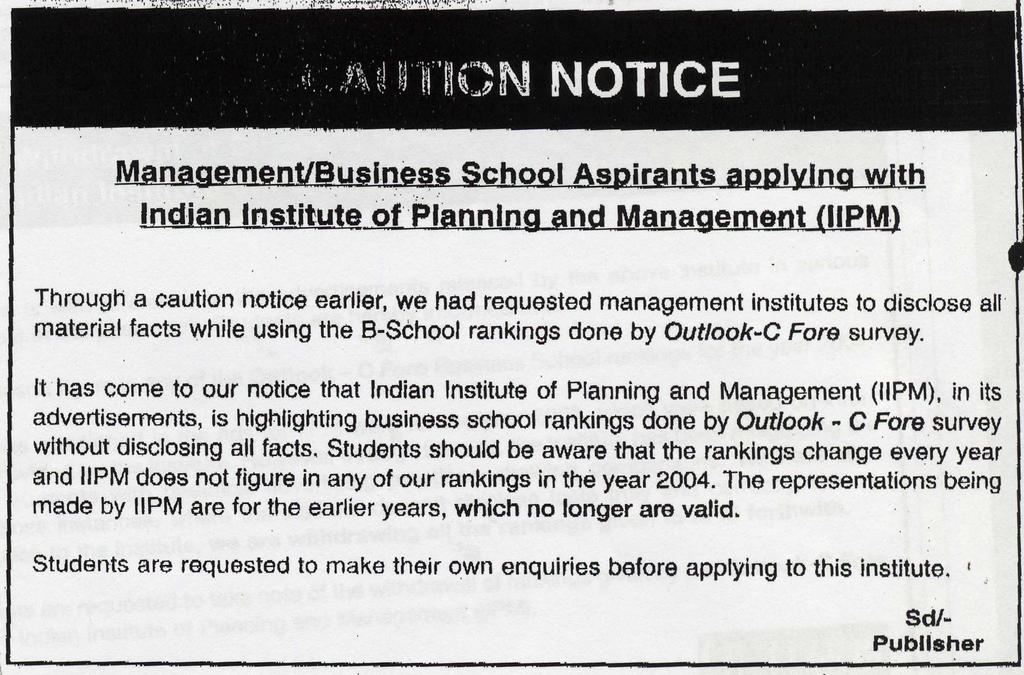
1) Published in Outlook magazine issue dt 4 July 2005, on page 87
2) Published in Outlook magazine issue dt 18 July 2005, on page 34
Sunday, October 09, 2005
Thank you, bloggers
Friday, October 07, 2005
Lies, damned lies and fake blogs
It feels strange to issue a clarification about an imaginary expose written about on an anonymous blog created 48 hours ago with 0 links (and I won't gratify them by providing the first one). But since Gaurav has blogged about it, and it's in the public domain, here's the deal:
The anonymous blogger wrote
"An article by a dubious small-time publication called JAMMAG on IIPM was sponsored by Amity, it turns out. Aaj tak ran a sting operation where it was revealed on camera that JAMMAG, accepted money in cash from Amity group of educational institutions to write a negative story on IIPM, Amity's cmopetitor for business education programs at the post graudate and undergradute level.
The Aaj tak story has JAMMAG employees on camera talking of the deal... and referring to another such deal for a engineering college which wanted to smear the respected IIT Mumbai."
Yeah, right! And the Pope is fasting because it's the holy month of Ramzan!!
There has been no story on Aajtak re: JAM magazine.
There is no expose because there is nothing to expose.
JAM is a magazine which, in the student interest, printed an article to verify some of the claims made by MBA institute IIPM in its advertisements.
Incidentally, the institute spent Rs 5.1 crores on advertising in May 2005 alone, making it the highest advertiser in print for that month, according to the Economic Times.
As for Amity, here's what I've written about them in the recent past
Credibility Crisis
Considering how 'dubious' and 'small time' JAM is purported to be, someone out there is sure going through a LOT of trouble anyways.
A series of 'blogs' (3 created two days ago and 7 created one day ago) have sprouted up, extolling the virtues of studying at IIPM. They are named:
IIPM Infrastructure
IIPM Rankings
IIPM Rankings 'The Real Truth'
Great Lecture by Sir Geoffrey Owen at IIPM
Placements IIPM
Summer Placement in Planman
IIPM is ahead of its time
IIPM's Publication and Research
Real Gaurav Sabnis (To know what Gaurav 'flesh and blood blogger' Sabnis has to say about that click here)
And they even feature 'comments' such as this:
IIPMstudent9 said...
I dont agree - Hindustan Lever, McKinsey and Bank of America came to campus in IIPM Bangalore - but they only offer 7 lac - 8 lac packages! My friends were happy, buit I'm looking for 12 lac packages... guess the international placements will be able to do that... I heard in New York IIPM students get 20 - 25 lacs...
2005 Student
RealGauravSabnis said...
This IIPM movement is really catching on ... here in the UK everyone is talking about your institute after Prof. Arindam Chowdhry attended meetings with Prime Minister Blair, to promote his book The Great Indian Dream,... Cheers!
And oh, 'The Real Gaurav Sabnis' has also blogged about attending a lecture by Prof. Raymond Richardson from the London School of Academics...
There is nothing more I have to say. Or can say. Except send me a copy of that tape! And do mark a copy to Aajtak!!
Scratch and wonder

When you travel Indian Airlines there are no surprises.
The flight takes off an hour late - and of course there are no proper announcements.
The air hostesses are middle-aged, frumpy and despite years of experience don't know how to apply their lipstick.
While other airlines take exactly 30 seconds to show you the safety procedure, that too as the plane is taxiing on the runaway, IA takes the long route. The air hostesses limply fling their arms back and forth showing you the emergency exits (like kids standing in the very back of P.T. class, pretending to do the exercises).
Should there actually be an emergency I bet the IA crew would be the first ones down the chute...
Anyways, the point is there was a little surprise on my flight - out of the little plastic packet which holds the napkins and cutlery came this little 'scratch card'. The purpose of this card was unclear - you don't stand to win anything. And this is what it said:
"Janki and Meera are Raju's wives. Shobha is Meera's stepdaughter. How is Janki related to Shobha?"
Scratch and you find the answer: "Mother".
I am foxed. What kind of thinking could be going into producing this 'food for thought' in addition to the food on the tray ( the only area where IA is actually superior to private airlines).
a) Bigamy is illegal in India. Raju, being a Hindu, cannot have two wives!
b) Couldn't we just have questions like "What is the capital of Uttaranchal"?
c) Shouldn't someone be pulled up for wasting money on useless initiatives like this (scratch cards are not cheap to print - JAM wanted to do one, so I know!)
OK - so we all have choices and don't really have to fly Indian Airlines. Unless like my dad, the government pays for your tickets. In that case, happy scratch card collecting!
Monday, October 03, 2005
Subscribe to:
Posts (Atom)