Wednesday, September 13, 2006

Outlook b school rankings 2006

I picked up Outlook's 'India's best b schools' issue as a matter of routine. And opened it with the usual 'let's see where they screwed up' kind of attitude. Just past experience - coz year after year these surveys never fail to disappoint.

Well, I must say that this year's Outlook effort is better thought out and likely to be a little more helpful to students. I still disagree with the survey on a few points - but overall there is improvement.

a) Year after year survey rankings suffer when some well known institutes refuse to participate. Most notably, the IIMs had decided to stay out of all rankings a couple of years ago.

Solution: IIM A volunteered information. CFore - which conducted the survey for Outlook - used the Right to Information act to get data from the other IIMs.

b) What about Bajaj and FMS? One or the other usually refuses to participate because they score very low in parameters like infrastructure.

Solution: University departments have been listed separately. The bad news is, no scores are provided. Sadly, this means that UBS Chandigarh - which ranked # 11 last year gets slotted as the no 3 'univ department'(below JB and FMS). Not fair, I'd say.
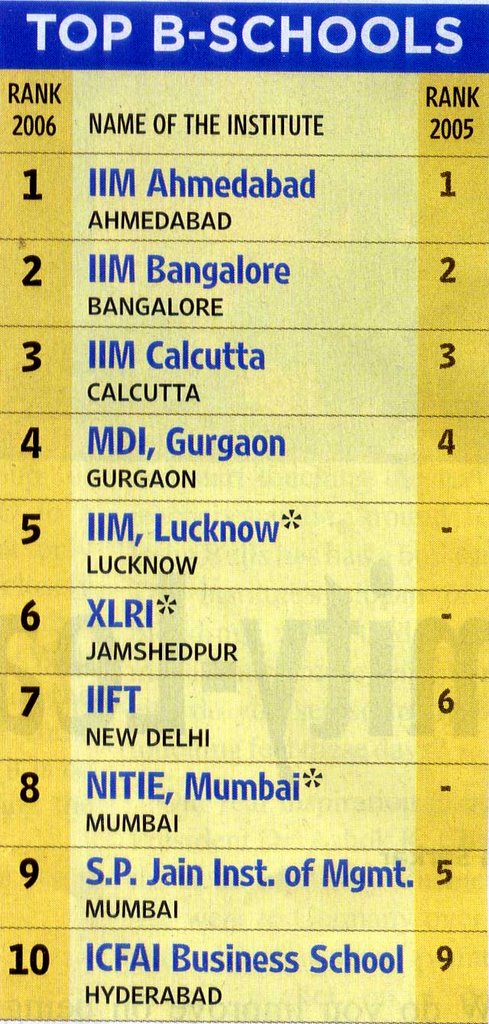


Also, nowhere do we get a sense of where the univ depts stand with respect to the entire universe of b schools. In fact, to avoid controversy, an 'overall' ranking has been provided only for the top 10.

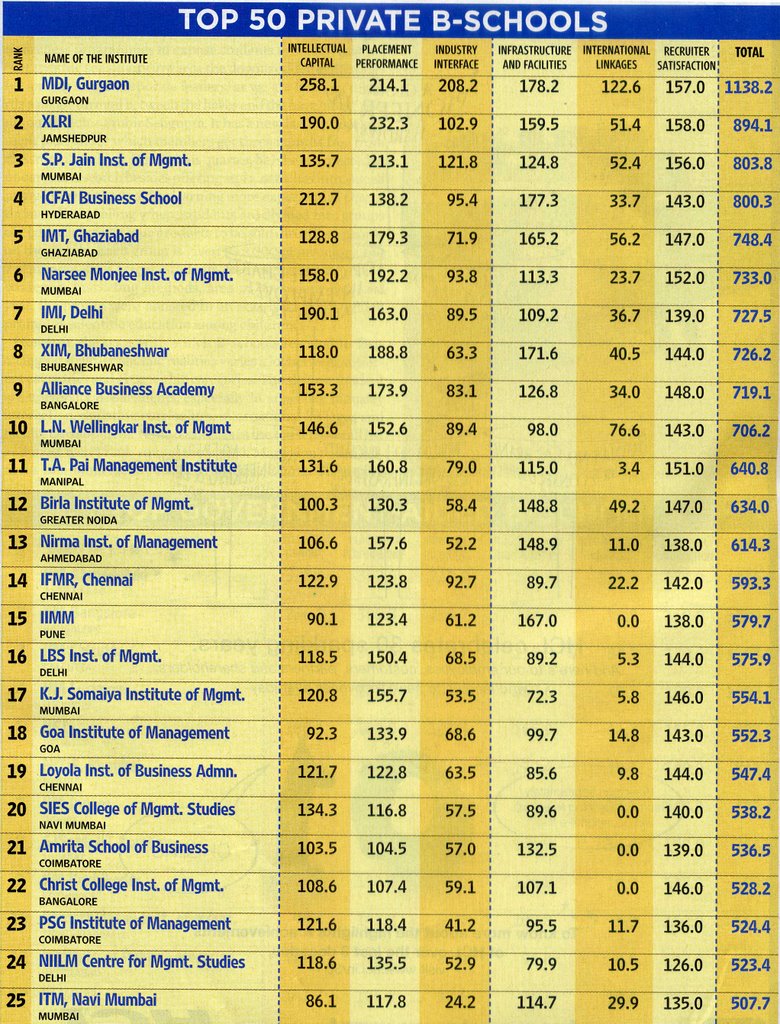


There are separate rankings for the 'top government aided b schools' and 'top 50 private b schools'. (click to see enlarged pic - scanned from mag as results will be available online only from Oct 16)

I like the idea of comparing apples with apples and oranges with oranges. The trouble, however, is that a student is equally willing to bite into either the apple or orange - all he/ she wants to know is: how sweet is it?

And herein lies the crux of the issue. This survey is based almost entirely ie 88% on facts. And 12% on a subjective parameter called 'recruiter satisfaction'. Fair enough (although satisfaction can also broadly be gauged by the fact that a company is coming back year after year to recruit from a campus).

But what about intangibles like 'brand value' and 'alumni network'? They are not factored in - as far as i can see. A way has to be found to quantify and include this X factor - and I think it must be given a weightage of around 20%.

Otherwise the advantage certain b school brands have over the other will never truly be captured... Compartmentalising is convenient but dances around the problem instead of tackling it head on.

The overall rankings
Which Outlook did not publish.. but which can be compiled on the basis of the scores provided. When you mix up the government and private b school rankings the top 25 looks like this (note: univ departments have not been given scores and hence not included in this list).

Figures alongside are composite scores.

1 IIM A (1446.4)
2. IIM B (1219.2)
3. IIM C (1193.8)
4. MDI (1138.2)
5. IIM L (1002.7)
6. XLRI ( 894.1)
7. IIFT ( 873.1)
8. NITIE ( 841.1)
9. SPJain ( 803.8)
10. ICFAI Hyd ( 800.3)
11. IIM Indore( 777.4)
12. SJSOM ( 764.5)
13. IMT G'bad ( 748.4)
14. NMIMS ( 733.0)
15. IMI Delhi ( 727.5)
16. XIM B ( 726.2)
17. Alliance ( 719.1)
18. Welingkar ( 706.2)
19. IIM K ( 658.0)
20. TAPMI ( 640.8)
21. Bimtech ( 634.0)
22. Nirma ( 614.3)
23. IFMR ( 593.3)
24. IIMM ( 579.7)
25. LBS ( 575.9)

A few observations:

1) MDI consistently manages to be ranked # 4. But as far as students are concerned, it's IIM A, B, C and L - then XL, SP, and MDI. In fact on IIT campuses students generally apply only to the '4 IIMs' (not even I and K) and rarely if ever to MDI.

2) IIM Indore or SJSOM would be preferred by most over ICFAI Hyderabad. In fact, despite scoring well on a large number of parameters, ICFAI to my mind does not belong in the top 10 for the following reasons:

- Placement performance is merely 138.2. In comparision, IIM Indore is 222.2, SJSOM 199.1, XIM B 188.8, IMI Delhi 163. The ICFAI Hyderabad class size is 700 which in itself is not a bad thing but certainly puts a lot of pressure on placements, especially quality of job.

You have only to compare the list of companies and designations of jobs offered at their flagship Hyderabad campus with the same at IIM Indore to realise the difference. For example UTI Bank offers 'Deputy manager' positions at XIMB but 'Executive' positions at ICFAI Hyd.

- ICFAI scores when it comes to 'intellectual capital'. While I think their case study initiative is commendable, the books and journals they publish - what I have seen of them - are less than impressive. One can, of course argue that almost all research generated from Indian b schools (IIMs included) is unimpressive. Then, why give an institute brownie points for churning out such material in larger quantities than other b schools and help it achieve a higher ranking?

- ICFAI has an independent entrance exam, which last year attracted 30,000 students. The buzz is that 'almost everyone' gets an interview call. Which may be an exaggeration but certainly the selectivity ratio is not very high

Secondly, not only must you travel to Hyderabad, you pay 3000 as 'interview processing fee'. So imagine, a cool Rs 3-5 crores is in the ICFAI kitty even before you join the course. This is not a practice one associates with institution of repute. Especially given the high course fee charged in any case ! (Rs 5.5 lakhs excluding boarding/ lodging)

3) IIM Kozhikode has been ranked no 19. It won't affect student interest in the campus ('IIM is after all IIM yaar') but it helps answer the question: I or K? Clearly Indore has established it is # 5 in the IIM hierarchy.

So yes, IIM K ranked # 19 appears absurd but, seen objectively, it should be a wake up call to the institute. Sure, it has the IIM brand name but that should not make it complacent.

Kozhikode appears to have a problem with intellectual capital. In fact, there's been an exodus of sorts last year. Notice the lack of full time faculty (barely 25%). Strangely enough the 'academic background' of the guest and adjunct faculty remains undisclosed on the website although I can tell several are professors at other IIMs.

K and I also suffer on industry interface. As Premchand Palety rightly observes in the opening essay 'The New Badshahs':

A major reason for their bad performance is location disadvantage. For effective industry linkages, any B-school should be near a corporate hub. Explains Pritam Singh, ex-director of IIM-Lucknow, "To achieve excellence, a B-school must have a business lab, like medical colleges have hospitals, that provides real-life exposure to live cases and projects." In light of the experiences of IIMs in Lucknow, Indore and Kozhikode, he questions the government’s wisdom in starting a campus in Shillong.

4) There are some absences in the Outlook survey, notably: all IIT b schools except for SJSOM, Symbiosis and related instis, and MICA.

If RTI could be used to extract info from IIMs, I think the same should have been done for IIT SOMs. If I were an engineers an IIT SOM would rank far higher on my list than several institutes outside the top 10.

Symbiosis, it appears, declined to volunteer information - although it has given an ad in the issue. They're smart enough to know they cannot repeat the no 4 ranking achieved in the Business Today survey.. so better to not be featured at all than explain an inglorious tumble.

Also, there is a separate feature on ISB, there is no mention of Great Lakes. I guess in times to come 1 year programs will be included in rankings as a separate list.

So what would I do as a b school director?
1) Add international linkages - exchange programs for both students and especially for faculty. That's one area MDI has absolutely cracked - it has a clear 70 point lead over rivals like XL and SP and all IIMs except A, which is almost equal.

I also think the ranking of the institutes you tie up with for exchange progams should be taken into account in some manner. Otherwise the parameter could lose its meaning.

2) Get an international accreditation. It's not easy, of course but MDI scores here again, with both Equis and AACSB accreditation.

3) The one thing you can buy with money is infrastructure - buy it. Most b schools are doing it in any case as the 2006 business school ratings of the All India Management Association (AIMA) published in Business Standard notes.

However, going forward we need to ask some questions: if a laptop for every student is fast becoming a norm, need we list computer: no of students ratio as a parameter?

And well, I could go on and on. But suffice it to say that if the recent Business Today b school ranking got an F, the Outlook survey gets a passing grade - but not distinction. Some of you may think I'm being too generous but I feel, taken in entirety, the rankings and the accompanying articles provide some perspective to the current b school scenario.

IIMs pe gussa kyun
I do wish, however, that Outlook would stop making statements like this:

Experts agree that while institutions like IIMs played a big role in raising the standards of management education and curricula, they gave little thought to the creative use of ecology on campus and connecting the students with nature. The new-age business schools have stepped in fill that void.

Evidently, the writer has not visited an IIM campus!

Then there's the anguished "Dalit students still get a raw deal":

...Students belonging to the SC/STs, who pass out of premier institutes like the IIMs, are still at the bottom of the heap when it comes to remunerations...The average salary for Dalits is at least Rs 2 lakh per annum less than the institute’s average and normally a Dalit is the recipient of the lowest salary offered at the IIMs. For instance, while the average salary for all students at IIM-A was Rs 9.7 lakh, the figure for the reserved category students was Rs 7.8 lakh.

So what is the point being made? That the highest paid jobs should also have quotas for reserved candidates? The article concludes that the differential is mainly attributable to lack of soft skills. But as a Dalit who graduated from IIM L points out:

Although IIMs offer special sessions for Dalits to tide over these problems, Doss admits that in an extremely competitive environment, there is a stigma attached to attending such remedial sessions, and most Dalits choose to give it a miss.

One question I would like journalists to ask is whether private b schools - on their own - are making any efforts to add diversity to their classrooms in the caste context.

If they can claim to emulate Harvard or Wharton in other areas -how about this one?

Sorry for the goof-up...
And finally, only Outlook would have the guts to acknowldge this error: a 2 page 'ad' by Amity cleverly disguised to look like two regular pages of the magazine. And its placement at the very beginning of the survey story makes it all the more misleading.

The following clarification has been published on their website:

On pages 28-29 of Outlook magazine dated 18th September 2006, there is an advertisement titled ‘Amity – Leading the pack.’

This is a paid advertisement released by the Amity Business School, Noida which was carried inadvertently. This, in no way, represents Outlook-C Fore survey.

The Amity Business School, Noida is not amongst the Outlook – C Fore rankings and, in fact, wasn’t included in the survey. The school has been refused approval by the AICTE which has been challenged in the courts. Right now, the matter is sub judice.

We regret any confusion that the advertisement may have caused to our readers.


The clarification will be carried in the next print issue as well. And for that sincerity, so rarely seen in a big media house, we must be grateful!

Tuesday, September 12, 2006

'Hutch Tuesdays'

Bet you have seen the hoardings and ads for the Hutch 'Tuesdays' offer. Tuesdays are the slowest day of the week for most malls and multiplexes, so any promo that revs up sales would be welcome.

What's more, it's a simple buy one, get one free deal applicable at Dominos, Barista, Fame and several other interesting outlets. But I don't have the full list and so I go the Hutch website in search of what's on today. Forget being highlighted on the homepage, you can't find a whiff of an offer - anywhere on the site.

OK, so someones remembers getting an sms from Hutch, we check it and call 123500 for details. And manage to download the 'm coupon'.

Now to contact Domino's. Again we check for the number on the net and call the Prabhadevi outlet. After much deliberation, the voice at the other end declares, " We don't deliver". Uh, Domino's does not deliver? Then what does it do??

The mystery is solved when they explain this is actually the Khar outlet. OK, so we dial Prabhadevi. There is more confusion at their end regarding the offer. We are about to abandon the search for cheesy nourishment on a night-when-we-will-be-working-late when someone finally gets it.

And in another 20 minutes, the pizza should be here. Or will it? The suspense continues. Thank you 'Hutch Tuesdays' for adding a little excitement to our dreary lives.

As if hanging from the office staircase to receive your faint signal... was not enough.

Monday, September 11, 2006

Jeans not allowed - what next?

Guttural manly voice :

Swapna sundari wearing maxi
Getting out of a yellow taxi
Walks into a club
Paagal ho gaye sab
Surprisingly.. she chooses me.


Squeaky high pitched female voice

Is that a pen in your pocket mister? Or are you .. just happy to see me ??... Lexi pens, now, in every paacket in your city

This ad for Lexi pens (listen to it here) plays day in and day out on the radio and I am not sure what to make of it. I mean it's silly enough to pass off as humour and yet.. in a country where colleges are banning jeans because :

a) it ensures discipline
b) low waist jeans and short tops represent a threat to collective morality

It shouldn't be long, before 'pens in pockets' get the axe ...

And what about toothpaste? Colgate Maxfresh gel with cooling crystals has a radio ad which goes something like this :

Woman interviewer : I see you are an MBA.. that means Married but Available

Flustered man: Um.. but..

Woman interviewer: I want you to work under me... So would you like to be paid in kind.. or kind?

And there's another version of that where a girl goes to buy a movie ticket and the guy at the counter says he has two.. but only if she agrees to sit next to him.

Not sure whether this will help the product.. considering that this is not Italy where even waiters look like they just stepped out of a movie set. But hey, toothpaste is becoming a risque item - parents, guardians and principals please note. Who knows what impressionable young minds are thinking as they brush each morning...

And of course mints.. they need to be banned too.Now that Polo is running its 'sabse bada hint' campaign. Kya pataa kaun kise kya hint de raha ho...

Bottomline : Sex can and is used to sell anything and everything... On the other side, the powers that be are trying hard to hard to sell 'decency' as a virtue. Confusion nahin hoga to kya hoga?

Ab Lexi pens ko hi dekh lo.The TV commercial is the 'wholesome' type. Mummy in a sari, cute kid, chacha. The radio ad on the other hand is about swapna sundari and not so subtle double entendre. It's all about tailoring the message for the audience.

The parallel with real life couldn't be more apt. All that parents and principals can demand is 'appear wholesome' in front of us. Peeth peechey kya ho raha hai.. woh to khuda hi jaane. Which seedha saada kid metamorphoses into 'studboy18' or 'ilikeithot21' while chatting late into the night - kya pataa?

The age of 'multiple personality on order' is upon us. As the Fastrack guys put it: 'How many you have?'

Omigod that was one of those ads... wonder if colleges would like to consider banning watches on campus as well?

Friday, September 08, 2006

The perils of user-generated content

'Keep an eye out for fashion and capture it on your Nokia camera phone. From clothes to accessories and personal style statements. Click anything you think is in vogue.'

That's an invitation from Nokia 'Eye on Fashion', which was one of the official sponsors of the Wills India Fashion Week. As brand-linked consumer promotions go, it's a good idea. But here's the problem:

1) Are the people getting clicked giving their consent?

I would think the answer is no, in many cases. And this applies especially to girls - like this one featured on page 1 of
www.nokiaeyeonfashion.com.. She appears to be simply walking down the road when one Gopal Raghuwansi clicked her on his camera phone and susequently uploaded her pic on the site.

I know this is very common. Ask any young and decent looking woman and she will tell you there are innumerable occassions when she wonders :"Is he sending a message or trying to take my picture?"

Believe me, it can creep you out, especially when the person taking the picture has *that* kind of studied casual look. The same which guys who brush past you in the bus usually have.

Of course the guy taking the pic may not have evil intentions. One young man once showed me a bunch of pics he had clicked of women, sitting in coffee shops. It was just a kind of 'timepass' - a thumb sport of sorts.

On the other hand, he could have been telling his friends 'this is my latest girlfriend' but one loser can usually smell another. I'm sure they'd know.

I don't know what the law says about this kind of photography in India, but as a company Nokia should not be encouraging it. At the very least, they should advise people who will participate in the promo on the need to get permission from the subject being clicked. It might be hidden away somewhere in the 'terms and conditions' but I could not see it.

In any case, something so important should not be hidden away in the fine print.

Also, I wonder whether the same rules apply to the 'citizen journalism' variety of photography and this kind of promo linked photography.

Today, when any kind of major news event such as the London bombings or the Mumbai train blasts occurs, some of the best pictures and videos are taken by ordinary people who happen to be there and possess camera phones. These images are often widely distributed - I'm not sure how many individuals get paid for rights. But you could argue - even if they get paid - it's a visual slice of history.

In case of a promo like 'Eye on Fashion' - that's not the case. The guy clicking the pic hopes to gain commercially - there are prizes to be won including designer clothing, Nokia 7360 or 7370 fashion phones. One lucky bum will even get a luxury handset - the 'Sirocco'.

2) The second worry is the Quality of the photos featured.

They are absolutely pathetic! Flip through the 11 pages online currently and at least 33% of the pics are self-portraits of guys wearing sunglasses. One even described himself as 'Googgles clothing'.

Other 'style statements' include a little girl in a shiny 'I want to be on Boogie Woogie' dress and a lady working in a tea garden. Frankly, the tea picker has more attitude than most of the jignes and bhaves types on the same page... All in all, not what Nokia probably had in mind when it conceived of this contest!

The other not-so-surprising fact is that the pic of the girl in pink has received 5263 views and 4946 votes. Whereas the boys on the same page mostly have votes and views in double digits. This says something about the profile of :
a) netsurfers
b) people who click camera phone pics and submit the same

Both are still predominantly male... and so lacking in style they wouldn't recognise a 'style statement' if it planted a slobbery wet kiss on their forehead!

Wheat vs chaff
The idea of 'user generated' content is a great one. And it works when you have millions and millions of people contributing such content - like at youtube.com. From a mountain of boring / mediocre trash you find a few gems and the system is designed such that users push these gems up to the top of the pile.

But when the number of users you attract is fairly low... you don't have enough gems. And the trash attracts more trash and repels people who actually have quality content. Because you haven't created an environment where the ego-driven creative types would like to showcase their work.


The problem is compounded when the site has a commercial angle. Take Sunsilk Gang of Girls. Extensively advertised, beautifully designed. But the blogs on the site? A couple are barely okay, the rest are simply not happening!

I say this not out of the haughty attitude that all blogs must be deep and meaningful. Teenage girls will write about crushes, cruel parents and pimples. But there are trendsetters and influencers who can write and express themselves well - and hook readers. Those girls are not patronising the site. And that cannot be a good thing for the brand!

So what does one do? I think you cheat a bit. Employ a few good writers to set the right tone for 'user generated' sites. Of course, what they write should not be all stiff but if you can get that 'amateurly professional' vibe you will attract more content along the same lines.

In fact I am even more convinced of the need for such a strategy, after recently covering a bunch of entrepreneurs setting up 'Web 2.0' companies in India for Businessworld magazine . These include soon to be launched social networking site yaari.com, consumer search engine onyomo.com and review site burrp.com

The Mumbai edition of Burrp has been up and running for 3 weeks now but generating those user generated reviews and reccos appears to be a very slow process! At the very least, if I were running Burrp I would hire a trainee, give him/ her a digital camera and go shoot all the restaurants being written about!

Not to undermine the importance of user participation and contribution... but from long experience with JAM I've learnt you have to tweak it and channel this raw energy to get the best possible results. In short, even user-generated sites need great editors...

I could write a lot more on this subject, and I will one day. But right now, it's time for some lunch!

Tuesday, September 05, 2006

Singled out

DNA reports:

The new face of Mumbai — young, single, and independent — wants to make it big. But it is a tough task in a city that seems to have no room for them.

In a market where demand exceeds supply, singletons have the toughest deal. They are at the bottom of the list of desirable tenants for housing societies that govern the affairs of buildings in the city.


Hmm. The more things appear to change, the more they don't - at some level. What do housing societies fear? That singles will spoil the 'peace'. Play loud music, bring home boyfriends and girlfriends, host late night parties. Basically, do a whole bunch of things that Mr & Mrs Solanki in apt 2b never had a chance to do in their youth. Or perhaps did, but gave up after they 'settled down'.

Of course many Indian singletons simply go to work, come back, eat a tiffin and crash out in front of the television. Just like boring old people. But society waale sochte hain, why take a chance ?

Sameera Khan, a researcher with the Gender and Space Project at Pukar, said, “The city is becoming exclusionist. Anyone who does not conform to people’s social standards is not accepted.”

I think the problem is now magnified - because of the sheer numbers and a shift in attitude. Ten years ago if you were young and single, you lived in a hostel or as a PG. If you were really lucky your company provided a shared accomodation ('chummery').

Now I notice a lot of young people prefer to share a flat with a few friends, rather than suffer odd rules and curfews at a hostel. Or the cramped lifestyle and general lack of privacy in a paying guest arrangement. Sharing a flat is sometimes cheaper, sometimes more expensive than other options.The more important thing is the freedom it accords you - and the fact that it feels like a 'home'.

The home bit is crucial because the average working professional may be single for a while. I remember most of the girls who completed their MBA with me got hitched by the time they were 25. So their single-and-alone-in-Bombay stint lasted just about 2-3 years. And the guys within 5 years of graduating.

That would still hold true for many today. But a larger prportion of the young, working population is waiting longer. For this bunch, 30 is the new 25. Hence the rising demand for single accomodation.

The answer, perhaps, is to have separate housing societies only for young and single people. "No kids allowed. No married couples allowed. No aunties in polyester salwar kameez allowed." Only dogs, dudes and live ins!

But seriously, we need to become more tolerant of people with different attitudes and lifestyles. Shaadi must not be a be-all and end-all. Actually, it isn't. Once married, the next worry everyone around you has is: "bacche". And once you have that there are not so subtle hints that the child needs a sibling. And so it goes until these kids are married and reproducing...

On a related note, I must bring up this peculiar tendency people have to bring up one's marital status. In a context where it is utterly irrelevant. Two b schools I was invited to speak at recently introduced me as 'Mrs Rashmi Bansal' and it bugged me slightly. Not enough to take it up with the organisers, but enough to write about here.

So marry - or don't marry. Either way that should not be of concern to your landlord. As long as you pay the rent and don't store RDX in his house. But, that kind of 'live and let live' spirit is still rare.

The question is: twenty years from now when you are Mr & Mrs Solanki in apt 2b - will you have it?

Friday, September 01, 2006

'Student' politics

'Age no bar for DUSU Polls' reports the Hindustan Times

The presidential candidates of ABVP and NSUI for Delhi University Students Union - Gargi Lakhanpal and Amrita Dhawan - are doing their graduation for the second time. Amrita, who is a commerce graduate from Bharti college, is pursuing an undergraduate course in History from the same college...

Gargi, on the other hand, first completed her Bachelor's degree in History from Lakshmi Bai college and then went on to join Aurobindo College last year for contesting the DUSU joint secretary's post, but did not appear for her exams. This year she has enrolled for BA with Aditi college saying it is more 'professionally oriented'.


Yeah, especially when the 'profession' she has in mind is a career in politics. Apaprently she tried to join a post-graduate course, but failed and hence settled for undergrad.

Two questions come to mind:
a) Why are such applicants admitted? Obviously under union pressure
b) Can we call such people 'students' at all?

I mean the primary goal of ordinary students is to study. Which is obviously the last thing on the minds of these people. Naturally they are disconnected from the real concerns and issues important to genuine students.

It's a vicious cycle. Genuine students keep away from politics. So these fake students step in to fill the vaccum. Seeing the kind of 'leadership' which exists, even the few genuine students who may contemplate standing for elections are scared away. And the rot continues.

As the HT article notes, most 'student leaders' are in their early 30s! NSUI, has therefore set an 'upper age limit of 27. But NSUI office bearers are all over 30 or nearing it. ABVP doesn't even pretend to have an age limit. The state gen. secy Nakul Bhardwaj told HT: "You can be a student at 40 too."

This ridiculous annual exercise - as well as the tragic muder of a professor n Ujjain by 'student' leaders - prompted me to write this column for sify.com.

It's called 'Students, politics and career paths'.

On an unrelated note: The HT website is not very helpful. I can't provide a link to the article quoted above because I can't find it - either on google or HT online. I trawled through their epaper archive but while I could view the article there I could not copy-paste it (that 'function is disabled') or link to it.

It would have been faster to type in the relevant paras - which is what I finally did. Web edition ka kya fayda?

Thursday, August 31, 2006

Impressions of Cochin - 2

And here are some of the other things that struck me about Kerala :

1. The backwaters are not just beautiful but amazingly clean. Wonder how and why? Where do the villagers dump their waste? And can we in the rest of plastic-bag India not learn a thing or two from them??


2. Banana can be eaten steamed, fried or sauteed. For breakfast, lunch, snack or dinner. And still taste good!

3. Coke and Pepsi are indeed banned. But there are underground channels to procure the stuff - like you have for booze in Gujarat!


4. Gold, gold and more gold. Every third hoarding bears smiling young women - thin, fat, young, middle-aged - weighed down by the precious yellow metal. And oh, you can even take a 'gold loan' at 12% to buy the stuff, wear it and stash it away in a locker.

Also prominent on billboards: apartments for sale and mens' underwear.

5. Buses in Kerala have no windows. I mean glass ones. Perhaps too many have been broken by protesters and unions in the past?

What they protest and unite for is not very clear. On a Saturday morning on M G Rd, I saw a few people holding placards that read : "Down with the Unholy Alliance."

Coke and Pepsi?
Bush and Blair??
Shahrukh and KJo???

Notwithstanding all this, I had a lovely time. Met some wonderful people. Ate good food and drank in some amazing sights. I definitely hope to visit Kerala again. And again.

pics taken with a Nokia 6670 1 mp cameraphone. Not too bad, huh?

Wednesday, August 30, 2006

Impressions of Cochin - 1

I'm standing in the lobby of the Taj Residency in Cochin when this poster catches my eye. The Last Friday promises 'blinding lights, intoxicating sounds' from 12 noon to 6 pm. As it's nearing 2.30 I head in the direction of the dull thumping sound where the young people of this fine city appear to have gathered to let their hair down.

Well, there were lights alright - excellent sound too. But a total of 8 people, two couples huddled on a sofa and a gang of boys staring at the empty dancefloor. In the adjoining bar, I finally spot a girl who looks like she's dressed up for the party. Slinky heels, danglers, orange halter top.

"No sweetie.. I'm a model from Bangalore," she drawls. Uh huh. A friend of the organiser - a dude looking young man who plays it cool when I ask him where the crowd is. "They're coming.. ," he says vaguely.

Simon's family is in the icecream business - they make the stuff that's sold under various local brand names like 'Lazza' and 'Uncle John'. The guy is obviously loaded and has taken upon himself the responsibility of making Cochin more 'happening'. "I plan to open up a cafe on Marine Drive where the youth can hang out... a really cool place."

'The Last Friday' has been advertised on billboards and in the local papers. Entry is just Rs 300 per couple. So why isn't anyone coming? Could it just be one of those freak flop events, or does it say something about the party culture of the city? Rather, the lack of it...

Of course, 'afternoon discos' are not peculiar to Cochin. Not at all. All over India, afternoon jam sessions are the answer to parental restriction on 'staying out late'. Especially for girls.

But Cochin - from the half a dozen young people I spoke with - seems to be a step ahead of most other cities in the restriction department. The girls hostel in a local college closes its gates at 6.30 pm. The swanky new mall on the one and only 'Marine Drive' is deserted on Friday night at 8 pm. And that's a week before Onam - when you would think it would be crowded with festival shoppers!

Where are the jobs?
With Bangalore and Mumbai also applying the brakes on nightlife (although partially lifted - the spirit remains crushed) I'd say parties - or the lack of them - does not define how happening a city is for its young people.

What worries me more is the lack of job opportunities.

Of course, Kerala is known to be a 'Gulf economy'. But the new generation hardly seems as keen to go that way. Devin is a twentysomething with an M A in History and a love of photography. He briefly worked in a call centre in Mumbai before dumping the job and heading back home.

"It was very hard," he says."No proper food, no friends... " But lady luck smiled on him. He's now got a job with Carnival cruiselines. How, I wonder, without a degree in hotel management? "A friend is working there already... so he gave my name," Devin grins.

The I-help-you, you-help-me culture seems particularly strong in Kerala. People really seem to go out of their way for their friends, relatives and neighbours.

But what will he do on the ship, I wonder. "I will be taking photos," says Devin. He demonstrates: "Hello madam! How are you today? You are looking very beautiful...Pose for photo, please?"

With his accent, smile and pleasing manner, Devin will easily pass off as Latin American.

Exporting vs outsourcing
While the rest of India - including Communist West Bengal - is trying to attract investment, the Kerala government is least concerned.

The only state in India that boasts 100% literacy must still export its human capital to the rest of India - and the world - because few want to take the risk of setting up shop here. The unions are just too much trouble.

But there's another problem when it comes to call centres: almost everyone has a thig agzent. It soundz very kwent but probbly nott to the years of ech aar maangers in BPO combanies.

Surely something training can and does tackle. But the point is you have to migrate to Bangalore, Chennai or Mumbai (Miami, in Devin's case) if you are serious about your career.

There is so much beauty in this state that rightly calls itself 'God's own country'. But sadness as well, for it could be so much... so much more.

Thursday, August 24, 2006

Clarification re: CV fudging

An update on my previous post. Several people wrote in to clarify that the CV fudger did get punished.

"The person was issued an Out of Placement service ticket (OOPS) and the firm where he had received a PPO earlier was also duly notified... The only action that was NOT taken was expulsion of the student from the institute."

I am glad to hear that - it sends out the right signals against such behaviour.

Some of you made a point about me 'glorifying' the fact that Gaurav Mathur did not fudge a certificate. I don't agree.

The point is the certificate was a mere technical requirement. There is no doubt that Gaurav would have genuinely completed it in a month or two - so fudging would have bought him the time and allowed him to keep his seat.

That is why it was a bigger dilemma.

The problem of some universities not completing their session in time is not new. It existed way back in 1991 when I joined IIM-A. It's about time the authorities concerned addressed the issue and did not penalise students.

A deferred admission could easily be granted while offering the lost seat to someone on the waiting list!

Lastly there is the issue of MBA institutes wilfully inflating placement salaries. Yes, something needs to be done about this.

Several people have left comments and sent me emails pointing a finger at IIM Bangalore. The charge is that the average salary figure released by IIM B in March 2006 was originally Rs 8.7 or 9 lakhs. But after other institutes released their figures, it climbed to Rs 9.8 lakhs - the highest across all IIMs.

How? An IIM student points out:"They had conveniently included a clause stating that only salaries of those who had agreed to disclose were accounted for! This means the bottom 20% can peacefully be ignored for calculation as they would have "not wanted" to disclose salaries..."

I think it's fairly simple to arrive at 'correct' placements figures. All the institutes must agree on a single method of computing averages and allow the process to be externally certified.

But this means that institutes have to get over their obsession with making headlines like "IIMX student gets 95 lakh offer" . And also stop judging their self worth by 'beating' everyone else when it comes to the average salary figure.

Perhaps IIM B has something to say in its defence - I would be glad to hear it. The idea of airing these issues in a public forum is to generate debate on this subject much before the placement season.

One method that could be adopted to ensure greater transparency in placement figures:
- Average salary for students with 0-2 years experience (basically freshers)
- Average salary for those with 2-5 years experience ('junior lateral')
- Average salary for those with 5 years plus experience ('senior lateral')

Of course Indian and foreign salaries should continue to be mentioned separately. And lowest salary figures must be released as well.

Media needs to be a little less gaga and a little more critical as well.

And yes, all this applies not just to IIMs but all MBA institutes. Coz inflation is something a lot of b schools are indulging in.

To take things a step further, there are instances of lesser known institutes who are 'tying up' with HR heads of certain companies to ensure their students get placed. Yeah, they actually keep aside a separate budget for this purpose.

The larger question that begs to be asked: is a bschool in the business of education or merely a glorified job placement agency?

Tuesday, August 22, 2006

Ethics of MBAs II

Character Aptitude Test
Character is what you do when no one is looking. And that is something an IIM cannot teach you.

(originally published on www.businessworldindia.com where I write a monthly column titled 'Life, liberty and the pursuit of yuppeiness')

Like thousands of twenty somethings, Gaurav Mathur dreamt of getting into an IIM. Unlike thousands of others, he actually did make it. But his dream was cut short just two weeks into the course.

A condition for joining any of the IIMs is that all the requirements for graduation of the student should be complete by June 30, 2006 (that is, in case the student does not have a Bachelor's Degree) for joining sessions of 2006-2008 batch.

In Gaurav's case, this was not so. Gaurav had just completed his fourth year of studies at MBM Engineering College, Jodhpur. After fighting a court case, he had succeeded in getting all the theory and practical exams done by June 30, 2006 but his Project, Seminar and Educational tour were still pending.

“I asked my case to be considered by Rajasthan University and made all sorts of efforts, but maybe because of the court complications (or simply my bad luck), things didn't turn out right. I then put my case to IIM Calcutta,” says Gaurav.

IIM C agreed to consider his case but asked him to sign he would abide by the decision of the Academic Council. The Council decided against Gaurav, and he was asked to leave IIMC.

But I am moved to write this column not to rant against rules and bureaucratic procedures – yes they infect even the IIMs which, ironically, impart education in management . This column is about the choice that Gaurav had – but didn't make. A choice which would have allowed him to keep his hard-won seat. But one he did not make because his inner voice would not allow it.

In Gaurav's own words:

There was little chance that my project etc would be completed before that date. I fought hard for it. But I knew it was almost impossible. So there were 3 choices left -

1. Convince some teacher to sign the certificate.
2. Forge a sign and put a false seal.
3. Modify the certi, honestly say that projects etc were not complete and plead before IIMC in the name of Justice.

Since no teacher was ready to sign a fraud certi, option 1 was out. Option 3 was almost sure to not let me inside IIMC …

Well wishers urged Gaurav to take option 2. A friend even had a copy of the seal to be forged and signing would be no big deal for anybody. Apparently, a babu would be checking the certificate – he would just take a look at it and put it in a box – ‘to be opened only when I would leave IIMC with my degree'. And everything would be ok by then.

Says Gaurav: “Looking at the practical side… I was doing nothing wrong. I deserved IIMC. I had earned it. And my seat will not be going to someone else. It is wasted. So I was not harming anyone either. And this logic was strong. Even my dad was ok with me getting a false sign on that certificate. (My friend) Sundeep had talked to him. Kabhi kabhi Krishna ban na padta hai.”

But something was not right - Gaurav was torn apart. What's more he had a scooter accident – and many other near accidents – which he took as a sign from God to do ‘the right thing'.

Finally on 29 th June 2006 he decided against submitting a forged certificate. He took his chances with the Academic Council and lost his seat.

Says Gaurav, “I do not regret my decision. I still have a lot of pain and anger in me. But somehow, among all the consternation and chaos, there is peace inside my heart. When you think about it, that inner voice, that self - respect, and yes, your bloody life.. is more important than an IIM.”

Faced with a dilemma similar to Gaurav, most would have chosen differently. Especially in a case where, like him, you have a reasonable chance of getting away with it. That's exactly what happened at one of the IIMs during the placement season earlier this year. A Placecom (Placement Committee) representative was found to have embellished his bio-data.

The ironic bit is that this institute has a mechanism to curb such fudging – all students are asked to submit their CVs for verification before they are accepted as the ‘official' CV to be given to recruiting companies. But here's the thing – the Placecom reps are the ones doing the scrutiny and so it really becomes a case of ‘who will police the policemen?'

The matter reached the Dean and acting Director of Placements. But can you believe it - - no action was taken! To quote a student who watched the entire proceedings with shock and disgust, “The guy escaped without a hair unhurt and was followed by others who were similarly inspired by him to decorate their resumes!”

The actual ‘decoration' falls in the nature of the inane. Some of the discrepancies (identified by comparing the candidate's summer placement and final placement CV):

• ‘All India Winners – FCB Ulka Marketing Case contest' (truth: his team was shortlisted for the final but did not actually win)

• Finalist (top 5 out of 200 teams), Marketing Case at Confluence – the International Business School Festival of IIM Ahmedabad (Confluence website shows his team was not shortlisted)

• Award of Honour for securing 3 rd rank in North India (in the summer CV he claimed to have got 4 th rank in his city – no mention of state honours)

And there are 9 more such points. All small - and in my opinion unnecessary lies - but which add up to one thing: lack of integrity.

What is worse is the institutional response – rather the lack of it. The thought of ‘ruining a fine young man's career' is what probably stopped the authorities from taking appropriate action. Which I think should have simply been: ‘debarred from placement'.

And I don't think their kindness will teach him any kind of lesson. If anything, he would be emboldened, knowing that one can get away with it. And so would others.

In fact, Gaurav Mathur had far more to lose – and yet he made a difficult choice. The CV Fudger was a high performer anyways, and the fudging was merely to improve his chances of getting into a ‘dream job' where competition is stiff. And that I feel makes his action even more damning. Not to mention dangerous…

Because there are a number of job profiles where you have enough freedom to be tempted to misuse it. And there can be horrific consequences, as IIM Bangalore graduate Anshul Rustagi learnt the hard way. According to news reports, Deutsche Bank dismissed the 26 year old derivatives for overstating profits by some 30 million pounds over a two-month period last year. He left the bank following a disciplinary hearing on January 10 th 2006.

Anshul traded complex financial instruments known as synthetic collateralised debt obligations (CDOs). The Financial Times noted: "The London-based former rising star was involved in trading highly illiquid and innovative products in the fast-growing world of credit derivatives and was part of a team given a free rein by the bank. Deutsche Bank executives said that in rarefied areas such as complex derivatives there was more reliance on individual bankers than on the risk managers who control them".

The motivation: most likely, a higher bonus. Given the complex nature of the instrument Anshul would have hoped to eventually make that money or square off the overstatement in some manner – and nobody would have been the wiser. But his luck ran out.

It all boils down to your personal value system. Of wanting to be a ‘star' even if it means doing the wrong thing. Justifying to yourself that others probably do it too, so what's the big deal?

The latest KPMG Forensic Integrity Survey found that there's been ‘no real decrease in the amount of unethical activity going on inside companies'. 74 % of employees reported misconduct, compared with 76 per cent five years ago. The level of serious misconduct now stands at 50 %, compared with 49 % in 2000.

So maybe the CV fudger has it all right after all – and will go on to do brilliantly in his corporate career. Gaurav Mathur, with his more active conscience should consider other career options.

Also read: my earlier post: Ethics of MBAs

Correction: The CV fudger was in fact debarred from placement - but not expelled. Read my update.

Monday, August 21, 2006

CA vs MBA

During my last chat on rediff, someone asked the following question :

vic asked: what do u think of chartered accountant career in terms of rewards it carry? kindly suggest

This is what I answered:CA is a good and rewarding career although like in medicine, building a practice from scratch takes time. Of course there is the option of working for someone else -- CAs are in demand in the industry like never before.

KPOs, equity analysis and accounting firms employ a lot of CAs at very good salaries. But remember it can be a very boring profession if you don't like working with numbers. So don't make a choice based only on the job potential!


Half a dozen readers sent in angry emails saying that Chartered Accountancy was a great profession – and that I was projecting a wrong picture. That no profession can be termed as ‘boring’.

Well, I’m afraid I can’t be politically correct and will go out on a limb to say that CA – despite being a respectable profession with great career prospects – has lost out to the MBA. And like it or not, this trend will only grow stronger.

The ABCD of CA
Ask most engineers, why did you do a B.E. and they’ll tell you: "That’s what all bright students who opt for science do.. unless they want to do medicine."

The situation is something similar with CA. ‘That’s what all bright commerce students do.. unless they want to do MBA. ” Of course the situation is a bit different. Even those doing the CA may eventually top it off with an MBA.

The difference between the CA and MBA is a bit like the difference between a 5 day test match and 1 day cricket. Acquiring a CA takes a lot of plodding and perseverance and at the end of the day, a result may prove inconclusive.

The MBA, like one day cricket, is quick, glamorous and performers get faster recognition as stars.

OK, let’s not stretch it. One day or five day – in both cases the players hold a bat and throw a ball. In case of CA and MBA, there is a difference. Both may join the same companies but their job profiles would be completely distinct.

This is not to say that one’s job is ‘superior’ to the other but the fact is that starting as a CA, you can expect to climb up the ladder upto the CFO position. While an MBA’s career path could - in theory – lead upto CEO.

The reason for this is simple : being CEO is about vision and leadership. This would require you – at times – to take a leap of faith, even when the numbers are against you. For example, you diversify into a new area of business. This may mean investing a lot of money, literally burning cash in the initial phase. It may look very bad on the balance sheet for a while, but there is a gameplan and eventually it pays off.

MBAs are exposed to all aspects of the business – their role is to take a birds-eye view of the organisation. On the other hand, CAs, are trained to look at the eye of the fish. And they do a damn good job of it. But should a CA decide to throw down his accounting and auditing arrow and don a different hat, it is not easy.

The mobility into general management and consulting that comes with an MBA from a premier institute is missing for CAs. Even though the CA has battled equally hard – and a rank holder in particular would be one among several thousand aspirants.

So, how do you decide?
Reasons to do a CA include :
1. Dad owns a CA firm, it makes sense to join the business
2. Professional qualification chahiye. CA is a good one – nothing stops you from doing an MBA later.
3. “I genuinely like accounting. It’s what I’ve always dreamt of doing in life.”

As few 17 or 18 year olds know what they want in life, reason 3 is rare. But reasons 1 and 2 are perfectly valid. If lucky, you may find you enjoy the subjects and become an excellent CA. If not so lucky but smart, you may not like what you study but still become a competent CA.

If neither smart nor lucky, you will probably remain a frustrated ‘trying to clear my CA’. The perception is that the CA success story is ‘all or nothing’. Either you clear the exam - rather 3 different exams – or you remain left behind. Whereas in case of MBA, while only a few make it to the top 10 institutes, there is always the hope of the next 10 and then the next 10.

However, things are changing on that front. In a recent interview, Mr T.N. Manoharan, President of ICAI, stated that the pass percentage has risen dramatically in recent years. "Gone are the days when the pass rates were 2-3 per cent. Now, if you consider both groups at the final level, these are at 15-20 per cent. In a single group, it is often as high as 30 per cent"

What’s more, 83 per cent of the 7,445 candidates who passed out in 2005 were absorbed by industries. Out of a total number of 1.3 lakh CA professionals, 10,000 are settled abroad. Of the rest, 55,000 were employed in industries, and the rest were practitioners. ICAI believes there is a requirement of 40,000 more CA professionals in the country.

In fact it does appear that ICAI has woken up and taken the challenge posed by the ‘lure of the MBA’ seriously. A new syllabus will be launched this year and the duration of the course condensed to 4 years. That's still 2 years more than an MBA though!

ICAI is also undertaking marketing itself aggressively. For example, by screening films at schools ‘to sensitise teachers, students and parents to the importance of the profession’.

Most importantly, ICAI has started offering ‘campus placements’. Not only is this great for newly certified students, it’s a good revenue earner for the institute. Like premier MBA institutes, ICAI charges recruiting companies - Rs 1.2 lakhs is the going rate for ‘Day 1’ at the Mumbai and New Delhi centers.

Top recruiters during the February/March interviews were Progeon (which offered 163 jobs), Gecis (160), Tata Sons (68) and Reliance Industries (63). The average salary would be Rs 4 lakhs while the highest salary offered was Rs 12 lakh per annum.

But it didn’t make headline news, unlike IIM salaries...

The basic problem
ICAI can shout itself hoarse over the great new career opportunities the CA brings – and rightly so. But it is impossible to fight the MBA. At best it can hope to attract some of the very bright students who become CAs first and MBAs later.

The very nature of the profession – exacting, detailed and dealing with numbers will put off many students. And there is nothing that anyone can do about it.

That is all I meant when I made my original statement – that CA can be a boring profession. That does not imply that all those who become CAs are either bored – or boring.

But just like you can’t become a doctor if you faint at the sight of blood, you can’t become a C A if your head spins when you look at a balance sheet. Like mine does. Realising this simple truth would save many young people a lot of wasted time and effort.

Karan Johar believes that "shaadi ki buniyaad sirf beinteha mohabbat honi chahiye..." I believe the same applies to one’s career. The only difference is, if you love your profession as much as Abhishek loves Rani Mukerjee in the film – it will lovingly embrace you in return!

Saturday, August 19, 2006

'KANK tanks'

Delightful headline - no it's not mine. That's the verdict from Hindustan Times. Kabhi Alvida na kehna had record first week collections - especially overseas . So commercially it's a 'success'. But, says HT, 'the man on the street is not convinced'.

"A good launch timing with plenty of holidays, and the film turning out better than the low expectations generated by the mixed reports has kept KANK going," says Adlabs chief Manmohan Shetty."People will however not see it a second time."

So I guess I was not far off the mark. A Karan Johar directed production cannot be a 'flop' but I think he underestimated his audience. Yes, SRK and Rani leave their spouses - but the way in which they go about it can hardly be described as 'bold'.

Some of the more ridiculous aspects of their 'relationship':

- Their friendship is based on the premise that "we will help each other save our respective marriages". I think this is pretty unnatural. I mean you don't just connect with a stranger and share your personal problems. Yeah I know - that scene where Dev meets Maya, the bride who's having second thoughts. But, really. It's just too filmi.

In real life, a man and a woman may connect. Become friends. And then one day share deeply personal things, or ask for advice. Dev and Maya behave as if they need an excuse to even be friends.

And what do they do all the while they sit in those New York cafes... Just discuss each others spouses? We, the audience, have no idea.

- The ridiculous schemes they come up with to help each others marriages. The manner in which Dev gives Rhea a 'massage' makes it clear he has no love for her. He has so much anger and resentment inside him - and it shows! In fact, even the one conversation he has with Rhea before his accident shows some amount of irritation towards her. That is compounded after his failure as a footballer.

From what we see of Dev he is suffering from a classic case of clinical depression.

On the other hand the scene where Maya comes in blindfolded from the S & M store to seduce Abhishek is quite hilarious. But, Abhishek isn't the one who needs to be turned on. She is the one who is uninterested. Given that Maya was Rishi's friend for years before marriage, it's not clear why she is so indifferent towards him.

I don't subscribe to the view that "Oh, he loves her so much, he is so dishy.. how could she ask for anything more?" The truth is someone who appears perfect can be difficult to live with (too much love can be smothering/ controlling). But the film fails to bring out that - or any other - reason.

- If Dev and Maya are 'soulmates' why do they go back to their spouses? Sexy Sam has already told the bahu: "In aadhi adhoore rishton ko chood do.." Leave my son, you can't be happy - or make him happy this way. A bold statement by a man on his deathbed.

But then what do the lovebirds do? Tell their respective spouses "I had an affair... it's over now... I'm sorry." Straying and then staying in a marriage - understandable. Except that these two feel so little for the spouses we're not sure what's keeping them back. Especially since they live in New York - not Shiv Parvati co-op hsg society, Ambernath where 'tales will wag.'

But ok, given that they wish to 'save their marriage' - what was the need to go and confess? The result was that much expensive crockery is broken, after which both Dev and Maya are abandoned by their spouses.

Lekin did even that leave them free to get back together. Nope. They spend 3 years thinking the other is 'happily married'. Until one day the met office reports their collective tears may trigger a devastating flood in the tri-state area.

Dev and Maya get together with the 'blessing' and consent of their spouses. They 'pay' for their infidelity by spending these three unhappy years. Perhaps so the audience does not get the message that it's ok to khisko from a marriage that 'easily'.

The fact is anyone who leaves a marriage - even of it is for what they think is 'true love' - does pay. And more so if there are children involved. There are residual feelings, regrets and of course have to face log kya kahenge - at least for a while. And you would have to work equally hard to make the new relationship work.

It's just that the KJo style of depicting suffering is too lachrymose and by this point the bums of the audience are hurting...

However, all in all I would still give KANK 3 stars. Yes, three because:
- it does tackle a difficult subject, although in a flawed manner.
- parts of it are entertaining
- a fresh take on some relationships

eg when Kirron Kher asks whether she can stay with her grandson and Rhea after Dev leaves the house. That's teh very anti thesis of the scheming 'Kyunki Saas' mother in law!

Anyhow, battle lines are clearly drawn. Anyone under 25 and not married will find it difficult to relate to the film in the first place. Whereas the shaadi-shuda types will feel a connect - esp the conversations between Maya and Rishi on the need to have 'discussions' for example.

Lastly, two depressed people spending so much time on screen depresses the junta who has shelled out 200 bucks for a ticket.

Maybe KJo should have got Rishi and Rhea to fall in love instead. And explorethe fact that you don't have to be sad and low to get attracted to another person. It happens to 'normal' people as well.

Interestingly, while I was typing this I switched on NDTV and there was a special episode of 'The Big Fight' on 'Modern Marriage'. The panelists included Shahrukh Khan, Karan Johar, Shobha De, tarot card reader Sunita Menon, the owner of shaadi.com and a psychiatrist.

SRK, KJo and Shobhaji hogged most of the limelight and surpisingly, the discussion was really interesting. SRK is fantastic as a speaker and could easily get into politics (but is too smart to do so!). Lucky man is also one of the few in Bollywood who boasts he is 'very happily married'.

Sunita Menon had this to say,"80% of the people who come to me have relationship problems. 50% of these are related to infidelity... Women are more perceptive and easily come to know when their husbands are having an affair. Yet, they come for advice on how to keep the marriage together."

For the sake of lifetyle, or children, or love. "Because this is not a big enough reason to end a marriage."

Both Sunita and Shobha believe infidelity is 'everywhere' except in case of lack of opportunity. Sunita declared,"I think everyone would do it if they were sure about not being found out."

Of course no conclusions could be reached on whether it is better to stay in a marriage for the sake of the kids- or not. Shahrukh Khan summed it up:"At an emotional level.. you would want to stay, at an intellectual level you think it's better to leave..." There is no black and white, just shades and shades of grey - each one has to choose their own shades and paint their own picture.

No wonder at the end of it all an 18 year old in the studio audience observes,"Good marriages seem to be an exception.. should I marry at all?" That is a question many in the current generation are asking. The answer, largely, remains a 'yes' but often without enough commitment or belief in the institution. Many more Devs and Mayas in the making!

All in search of 'beinteha mohabbat' - whatever that is! Does mohabbat leads to compatibility or compatibility leads to mohabbat - that remains the eternal question.

Friday, August 18, 2006

Maruti: Putting more Indians behind the wheel

37% of India's cars are sold to first time buyers vs 81% in China.

India's largest car manufacturer thinks that is a tremendous opportunity. Jagdish Khattar, MD of Maruti Udyog observed in an interview to DNA: "More than 25 million two wheelers have been sold in India in the last 5 years, and they can unleash a demand explosion once these customers upgrade to entry-level cars".

He cites a globally used thumb rule - a family becomes a potential car buyer the moment its annual income equals the price of a car. Khattar points out that according to NCAER, 28 million households in India will have an annual income between Rs 2 and 10 lakhs by 2010.

So far so good, but the interesting thing is it's not just money that holds people back from buying a car. As Maruti forayed into B and C class towns and semi urban areas its dealers discovered the following:

1) People could buy a car but worried that maintenance and spare parts would be expensive.

2) Many simply did not aspire to buy a car.

3) Other concerns include not knowing how to drive and being scared of the road/ traffic conditions

Fear no 1 is what the company can handle most easily. After all its cars may not be sex on toast but one thing a Maruti customer is really happy about is the easy and cheap availability of spares and repairs.

Problem no 2 is tackled by the 'tipping point' principle. Ten years ago a washing machine was seen as 'not necessary', five years ago mobile phones were a luxury. When enough people in the target buyer's peer group invest in a car, mindsets change. Maruti has systematically targetted such groups eg teachers, public sector and bank employees etc.

It's the third concern that Maruti - as well as other car manufacturers - would find most the hardest to tackle. Unlike America where you have 'Driver's Ed' as a high school subject, we don't consider learning to drive a must-have skill.

Of course we have a lot of driving schools which 'teach you' for a fee but it might be a good idea for Maruti to offer first time buyers free or discounted driving lessons. It just adds to the comfort level.

But the roads and traffic - that's something they can't do anything about. In fact the more cars on the road, the worse that's going to get! The last problem which Khattar does not mention but which is very real is 'parking'. That too is a deterrent.

The Future
I think Maruti is doing a number of interesting things - which shows it is very much in tune with the market. From a solid but stodgy company it's become far more 'with it' after launching Swift. Recent sales figures make that clear.

With rising oil prices and the demand for 'cheaper to run' cars Maruti is setting up a diesel engine plant. It also recently launched an LPG version of Wagon R and offers the Esteem with a factory fitted CNG kit for those who desire it.

The one area where Maruti is lacking however is its existing customers who wish to upgrade. Especially for those who own an Esteem. Yes, you could buy a Baleno but the car is so uninspiring that despite the huge discounts on offer, hardly anyone is
biting. But Khattar plans to launch 5 models in 5 years - so I guess they will eventually tackle that problem.

Things have certainly changed since the days when Maruti 'bookings' sold in black. Or from the days when you had to save up for years to buy a set of wheels. Today 80% of the cars sold in India are bought on EMI.

So looks and features become more and more important - you don't mind paying a thousand or two extra per month for something you really like. It also means people are buying cars at a much younger age.

The bottomline is there will be more and more cars on our already crowded roads. That may be great news for Maruti - and other car manufacturers but not much fun for rest of us. If Khattar's predictions come true and India goes the China way in car sales, the situation will truly grow crazier.

But hey - it's a democracy. The Ambani Maybach and the average man's Alto will be stuck in the same never ending traffic jam on the same potholed road!

P.S. My sudden flurry of posts on cars and driving are related to my own purchase of a car this month. I guess the excitement will die down soon and I'll get back to writing abt regular stuff :)

car pic from www.dancewithshadows.com

Wednesday, August 16, 2006

Fast Company Blogjam

Was invited to participate in Fast Company's Blogjam. This is what I posted.

And yes, I did see Kabhi Alvida Na Kehna and have a whole lot to say about it. I won't be reviewing though - enough of you have done that already. The benefit of writing about a film 10 days into its release is you can dissect it without worrying that you will 'spoil it' for potential viewers. If you were really keen to see it, you would have - by now.

I'm also delighted with the news of Indra Nooyi being designated CEO of Pepsico. 'Women managers' is one of the subjects I write about on a regular basis - so I have much to say on that front as well.

But first I have to put a six year old to sleep... And it's likely I will fall asleep before she does!

There just isn't enough time in a 24 hour day is there?

Friday, August 11, 2006

Mumbai, Delhi Inexpensive, but for whom !

You've come across the surveys which keep getting published about our cities being the 'cheapest' in the world. From your own experience, you know they aren't really true...

A UBS study published yesterday moved me to write this guest blog for Business Standard.

Wednesday, August 09, 2006

Kabhi Alvida na Kehna - will it be a hit?

"I don't want to see Kabhi Alvida na kehna," said my daughter as the promos played on TV last night. "It has too much rona dhona."

Well, honey, I wasn't planning to take you to see it anyways. But the point is - much of the youth audience seems to share that assessment. Is it my imagination or is KJo trying a little bit harder than usual to get the audience to see his film?

Not only do we have the usual posters, telly teasers and an official 'making of KANK' on NDTV. Youth channels such as MTV and Zee Music have hour long features spread over the week. Suddenly songs like 'Rock n roll soniye' are getting airtime. As if to say - it's not that weepy, there is a fun element as well.

The fact is - for the very first time, Karan Johar is venturing into slightly unfamilar territory. The guy whose films defined feel-good and 'family values' is suddenly dealing with a subject which is very contemporary but will make people uncomfortable.

So what exactly is KANK about?

First of all, let me tell you that contrary to popular belief, KANK is not just about infidelity. It’s not a frivolous tale of just an extra-marital affair. The film delves into the grey areas of all relationships. It also tries to look at the reasons why people get married and also looks at the psyche of those who look for love outside marriage. They don’t have it easy; there is guilt and sadness there too. In a way, KANK is my take on modern human relationships.

But it is a Karan Johar film so...

"It is a human drama with glam and gloss intact but I have tried to keep it real."


In short - we have the KJo 'look' and 'feel' (the songs sound exactly the same! the actors are exactly the same!). But we are working with a subject which is taboo as far as big banner film makers go.

Yes, we once had a Silsila but I think there half the attraction was the real life parallel in the casting - with Amitabh, Jaya Bachchan and Rekha in the lead roles. And there, the folks having the affair realised 'what we are doing is wrong' and went back to their original spouses.

Is that what will happen in KANK? From what is being said by both SRK and KJo in interviews, I think the film plans to go further. And that is why the makers of this film are scared to death.

As Anupama Chopra recently wrote in NYT in a piece titled "Sex, Turmoil, Infidelity, Divorce: That's Bollywood?" :

"LEAVE my son," a dying man tells his daughter-in-law from a hospital bed. "You don't love him. By staying with him you are denying him of someone else's love and yourself of true love. These unfulfilled relationships won't make anyone happy."

Amitabh says this after he stumbles upon Rani Mukherji nuzzling Shahrukh Khan - both happen to be married to other people.

This is wholly logical but the trouble is how do you provide a 'happy ending'? In previous films KJo has resolved triangles by killing off one of the spokes (Rani in KKHH, SRK in K2H2). Unfortunately, killing off two people is a little more difficult and difficult for the audience to swallow.

You can't have a take on modern relationships which goes - strap up the other two spouses into one car and hope they either fall in love with each other or have an accident.

Here's what I think will happen: SRK and Rani will leave their marriages - and the movie will also show Abhishek and Rani finding love elsewhere (not with each other), after a period of time. In typical K Jo style, the whole story will probably be narrated as a flashback.

"Mohabbat aur maut - donon bin bulaye mehmaan hote hain..." goes one of the dialogues in the film. Whether this film will live or die at the box office is the big question.

The answer lies in SRK's own words: "I was embarrassed doing some scenes of the film. I am not a prude but I found it odd that I sleep with someone else's wife in the film. I felt shy doing them (the scenes) and I blushed while saying certain dialogues..."

If that's how we felt doing the film - you can imagine the effect of watching it on the typical middle class Indian. Who wants to go to the movies and come out feeling disturbed/ asking uncomfortable questions...

For all these reasons I think KANK will do reasonably well - recover its money - but not be a superhit. That distinction will go to Munnabhai Lagey Raho - whose music, trailers and promos promise a laugh riot, just like the original.

But all said and done, it's good to see KJo try his hand at a theme which is different and relevant to modern India. How different and relevant... in 48 hours we shall find out!

Monday, August 07, 2006

Lost in Lebanon

The Indian embassy in Beirut has an unusual problem on its hands, says the Hindustan Times.

While the last of the 2,000 Indian evacuees left by naval ship on July 26, there’s been a steady stream of Indians turning up at the embassy after that. The problem: most of them are illegal immigrants with no visas. Many don’t even have a passport or a photocopy of any proof of identity.

And, had the situation not been so bad in Beirut, they would never have come forward. The fact is, there are thousands of such illegal immigrants from India across Europe and America. Even as the India growth story is attracting foreign investors and talent—and India is supposed to be where the action is—the lure of going abroad at any cost remains strong.

Who are these immigrants? The poor—from Bihar and UP migrate within India to Mumbai, Delhi, Punjab. From Punjab—which is one of the richest states of India, they dream of migrating abroad. Singer Rabbi Shergill sums up the story in his song Jugni

Jugni ja varhi Punjab
Jithe parhe likhe bekaar
Vech Zameena Javan Bahar
Uthey maran jhadu
Uthey gori len viyah
Pichay tabbar take rah
Veer meriya ve Jugni kehndi aa
Ek Navin Udari Lehndi aa


(Jugni blazed into Punjab
Where the educated are unemployed
Selling off their lands and going abroad
Where they sweep floors
Where they marry a white girl
Back home the family awaits their return…)

In the land of ‘milk and honey’, the milk isn’t creamy enough and the honey not sweet enough for the average young person. Almost every family has a relative or two abroad—who bring back tales and pictorial evidence of a better life. And so, people are willing to take the risk.

Even if you end up sweeping floors… the floors there are cleaner, you see!

Passing them by
The fact is that there are more opportunities today —but only for certain kinds of people. Those who are either very entrepreneurial, or those who have earned degrees which are in demand. The former seek out opportunities, employers seek the latter out.

But the vast majority of people — the average Jais and Veerus — don’t fall in either category. The option before them is to till the land —like their forefathers or work in a chhota mota capacity somewhere. In this dictionary, the ‘MBA’ acquires a whole new meaning— ‘Mera Beta Abroad’.

There is a whole industry to cater to this aspiration. No, they don’t teach you how to crack GRE or TOEFL. Theirs is a simple DHL style delivery business: getting you to your destination. And it’s apparently a Rs 1,000-crore industry.

A report in The Tribune some years ago noted that 10-20,000 able bodied youth from Punjab pay between Rs 2.5 to 10 lakh to gain ‘safe passage’ abroad. Lebanon is apparently one of the ‘softer’ countries, where getting visas is not a big problem. And that, it seems is where the actual racket starts:

The prospective candidates, carrying only rucksacks or backpacks, endure squalid travelling conditions on their way to their destinations. At times they have to crisscross the countryside at night, through snowclad hills and hostile terrain. They even cross rivers and channels at the risk of getting swept away by strong currents. Some may get attacked by wild animals. They survive on just a few pieces of dry bread, some tea and water…

Once in a while you hear of a boat tragedy—taking with it stowaways to a watery grave. Or a sad case like the 58 Chinese illegal immigrants who suffocated in the back of a truck on their way to Britain. But more often than not, the ‘delivery’ is completed—Germany, Greece, Italy and Austria are some of the favoured countries.

The immigrant manages to find some very basic employment, pick up the local language and if lucky to be fair skinned, even pass off as a local. In France, I met one such boy in a grocery store. I thought he was Algerian or maybe Italian. Overhearing my husband and I speaking in Hindi, he sidled up to us and whispered, “Yahan se mat kharido… It’s a day-and-night shop… everything here is more expensive.”

The boy spoke fluent French, of course. But I’m sure he was being paid below minimum wage.

When governments ask what can we do to curb illegal immigration the answer is nothing—because there will always be demand for labour which is willing to be exploited. Just like Bangladeshis are flocking to India and getting employment—because they are willing to work at even lower rates than our already lowly paid labour.

So jobs may be shifting to India, but there will always be enough Indians willing to shift for jobs. Until bombs start raining from the skies and suddenly—you would do anything to get home.

(This column originally appeared on www.sify.com)

Saturday, August 05, 2006

The Attitude Earthquake hits India

In a week's time the car population of Mumbai will increase by one. I will be responsible for it. Yes I know I recently wrote about the merits of car pooling but guess what - I have been car pooling for several years now. With my husband.

Times have changed and so have our schedules. After spending a small fortune on travelling in sadly maintained taxis driven by people who never ever have change, I decided to spend a bigger fortune and just buy another car.

Anyways, this post is not about justifying why I am buying a car but about a surreal experience I had at the Ford showroom while buying it. There I am, furrowing my brow over finance discount, dealer discount and all that jazz when I hear the salesman tell a prospective customer:

"Sir, if you drive everyday then go for Fiesta - it's more comfortable. If you drive once a week take Ikon..."

The 'customer' is this stringy 18 year old kid. Actually there are 3 of them - 1 boy and 2 girls, all pretty grungy and look like they've just escaped from college.

I ask the lady who's assisting me,"Do kids like this come in often?" I mean sure they probably do - but for the dealership to take them so seriously is kind of a shocker.

"Yeah," she replies,"Some just come for timepass but others come back with their parents and actually buy the car.." I'm guessing officially it's for 'family' use but in all cases with generous rights for the kid who's taken the trouble of doing so much R & D.

I don't know why this should shock me, really. Many of my college-age cousins in Delhi get to use the car - but beat up Maruti 800s or at best a Santro. But times are changing and more and more parents want their kids to have 'the best'. Whether it's a car or education abroad...

For me, buying a car that costs over six lakhs is a big deal - even today. I wonder what will be a big deal for the kid I saw in the showroom today, who gets it at age 19. Not that all Indian teens are like him. But there are enough now to wonder, "What will be this generation have to strive for... sweat for... look forward to?"

In this context I think we can draw a parallel with Japan.

What lies ahead
There is a large body of work which has studied the changing consumption and behaviour patterns of Japanese youth - and although circumstances are not exactly same in India, I feel they are quite close. Japan was a country with a strong traditional and family culture. And it went through a phase of rapid economic growth. A paper by Ana M Guy-Yamamoto notes:

The first distinctly 'different' set of Japanese youth were the Shinjinrui which means specifically "New human breed". This term was coined in the 1980s when this generation, at the time in their early twenties, were showing a different set of values in their work and leisure behaviour..."

The shinjinrui rebelled against the culture of being a ‘salaryman’ ie being employed in one company for one’s lifetime. They expressed an image consciousness – leading to the rise of luxury brands. And they indulged in more leisure. These new attitides were fuelled by the fact that Japan was going through a buyoant period, now known as the 'bubble economy'..

A UCLA study concluded that the shinjinrui are characterised by:

1. Individualism, and particularly selfish behavior patterns, in which youth tend to place highest priority on individual benefit or values;

2. A strong predilection toward consumer behavior; and

3. Expressionism, the tendency to insist on presenting oneself and the individual's attachment to such presentations.

To place the shinjinrui in a favorable light, they were the first generation to be fully brought up in an affluent consumer society.


India is currently experiencing a 'shinrinjui' of its own. A whole new generation which has not experienced a world without satellite TV, SMS and shopping malls is now entering the workforce. Those born around 1980 and who are around 25 today still have some memory of the pre-liberalisation India. Those born post 1985 have none at all.

So we are seeing all of the above attitudes - and they are impacting the work culture and life in general. Going by the Japanese experience, the trend would continue for about a decade. Shinjinrui were followed by a 'dankai jr' generation with similar characteristics ("collectivist, trend leaders, preference for known brands"). Why give them a different name at all? Because that's what journalists and consultants are paid to do!

But what happens next is interesting. In the 90s Japan went through an economic slowdown but as the New Yorker notes in a 2002 article: "You wouldn't know that the country is in recession from the way young people spend money".

Because of the recession and the inflation of real-estate prices, many young Japanese continue to live at home well into their twenties; buying clothes is one of the things that living rent-free in a small apartment with your parents permits you to do. One young Japanese curator, Koji Yoshida, explained to me that the phenomenon of the free-spending Japanese youth is a product of paternal guilt.

This kind of indulgence from parents has resulted in new kinds of youth attitudes. For example, the otaku. Otaku originally referred to a category of young Japanese men who were fixated on manga but now means "being focussed and almost obsessed with something you like." The word is often used to describe someone with a fanatical interest in computers or fashion.

And fashion for many means 'pursuing right T-shirt or cap ... with a kind of dogged intensity'. Young people are willing to pay 400 dollars for a limited edition sweatshirt which is 'in' at the moment. The money? Comes from parents or from temp jobs which have become popular for two reasons
a) because they choose to remain independent
b) because companies aren't hiring permanent workers.

The Indian context
So are we looking at a future when Indian kids will spend their time and their parent's money obsessing about buying the new bling thing even as they hop from one job to the next in search of enough excitement to make attending office seem like bungee jumping?

Well yes and no. Unlike Japan where 'poverty' is non existent, India has many social strata. The underprivileged and the middle class will continue to have fire in the belly - they will aim to work hard, crack exams, get good jobs. This lot will remain slightly conservative in its consumption pattern - be label conscious but not price-blind.

However in their approach to work they are already (and will continue to be) very demanding, individualistic and restless. Tolerance to criticism or work not upto their liking is low - that's already clear as companies struggle with attrition. These folks don't have the luxury of not working, but there are so many jobs available that they have no incentive to suppress their true nature. Which is to 'do what I want to do, no compromises.'

But there is also a growing number of young affluents into their 20s who are not sure what they want to do. And parents are indulgent enough to allow them this luxury. In Japan they are referred to as 'parasite singles' as they continue to remain dependent on their parents for sustenance, and live in their home.

The emergence of 'parasite singles' can be seen as casting a shadow over the Japanese labour market for young people as well. Since parasite singles do not face financial difficulties, they do not look for jobs with high wages, treating work as something akin to a “hobby.” Because of this attitude, if they find their job uncongenial, they immediately give it up. The resulting unemployment of young people is a “luxury unemployment” that does not involve real financial necessity. To them, work is a discretionary pastime, or a means of earning pocket money.

In India, I think it’s slightly different. We would never label someone who stayed at home as a parasite single… But there is an attitude of ‘hobby employment’ among those who can afford it. A group of young people who is constantly looking for 'experiences'. Six months here, 1 year there - collecting bits and
pieces to stick on a resume to make it look eclectic and interesting.


When the parent starts wondering where this will all lead, the kid buys a litle more time by going abroad to study. Or finally agrees to join the family business - which is why he/ she could fool around in the first place.

Ultimately this would lead to a few geniuses like Farhan Akhtar - he just sat home watching videos for two whole years after college. And then went on to make Dil Chahta Hai. But there will also be a bunch of confused souls who will ping pong between extremes of hedonism and spirituality in a desperate search for some meaning in life.

As Japanese novelist Ryu Murakami noted in Time magazine in the year 2000.

By the 1970s, we had already achieved the national goal. We had worked hard to restore the country from the ruins of World War II, develop the economy and build a modern technological state. When that great goal was attained, we lost much of the motivating force that had knit the nation so tightly together. Affluent Japanese do not know what kind of lifestyle to take up now. That uncertainty has pulled people further apart and caused a whole raft of social problems...

In India we do have a balancing factor. We have the motivating force of making this country a great one. Previous generations were cynical and felt helpless. The current one is aware, interested but mostly self obsessed.

I expect that the next generation – those born after 1995 will be far less enamoured by the materialism which fascinates this one. We are seeing some signs of young people already meandering into the path of nation building. Like the folks at Bharat Uday Mission. With the right kind of impetus and leadership we will see many more.

Of course someone needs to coin cool names for all these groups of people - like the Japanese have. Offhand I though of one - 'aaraamkhor' for the parasite single. Nah, sounds good - not descriptive enough. But you get the idea - and can probably come up with better ones :)

Bottomline: Individualism is a natural human trait. We suppress it out of economic or emotional necessity. But when those needs are taken care of - especially the economic ones - it rears its hard nosed head and disrupts the carefully woven fabric of society.

It takes time while the old fabric is torn up and fashioned into a new garment. And for a while, people will walk around looking like they have no clothes at all... but the human race is adaptable and eventually we adjust.

Just like I am adjusting to a 19 year old driving around in a Ford Fiesta. And the realisation that my daughter may someday expect me to buy her one...

Tuesday, August 01, 2006

USA Today on Arindam Chaudhuri's 'article'

Arun Bhat sent me a link to this piece in USA Today on folks who pass off other people's articles/ columns as their own on blogs/ websites. Del Jones observes..

The Internet is becoming a cesspool of plagiarism.

Steve McKee, a partner at Albuquerque advertising agency McKee Wallwork Cleveland, found that out in June after he wrote his monthly column for BusinessWeek.com.

The column, entitled "Five Words Never to Use in an Ad," was one of his more popular pieces. A search revealed that 36 blogs had picked it up and posted it to their sites, something that is usually considered to be fair use in the blogosphere. However, to McKee's annoyance, 13 of those took credit for writing it as their original prose.

"They're like cockroaches," McKee says. "Ideas are our assets, and it's frustrating when people take them from you without shame."


I fully agree. I've had some of my writing used by bloggers and little known websites without attribution or permission. It really sucks.

But wait, the USA Today article gets more interesting:

A July 3 column written for BusinessWeek by former General Electric CEO Jack Welch and his wife, Suzy, was posted on the Indian Institute of Planning and Management (IIPM) site from New Delhi. There was no attribution to either BusinessWeek or the Welches, only a photo that appeared with the column of professor Arindam Chaudhuri, a business guru and best-selling author in India who works for IIPM.

When USA TODAY tried to contact Chaudhuri by e-mail on July 21, the e-mail was forwarded to Naveen Chamoli, dean of IIPM's Centre for Planning and Entrepreneurship. Chamoli e-mailed back saying that Chaudhuri was traveling, inaccessible and had nothing to do with the Welch column being posted beneath his photo.

Chamoli said in his e-mail that IIPM has rights to the Welch column through the New York Times News Service/Syndicate. Chamoli said in a subsequent e-mail that a Welch byline was added after the USA TODAY inquiry because, "others could be confused."

Jack and Suzy Welch, on vacation, had no comment.


All I can say is, while the internet enables plagiarism, it also makes it easy to identify a plagiarist. Someone, somewhere generally notices and tips off the original author. To fayda kya hua? Apni izzat mitti mein milane waali baat hai...

Disqus for Youth Curry - Insight on Indian Youth